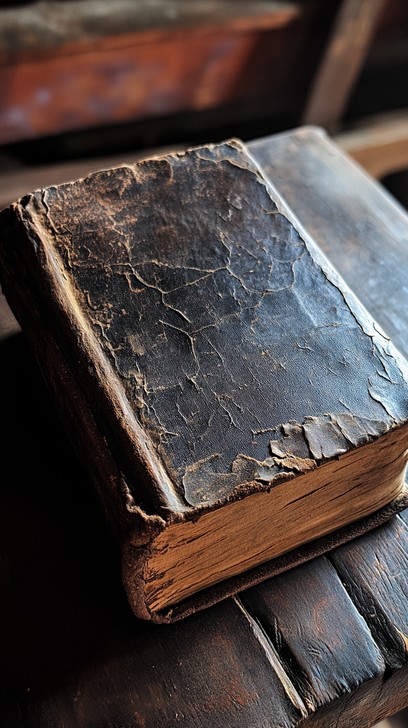
 The Book —Liber
It was a lovely brisk morning, the dew was still very wet on the grass, their woolen mantels were wet at the bottom from walking through the early morning fields. They were coming from the neighboring village, so it was wise for them to bring Conall. Conall a farmer, was well known in the region and well trusted.
When those in the village saw these men walking up the hill, they didn’t see foreign invaders. Yes, they see strangers indeed, but holy men who look unnervingly familiar from a bygone time, carrying with them a guide they already trust. This helped displace any thoughts of violence with more of a deep, watchful curiosity instead.
The Monks looked like the old Druids, dressed in long robes and their tonsure, unlike the Roman Monks, they didn’t shave the tops of their heads, they shaved the front of their hairline from ear to ear, leaving the back long like the old Oaks. When the villagers saw these men walking up the hill, they didn’t see foreign invaders; they saw strangers with a good friend, several holy men, following an already trusted guide.
—
The mud of the northwestern slopes was thick, it clung to the wool of Conall’s mantle as he led the two strangers up the ridge toward his mother’s kin. He walked a few paces ahead, his heart hammering against his ribs. He knew the spears that watched them from the high gorse. If he were not the pointed walker, the two men behind him would already be feeding the crows.
“They look like us,” a voice whispered from the brush.
“Aye.” the voice whispered back.
Conall could feel them all looking at him. He didn’t turn his head, but he kept his hands flat and open at his sides. He spoke clearly and loudly. “These are men of peace,” he called out to the silent tree line. “They come from the southern coast. They carry no irons.”
Behind him, the two monks walked in a rhythmic, silent cadence. To any man of the hills, they looked like a variant of their own Filidh — Druids. Their heads were shorn strange—not bald at the crown like the rumors of the Roman men, but shaved clean across the forehead from ear to ear, their dark hair falling long and wild down their backs. They wore heavy, undyed wool cloaks that smelled of salt water and peat smoke. But it was not their hair or their robes that drew the sharp eyes of the scouts.
It was the straps.
Slung across the shoulder of the elder monk was a massive, stiff hide container—a tíag— a box, reinforced with thick bands of dark leather and a brass buckle. It hung heavy against his hip, swinging with a dense, solid weight that didn’t shift like a sack of grain or a skin of wine. It looked like a locked chest, or a portable tomb for a child’s bones.
When they cleared the crest of the hill, the village chief, Ronan, was already waiting by the central hearth fire, flanked by three men holding ash-wood spears. Ronan’s eyes passed over Conall, dismissing him, and locked onto the monk with the leather box.
“Conall of the Low Glen,” Ronan said, his voice flat. “You bring men who wear the hair of the truth-speakers, but they carry the smell of a foreign sea. What is the weight on his hip?”
The elder monk did not wait for Conall to speak. He stepped forward, his eyes bright and entirely devoid of the fear a man should have when facing three spears. He unbuckled the heavy harness of the tíag and lowered the mass onto a flat oak bench by the fire. The thud it made was deep and dead.
With slow, deliberate movements, the monk unclasped the leather casing. From its womb, he pulled an object that made the scouts step back.
It was a perfectly squared, immense block of seasoned oak boards—a clár—bound tightly together by strips of pig-hide. It was thick as a man’s thigh. The monk looked up at Ronan, then down at the wood. With a flick of his thumb, he unhooked the bronze latch.
The wood swung open on leather hinges, and a collective murmur rippled through the gathering.
Inside the wood were dozens of impossibly thin, pale sheets of dried calfskin, pressed tightly together like a frozen stack of bleached autumn leaves stripped from a sacred grove. But as the wind from the ridge caught the leaves, it made them flutter with a dry, rhythmic thwip-thwip-thwip, the villagers leaned in, their breathing shallow.
The pale dead skin was not clean. It was covered from edge to edge in thousands of tiny, uniform, looping black scratches. Rows upon rows of jagged, dark markings marched across the hide in terrifying precision.
To Ronan’s sharp eyes, it looked like a corruption. It looked like a silent, unnatural blight that had crawled out of the damp earth to rot the animal’s hide.
“It is a nest,” whispered one of the spearmen, his knuckles whitening on his shaft. “Look at the skin. It is covered in black mold.”
An old woman stepped out from the shadow of her dry-stone clochán. Her hands were stained green from crushing wild herbs, and her eyes were sharp as a hawk’s tracking movement on the sliabh. She did not look at the monk’s face, nor at his strange, ear-to-ear Druidic hair. She locked her gaze entirely on the heavy object he cradled against his ribs.
She pointed a bone-thin finger. “What do you hold against your heart, southern man? What is that thing? It looks like a clár stolen from a chieftain’s tomb, but it breathes like a trapped bird.”
The monk stepped near the village hearth. He smiled, a gentle, calculated expression. “It is a lebor, mother.”
The word fell into the dirt between them, dead and heavy. The old woman spat into the fire. “That is no word. That is a hollow rattle in the throat. A true word has a mother and a father; it comes from the belly and dies on the wind. I ask you again, what is the name for the thing in your hands? What is its soul?”
“It is a house of voices,” the monk said softly. He unlatched the bronze hook and let the oak boards swing open.
The woman gasped, stepping back toward the stone wall of her hut. The wind from the valley caught the vellum leaves, making them flutter—thwip-thwip-thwip—against one another.
He flipped through the pages and found the Sermon on the Mound and began to read. “Now, when Jesus saw the crowds, he went up on a mountainside and sat down. His disciples came to him, and he began to teach them. In the Beatitudes He said: “Blessed are the poor in spirit, for theirs is the kingdom of heaven. Blessed are those who…”
The old woman interrupted. “It is a stack of duilleoga,” she whispered, her voice trembling as she forced her own world onto the object. “You have stripped the leaves from a sacred oak and bleached them white in the sun. But what is the black rot crawling across them? It looks like a swarm of frozen ants. It looks like. . . like tiny, dark fid.”
“They are fid,” the monk seized upon her word, his eyes gleaming with the trap. “You speak truly. They are trees. A forest of letters.”
“No,” she said, her voice rising in panic as she watched his finger trace a line of the dark mold. “When our Filidh speaks, his words are alive. They go into the ear, they stir the blood, and then they vanish into the air where the gods live. But your things… they do not die. You have taken the holy breath, the speech of the Tuatha, and you have murdered it. You have trapped the living word inside a cage of dead calfskin and buried it under a swarm of black mold.”
She looked around at the young men of the rath, her eyes wide with a sudden, devastating realization. “Do you not see what he has brought up the hill? If the word can live in that box without a human throat to speak it, then he does not need our elders. He does not need our memory. The box will speak for him, and we will become the ghosts.”
“Why do you say these words to the wood-skin and not to us?” the woman demanded, her hands curling into fists. “Your eyes are fixed on the calfskin, not on the faces of the tuath.”
The monk offered a patient, pitying smile. “I am not speaking to it, mother. I am reading from it.”
“The. . . the fid is speaking to you?” she whispered, her brow furrowing as she struggled to find a concept for what she was witnessing. “It has a voice?”
“In a way, yes,” the monk replied smoothly. “The voice of the Lord is locked within these leaves.”
The old woman hesitated, then stepped closer. The young spearmen watched her, breathless. She leaned her gray head down, lower and lower, until her ear was a hair’s breadth away from the open vellum. She stayed there for three long heartbeats, listening to the crackle of the hearth fire and the wind rushing up the sliabh.
She stood up straight, her eyes narrowing. “I do not hear a single breath. There is no sound in that box.”
The monk let out a soft, booming laugh. “No, mother, you do not understand. I am reading. These black marks—these fid—they do not make a sound for the ear. They crawl into my eyes, and they tell my tongue what it must say.”
The old woman’s eyes flew wide, white showing all around her dark irises. A cold, visceral horror-struck her soul. He wasn’t talking to a spirit. The silent black rot on the dead skin was actively commanding his mind.
“Demons!” she shrieked, her voice cracking across the rath. “They are demons! They have stolen his head!”
Before the monk could close the boards, her green-stained hands lunged forward. She slammed the oak covers shut and ripped the heavy block out of his grip. She bolted out from the circle of huts, her bare feet tearing through the mud of the village gates.
“Bring the iron! Bring the fire!” she screamed as she ran toward the wild heath outside the walls.
The monk cried out, stumbling forward, but the village men blocked his path with their ash spears. Conall, their guide from the neighboring valley, ran after her, his hands raised in panic.
By the time the villagers caught up to her on the slope, she was on her knees, furiously clawing at the rocky earth with her fingernails. She shoved the heavy oak box deep into the dark peat, kicking dirt and stones over it, trying to suffocate the silent magic before it could infect the rest of the hill.
“It is not dead!” a young spearman shouted, shoving her aside. “The mold lives on the skin! Earth will not kill a curse!” He dug his fingers into the fresh dirt, dragged the mud-slicked lebor back into the light, and ran headlong down the steep ridge toward the roaring waters of the river below.
A dozen villagers chased him to the rocky bank. With a great, grunting heave, the warrior cast the monk’s sacred book into the deepest part of the current. They stood on the rocks, throwing heavy stones down onto it, trying to pin it to the riverbed, screaming at it to drown, waiting for the black marks to wash away or choke on the water.
Conall finally threw himself between the angry villagers and the river, his hands held high, his voice hoarse from shouting.
“Listen to me! Stop!” Conall roared, pointing back toward the village where the elder monk stood surrounded by spears. “If you drown their spirit-skin, more of them will come up the mountain! They have hundreds of these boxes in the south! If you kill this one, they will send men with iron swords to find it!”
The chief, Ronan, walked to the edge of the water, looking at the water-logged oak boards bobbing violently against the rocks. The leather bindings were swelling, but the box remained stubbornly intact.
“Take it out,” Ronan ordered grimly.
Using the tip of a spear, a warrior hooked the leather strap and dragged the dripping, mud-caked mass back onto the gravel.
Conall scooped up the wet, ruined object, cradling it like a hazardous corpse. He walked it back up the hill, where the monk stood pale and silent. Conall thrust the soaking tíag back into the holy man’s arms.
“Take your box of silent words,” Conall whispered, his voice trembling with an urgent, quiet ferocity. “Take it and walk back down to the sea. If you or your leaves ever cross the ridge into this valley again, we will not waste our time trying to drown the skin. We will drown the man who reads it.”
The monk looked down at the mud dripping from the sacred text, his elaborate technology defeated by the raw elements of the earth. He did not speak. He turned his back on the village, his long, Druidic hair whipping in the wind, and began his long walk down the mountain.
He never returned. But as the old woman watched him vanish into the mist, she looked down at her hands, still covered in the dirt of the hill, knowing the silence of the valley had been broken forever.
The Book

