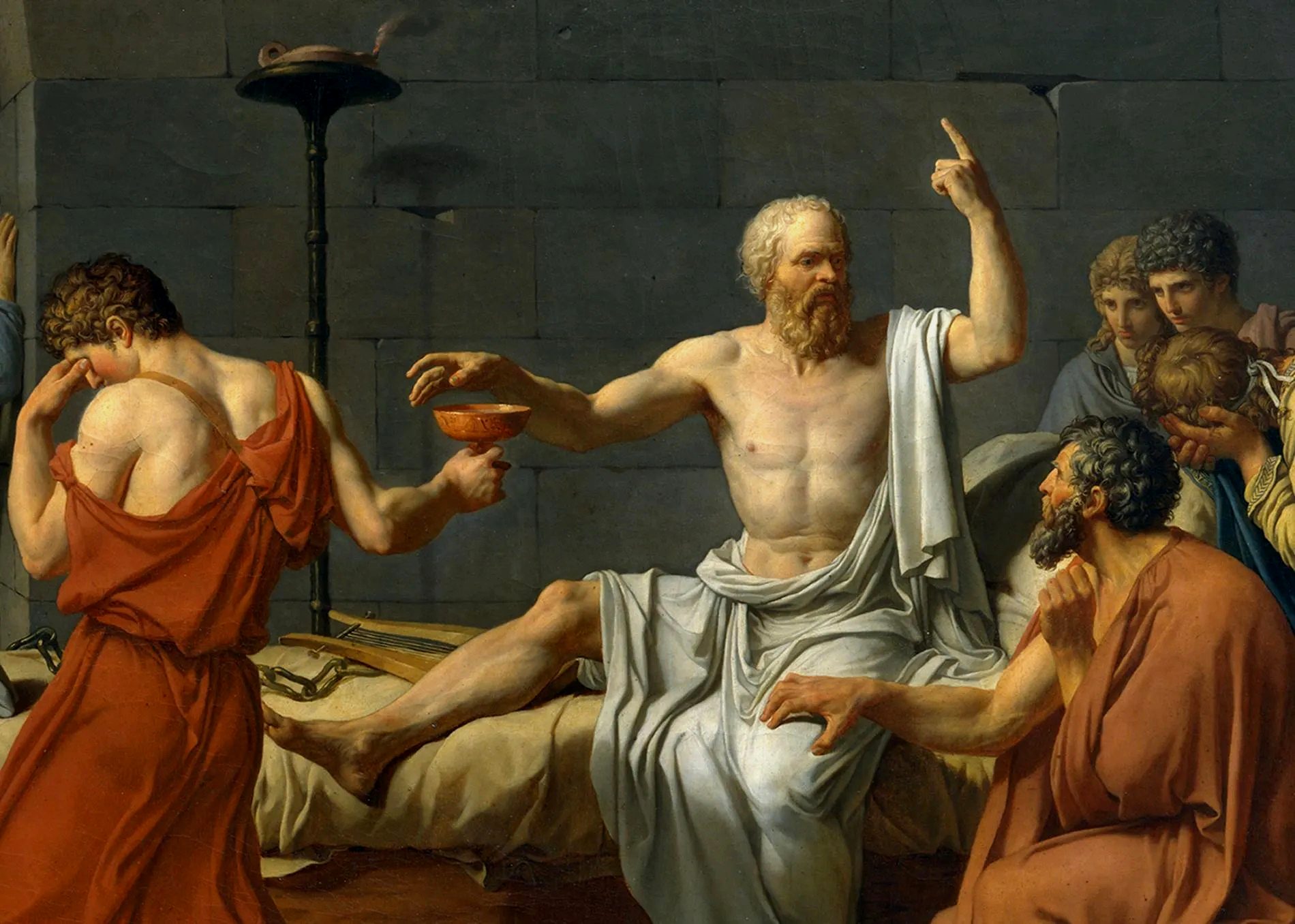
Title: The Death of Socrates
Artist: Jacques-Louis David’
Date: 1787
Medium: Oil on Canvas
Socrates The Ultimate Anti-Technocrat
In this masterpiece Jacques-Louis David depicts a seventy-year-old Socrates calmly reaching for the executioner’s hemlock, his gaze fixed on higher natural truths while his disciples collapse in grief, even the executioner feels shame. Socrates, robust in form, unbroken in spirit, and entirely unmediated by machines. He represents the raw physical and mental grit demanded by the ancient frontier. He chose a noble death over submission to a corrupted, insecure ruling class. This execution occurred in 399 BC in Athens, Greece. Socrates was executed by forced suicide via poisoned hemlock.
What is similar today?
Placed against the backdrop of 2026—where a fragile, insular elite seeks to hide behind the automated walls of Synthetic Intelligence and achieve an artificial immortality—this image serves as a stark historical mirror. It demands a fundamental question: Who holds true power—the men who command the machines, or the men who master themselves?
Debate Hub: The Geometry of Human Power, Identity, and Technology
This section compiles historical patterns, biological realities, and technological thresholds to analyze how human societies organize, survive, and collapse. These topics are designed to challenge contemporary assumptions about globalization, elite governance, and the future of human identity. We hopes to create topics for debate and highlight very interesting conversations.
.
- RACE – In-Group Continuity vs. Global Cosmopolitanism
.
.
.
.
philosophy: philo-sophia
Phílos (φίλος) — Refers to the love of friendship, affection, or a devoted pursuit rather than purely romantic or unconditional love.
Sophía (σοφία) — Denotes deep knowledge, insight, practical reasoning, and a fundamental understanding of reality and human experience.
Origin — The term forms the etymological root of philosophy, traditionally credited to ancient thinkers like Pythagoras, who viewed the pursuit of wisdom as a lifelong path of inquiry rather than claiming to possess wisdom already.
.
.
.
.
.
.
.
.
.
.

