 Devil In The Garden — The Legend of Stingy Jack
As told by John Dillon, an old Irishman by the fire.
Ah now, draw the chairs in close and mind ye don’t let the fire die, for I’ve a tale to tell ye of a man so mean and so clever that even the Devil himself couldn’t best him. They called him Stingy Jack, though his full name was Jack Killian O’Sullivan, and there wasn’t a soul in the whole of Ireland who hadn’t a story about the blackguard.
He was a terrible drinker, a notorious miser, and as sharp as a butcher’s knife. The village folk held him in low regard, and rightly so. He’d cheat a blind man out of his last farthing and then ask him for the loan of his stick. One evening the Devil, sittin’ down below and hearin’ all the tales of Jack’s wickedness, decided the time had come to collect that black soul for himself.
So the Devil appeared before Jack on a dark road, all horns and smoke and the smell of sulphur.
“Jack O’Sullivan,” says the Devil, “yer time is up. Come along with me now.”
But Jack, for all his faults, was no fool. He looked the Devil up and down and says, calm as ye please,
“Ah now, sure ye wouldn’t drag a man to hell without lettin’ him have one last drink. The least ye can do is walk with me to the pub yonder and let me wet me throat before the long journey.”
The Devil, thinkin’ the soul was already as good as his, agreed. Off they went to Jack’s favourite tavern. Jack ordered the finest whiskey in the house, drank it down in one go, and then turned to the Devil with a sorrowful face.
“I’ve not a single coin on me,” says he. “But you’re a powerful lad. Turn yerself into a silver piece and pay the landlord, and then we’ll be on our way.”
The Devil, still underestimatin’ the man, changed himself into a shiny coin right there on the counter. Quick as a flash Jack snatched it up and shoved it into his pocket beside a little silver crucifix he always carried. The Devil was trapped, trapped fast against the holy cross, and no amount of thrashin’ and cursin’ could free him.
“Let me out, ye thievin’ scoundrel!” the Devil roared from inside the pocket.
“I will,” says Jack, “but only if ye swear to leave me alone for ten full years.”
The Devil had no choice. He swore the oath, and Jack let him go. Away the Devil went, mutterin’ and black with rage, while Jack just laughed and ordered another whiskey on the house.
Ten years passed to the very day. Jack was stumblin’ home from the same pub, three sheets to the wind, when the Devil stepped out from behind a ditch, lookin’ none too pleased.
“Time’s up, Jack,” says he. “No more tricks.”
Jack leaned against an old apple tree and sighed.
“Ah, have a heart, will ye? Let me eat one last ripe apple before ye drag me below. Climb up there and fetch me the biggest one ye can find.”
The Devil, still not learnin’ his lesson, scrambled up the tree. The minute he was among the branches, Jack took out his knife and carved a great cross into the trunk. The Devil was stuck fast, unable to climb down past the holy mark.
“Free me, damn ye!” he howled.
“I will,” says Jack, “but only if ye swear never to take me soul to hell, not now, not ever.”
Again the Devil had no choice. He swore the second oath, and Jack let him climb down. The Devil vanished in a puff of smoke, and Jack went home chucklin’ to himself, thinkin’ he had bested the Lord of the Pit for good and all.
But years later the inevitable came. Stingy Jack took his last breath and died. His soul rose up to the gates of Heaven, but St. Peter took one look at the list of Jack’s sins and shook his head.
“There’s no place for the likes of you here,” says he, and locked the gates.
So Jack’s soul fell down, down toward the fires of Hell. But when he reached the gates below, the Devil was waitin’, arms crossed and a cruel smile on his face.
“Ye made me swear never to take yer soul,” says the Devil. “And a promise is a promise. There’s no room for ye in Hell either.”
With that he slammed the gates shut, leavin’ Jack stranded in the pitch-black nowhere between Heaven and Hell. Then, mockin’ him one last time, the Devil reached into the furnace and tossed Jack a single burnin’ ember.
“Here’s a light for yer wanderin’,” says he. “Enjoy eternity.”
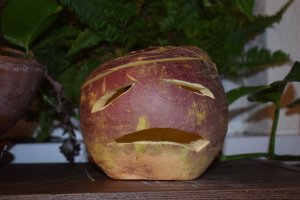
Jack had nothin’ left in his pockets but a turnip and a small knife. He sat down in the darkness, hollowed out the turnip with careful strokes, and set the hellish ember inside it. And from that day to this he has walked the earth, a restless soul with only a turnip lantern to guide his way, never welcome in Heaven, never allowed in Hell.
That’s why, on the night of Samhain—what the young ones now call Halloween—the people of Ireland would carve fierce faces into turnips and set a light inside them, to frighten away the wanderin’ spirit of Stingy Jack. When the Irish crossed the sea to America they found the pumpkin softer and easier to carve, and so the Jack-o’-lantern changed its shape, but never its meanin’.
So when ye see those glowin’ faces in the windows this night, remember the clever, miserly drunkard who tricked the Devil twice and paid the price forever. Keep an eye out for a lonely light bobbin’ along the dark roads… for it might just be Jack of the Lantern himself, still lookin’ for a place to rest his weary bones.
And that, me friends, is the way the old ones told it.
Ná bíodh eagla oraibh… but keep the door shut all the same
.
.
As told by Gollum — A tricksy hobbit.
Yesss… yesss, preciousss. Come closer, closer. Listen to Gollum. Listen careful, or the dark will eat the words.
Long ago… long, long ago in the cold wet hills of Ireland there lived a nasty little man. Clever, oh so clever, but mean. Stingy Jack, they called him. Jack Killian O’Sullivan. A drunkard. A miser. A tricksy thief who would steal the last crumb from a starving bird and laugh, yes, laugh. The village folk hated him. Spat when they said his name. Gollum likes that. Nasty man. Good.
One night the Big Red One—the Devil, the Master of the deep fire—heard the stories. Heard how clever and wicked Jack was. Wanted his soul. Wanted it for the dark pits. Came to take it. “Your time is up, Jack,” the Devil hissed. “Come with me now.”
But Jack… oh, Jack was tricksy. More tricksy than Gollum even. He smiled his nasty smile and said, “One last drink, yes? Just one. Then we go. The least you can do, master.” The Devil was greedy. Thought the soul was already his. Agreed. They went to the stinking pub. Jack drank the burning water. Then—sneaky, so sneaky—he said he had no coin. No silver. “Turn yourself into a coin, yes? Pay the man. Then we go down, down into the dark.”
The Devil was stupid that night. Stupid and proud. Changed into a shiny coin. Right there on the sticky table. Jack snatched it! Quick like a spider! Shoved it into his pocket next to a nasty little cross of silver. Trapped! The Devil was trapped against the bright hurtful thing. Could not get out. Screamed and begged. “Let me free! Let me free!”
Jack laughed his ugly laugh. “Swear first. Swear to leave me alone for ten years. Ten long years.” The Devil had no choice. Swore. Jack let him go. The Devil fled, burning with hate. Jack stayed and drank more. Clever, preciousss. Very clever.
Ten years later… ten cold years. The Devil found Jack again, stumbling home, full of the burning water. “Time is finished,” the Devil growled. Jack looked at a tall apple tree. “One last apple,” he whispered. “Just one. Climb up, fetch it for poor Jack.” The Devil climbed. High into the branches. And while he was up there, Jack took his knife—sharp, sharp knife—and cut a cross into the trunk. Deep. The Devil could not pass it. Trapped again! High in the tree like a trapped bird.
“Free me!” the Devil screamed. Jack smiled. “Swear never to take my soul. Never, never, never to Hell.” The Devil swore. Had to. Jack let him down. The Devil vanished in smoke and fury. Jack thought he had won forever. Foolish Jack. No one wins forever.
Years passed. Jack grew old and thin and yellow. Then he died. His soul floated up… up to the bright gates. But the shiny man at the gate—St. Peter—looked at the long black list of Jack’s nasty deeds and shook his head. “No place for you here. Go away.” Locked the gates. Jack fell. Down, down, down toward the red fires.
But at the black gates of Hell the Devil was waiting. Smiling his terrible smile. “You made me swear,” he said. “A promise is a promise. No room for you in my fires either.” He slammed the gates. Left Jack in the empty black. Nothing. Nowhere. Then—mocking, cruel—he threw Jack one single burning coal from the deep pits. “Light for your long walk, little thief.”
Jack had only a turnip in his pocket. And his knife. He sat in the dark and carved. Hollowed the turnip. Put the hell-ember inside. Now he walks. Walks forever between the lights and the dark. No home. No rest. Only the glowing turnip to show the way. They call him Jack of the Lantern now. Jack-o’-lantern. Wandering, wandering, always wandering.
That is why, on the cold night when the veil is thin, the soft folk carve faces into turnips… later into big orange pumpkins. They light them and set them in windows. To scare the lonely spirit away. To keep Jack from coming near their warm houses.
But Gollum knows… Gollum knows. When you see that little fire bobbing in the dark, it might be him. Still walking. Still looking for a place that will take him. Still tricksy. Still alone.
Yesss… alone forever. Just like Gollum.
Gollum… gollum.
.
.
As told by Maimeó O’Leary, an old Irishwomen who’s offended you’re even askin’.
Ah for the love of God, is this what the young ones are askin’ for now? Sit down and stop fidgetin’. I’ll tell it once and only once, and if ye interrupt me I’ll give ye a clip round the ear.
There was a useless article of a man by the name of Jack O’Sullivan. Stingy Jack they called him, and never was a name better earned. Drinker. Miser. Wouldn’t give ye the steam off his porridge. The Devil himself got tired of hearin’ about him and decided to come collect the black soul.
Jack, of course, being the slippery little weasel that he was, managed to talk the Devil into a final drink. Then he tricked the poor eejit into turnin’ himself into a coin and stuck him in his pocket next to a crucifix. Ten years of peace he bought himself with that one. Ten years later he trapped the Devil up an apple tree with another cross. Made him swear never to take his soul at all.
And what thanks did he get for all his cleverness? When he finally died, Heaven wouldn’t have him and Hell wouldn’t take him. The Devil, pure spiteful, threw him a burnin’ coal and told him to be on his way. Jack hollowed out a turnip, stuck the coal in it, and has been wanderin’ the roads of the world ever since, the poor misfortunate creature.
That’s why we carve faces in turnips (and the Americans in their big soft pumpkins) of a Samhain night. To keep that restless soul away from the door. Now. Are ye satisfied, or do I have to tell ye the one about the banshee next?
.
.
As told by Miss Mary Wollstonecraft — a very proper English schoolteacher who disapproves of the whole thing.
Now then, class. Settle down. What we are about to discuss is a rather vulgar piece of Irish folklore, and I must ask you to approach it with the appropriate degree of scholarly distance.
There was, it is said, a man of low character named Jack O’Sullivan, popularly known as “Stingy Jack.” He was a habitual drunkard and a man of extreme parsimony. The Devil, upon hearing of his reputation, sought to claim his soul. Through a series of rather underhanded tricks involving a public house, a coin, a crucifix, an apple tree, and a second crucifix, Jack managed to extract from the Devil two binding promises: first, a ten-year reprieve, and second, a permanent exemption from Hell.
Upon his eventual death, Jack found himself refused entry to Heaven on moral grounds and, owing to the aforementioned contract, refused entry to Hell as well. The Devil, in a final act of rather childish spite, provided him with a single burning ember. Jack placed this ember inside a hollowed turnip, and thus began his eternal wandering.
This, children, is the origin of the so-called “Jack-o’-lantern.” I trust you will all remember that superstition is no substitute for good character, and that tricking the Devil is not behaviour we encourage at this school.
Any questions? No? Excellent. Open your exercise books
As told by Luke Ryan — a drunk pirate.
Arrrr, gather round ye scurvy dogs an’ lend us yer ears, for this be a tale o’ the meanest, sneakiest bilge-rat what ever drew breath… Stingy Jack O’Sullivan!
Now Jack, see, he were a right miserly drunkard. Wouldn’t buy a round if his own mother were dyin’ o’ thirst. The Devil himself heard tell o’ this black-hearted swab an’ decided it were high time to collect that stinkin’ soul.
But Jack, the clever little barnacle, talks the Devil into one last drink at the tavern. Then—ha!—he tricks the old goat into turnin’ himself into a silver piece to pay the tab. Jack snatches the coin an’ stuffs it in his pocket next to a crucifix. Trapped the Devil proper, he did! Made him swear to leave Jack alone for ten whole years before he’d let him free.
Ten years later, the Devil comes back, all fire an’ fury. Jack, still three sheets to the wind, points to an apple tree an’ says, “Fetch me one last apple, ye horned bilge-sucker.” Up the Devil climbs… an’ Jack carves a cross into the trunk! Stuck him up there like a parrot in the riggin’! This time Jack makes him swear never, ever to take his soul to Hell.
Well, years go by an’ Jack finally kicks the bucket. Heaven won’t have the blackguard, an’ Hell can’t take him neither on account o’ the promise. The Devil, laughin’ like a mad thing, throws Jack a burnin’ coal from the pits an’ says, “Go on then, wander forever, ye dog!”
Jack only had a turnip an’ a knife left. Hollows out the turnip, drops the coal inside, an’ off he goes, bobbin’ through the dark for all eternity. That’s why we carve faces in them orange things (used to be turnips, ye know) of a Halloween night… to scare the restless old bastard away from our doors!
Now… where’s me rum? I seem to have misplaced the end o’ the story…
.
.
A Shakespearean Tragedy
Enter a Chorus of restless spirits.
Chorus:
Attend, O mortal hearts, this woeful tale
Of Jack, yclept the Stingy, base and pale,
Whose miser’s soul and cunning tongue did weave
A snare so tight e’en Hell could not retrieve.
In Ireland’s green and rain-soaked isle he dwelt,
A drunkard mean, by every neighbour felt
As thorn and plague. The Prince of Darkness heard
His black renown, and sought the soul interred
In flesh still breathing. “Come,” the Fiend did cry,
“Thy glass is spent; with me thou now must die.”
But Jack, with serpent’s wit, did softly plead:
“One final cup, dread Lord, is all I need.”
The Devil, proud, consented. To the inn
They went; the liquor burned like original sin.
Then Jack, most false: “I lack the coin to pay—
Transform thyself to silver, and away
We’ll journey.” Foolish Fiend became the piece;
Jack seized it swift, and with a crucifix
Did cage the coin against his greedy breast.
Ten years of freedom bought he with that jest.
Again the Devil came when time was done.
Jack pointed to an apple tree, and spun
Another lie: “One fruit, I beg, before
The dark descent.” The Fiend climbed ever more.
Then Jack with knife did carve the holy sign
Upon the bark, and trapped the power divine
Of Hell itself. “Swear now,” quoth he, “that ne’er
My soul shall feel thy everlasting care.”
The oath was sworn; the Devil fled in shame.
At length Death claimed the trickster for his own.
Heaven’s bright gates refused the wretch’s moan;
Hell’s blacker doors, bound by the solemn vow,
Denied him entrance. Thus was Jack cast now
Into the void between. The Fiend, in scorn,
Did toss one ember from the pits forlorn.
Jack carved a turnip, set the coal within,
And so began his endless, restless spin
Across the earth, a lantern for his guide,
Forever banned from both the saved and fried.
Thus on All Hallows’ Eve we carve the face
In gourd or root, to keep him from our place.
Beware the glow that drifts along the lane—
It may be Jack, still wandering in pain.
Exeunt omnes, leaving only the faint light of a distant lantern.
.
.
.
.
.
.
Living Pan-European and American Cultural and Heritage Community Center

.
.
EMAIL: peachcommunity yahoo.com.
.
.
.
quicklink
.
.

