From Celts & Druids
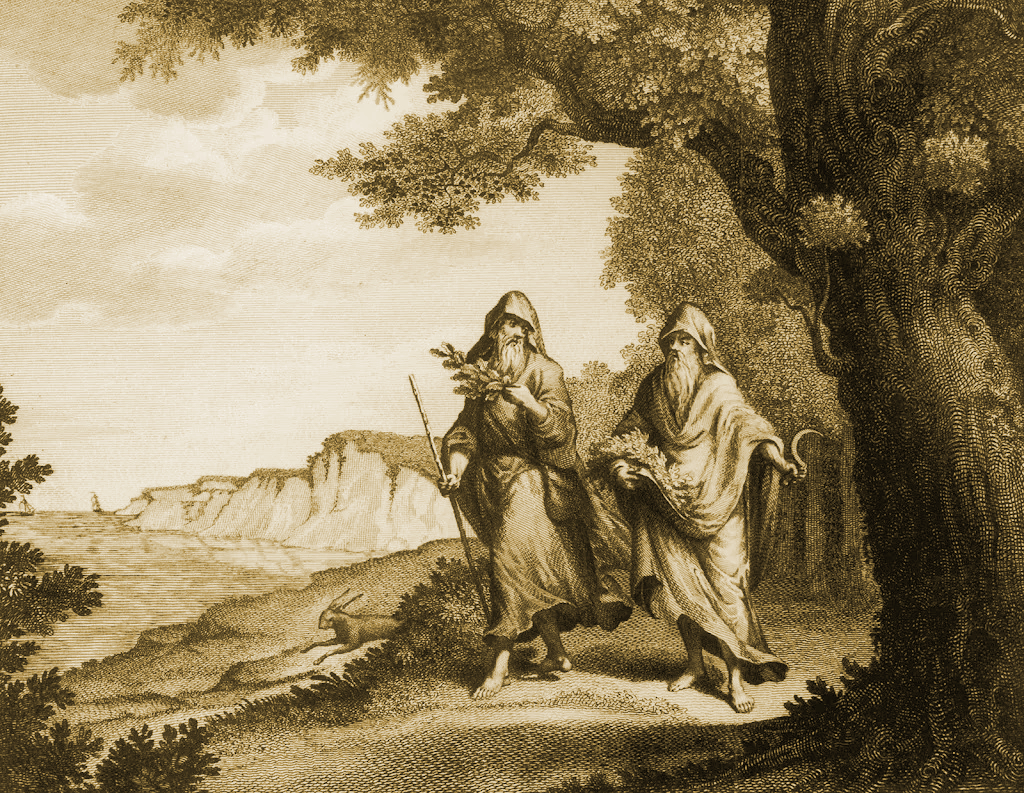
Diviciacus and Dumnorix of the Aedui
The story of Diviciacus (Avenger), ~90 BC ~50 BC of the Aedui in Gaul. Caesar describes him as a Senator. He is the only well known Druid mentioned during the life of the Roman Empire. Diviciacus was given the opportunity to Speak to the Senate in Rome. He spent time conversing and living in Cicero’s home. Cicero spoke highly of him and in honor. Diviciacus was well liked by all who met him. He was intelligent, spoke Latin well and honored the laws of Rome. This made him accepted and, after the wars and conflicts with the Romans, that acceptance put all at ease.
Diviciacus had a younger brother called Dumnorix (King of the Deep), ~82 BC ~54 BC. He was the powerful chieftain of the Aedui and, after the conflict in 61 BC, the tribe had a truce and an agreement with Rome. Thus, became allies. However, Dumnorix did not care for Rome at all, he was a member of the anti-Roman faction, who thought it better to be dominated by their fellow Gaul, rather than the Romans. What made the Gallic tribes anti-Rome was the lack of freedom, but these were the terms negotiated after the war.
Another leader, Orgetorix, was a prominent Helvetii chieftain. He conspired with Dumnorix and other tribal elders to make themselves kings. By their combined power, they would rule all of Gaul. This would be akin to a Gallic version of the triumvirate in Rome. In order to strengthen this alliance, Orgetorix married his daughter to Dumnorix.
According to Julius Caesar’s book, Commentarii de Bello Gallico, this conspiracy was discovered. When the people of the Helvetii found out, they proceeded to put Orgetorix on trial for orchestrating a secret conspiracy to seize power. If he was found guilty, the punishment would be death by burning. Unfortunately, Orgetorix died a short time before the trial, amid rumors of suicide.
This did not settle anything with Dumnorix. He was still very anti-Rome. Although Diviciacus spoke to Caesar and even to the Senate, he felt at the time all agreements stood. Unfortunately, this riff put the brothers at odds, and the fact that Dumnorix was a threat to Rome put Caesar at odds with Diviciacus.
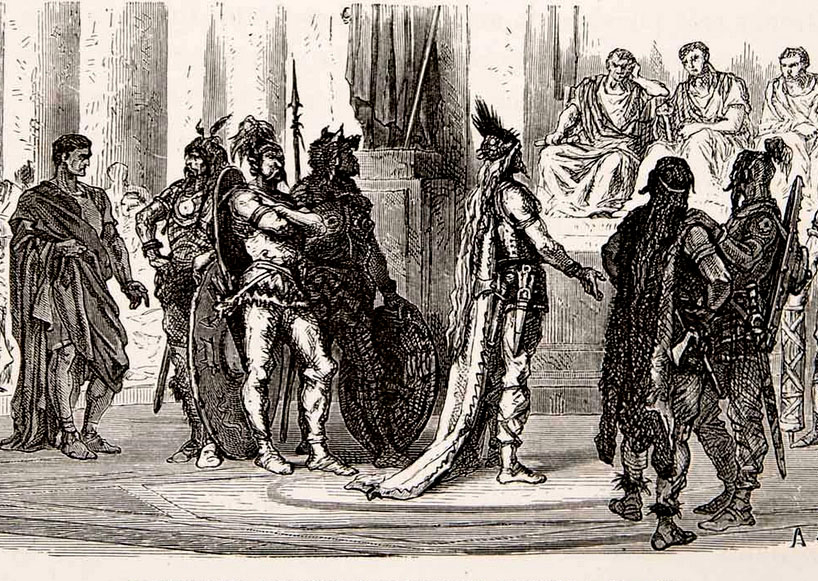
The Squeeze
How Rome Manipulated the Two Brothers
Insidiously, this situation was masterminded by Julius Caesar. His true intentions were to put Diviciacus in a brutal, agonizing vice grip — and in Chapter 20 of his Gallic War commentaries, he explicitly brags about how he managed the ruse.
The Romans were absolutely not okay with Dumnorix. They considered him an existential threat to their conquest. But, instead of executing him immediately and turning him into a martyr, Caesar realized that holding on to the relationship with Dumnorix was the ultimate weapon in order to keep the Aedui nation completely paralyzed.
Here is exactly how the Romans pulled off this high-stakes manipulation, structured to show the precise squeeze that put Diviciacus squarely in the middle.
The public intervention when Caesar gathered the absolute proof of Dumnorix’s treason—the grain blockades and the cavalry sabotage—he summoned Diviciacus to his military tent. Instead of using a standard Roman translator, Caesar dismissed his regular staff and brought in Gaius Valerius Troucillus, a highly cultured Gaul from the Roman province who was a close personal friend of Diviciacus. This was a deliberate psychological trick to make the Druid feel safe while delivering an ultimatum.
The Druid’s Paradox — Diviciacus was trapped in a horrific moral paradox. He burst into tears and literally threw himself at Caesar’s feet. He confessed to Caesar that he knew his younger brother was plotting against Rome, but he begged for mercy. Diviciacus knew that if Caesar executed his younger brother, the entire Celtic populace would believe that he, the elder Druid brother, had used his Roman alliance to murder his own flesh and blood. His spiritual and moral authority would evaporate overnight. Worse still if Dumnorix was killed by Rome, the anti-Roman factions within the tribe would rise up, turn Dumnorix into a martyr, fostering a national backlash and plunge the Aedui into a catastrophic civil war that would destroy the tribe completely
The Cold Roman Grace — Caesar saw exactly how to exploit this agony. He took Diviciacus by the hand, told him to stop weeping, and declared that solely out of his deep love and respect for his high morals, he would pardon the younger brother. But, this “grace” was a total illusion. Caesar pulled off the control of Dumnorix through three systematic steps. He refused to send Dumnorix home free. He placed him under a permanent 24-hour watch. Roman military surveillance was a shackle around his ankle. Every move, every message, and every breath Dumnorix took was monitored by Roman centurions. Caesar knew by sparing Dumnorix, he would turn this younger brother into a living hostage. Diviciacus knew that the absolute moment he stepped out of line with Roman foreign policy, or the second the Aedui stopped supplying Rome with soldiers, Caesar would instantly tighten the noose around Dumnorix’s neck. Finally, Caesar brought Dumnorix into the room in front of his older brother, listed out every single one of his secret plots to his face, and told him he was only alive because of his brother’s tears. This systematically poisoned the relationship between the siblings. All trust was lost.
Dumnorix now looked at his elder brother not as a chief Druid, but as a compromised Roman puppet, while Diviciacus had to live with the agonizing knowledge that his compliance was the only thing keeping his rebellious brother breathing.
This psychological hostage situation lasted for four agonizing years until 54 BC, when Caesar ordered the Gallic cavalry to board ships for his second invasion of Britain. Dumnorix desperately tried to rally the Gallic nobles, whispering to them that Caesar was taking them across the sea to butcher them out of sight of their homeland. When Dumnorix finally slipped into the greenwood, away from the Roman camp with his private cavalry, Caesar didn’t hesitate. He halted his entire invasion fleet, sent his heavy horsemen into the forest, and ordered them to hunt Dumnorix down.
He explicitly told his soldiers: “If he resists or refuses to submit, kill him on the spot.” Dumnorix surrounded in the deep greenwood, screaming to his final breath that he was a ‘free man of a free state.’
Back in the camp, Diviciacus was left standing completely empty-handed—his brother dead, his moral authority compromised, and his tribe now firmly under the iron boot of Rome.
The sibling trap was laid bare and one of the most vivid, tragic examples of how Rome’s political machinery systematically ground down the ancient, uncorrupted kinship bonds of the Celtic social structure from the inside out.
Does it sound familiar?
.
.
Ending II:
The Ghost of the Greenwood
(The defiant perspective of the Gallic chieftains)
But history is a long, patient game, and Caesar’s propaganda only tells us how he wanted to be remembered. There is another way this story ends—one hidden behind the cold, stone-faced silence of the brothers.
For all we know, Dumnorix and Diviciacus never groveled. When Caesar dismissed his staff and brought in Troucillus to deliver his insidious ultimatum, the brothers may have looked right through the polished Roman armor. They knew the Roman grace was a total illusion. They knew the 24-hour surveillance was the desperate act of a paranoid conqueror who was terrified of what lay beyond his campfires.
Taking the squeeze like men of stone, they matched Caesar’s cold gaze, spit in the dust of his tent, and delivered a generational blood-promise that no Roman scribe would dare record.
“Kill us now, Roman coward! Barcus is waiting on the other side for us, laughing at you—and we will all be back.”
It took exactly ten years for that greenwood curse to find its mark. The sovereign spirit of Gaul, which Caesar thought he had safely paralyzed and bound in the forests, did not die under the hooves of his heavy cavalry. Instead, the defiance of the Celts followed Caesar back across the Rubicon. It slipped past his elite legions, walked right through his grand arches, and waited for him in the shadows of the Senate. They whispered in the ears of the elite, the republicans, the honorable and just.
When the daggers tore into Julius Caesar on the Ides of March in 44 BC, it wasn’t just Brutus and Cassius striking him down. It was the collective, mocking return of every hostage he had ever starved, every brother he had ever broken, and every free man who had promised him from the depths of the forest that Rome would bleed.
In his final, bloody moments, this monstrum sanguisuga carnifex he realized he hadn’t built a monument to himself at all—in the end he had only collected a pile of dust. This was justice.

.
.
.
.
.

