
.
.”
.
OCTOBER
.
The Celts
From whence we came.
Irish, Scottish, Anglo, Saxon, Pict, Jute, Viking.
Through the misty mountains,
the land above,
the fires below.
Thick with fog,
floating in the sky,
fell into the cooling waters,
the last piece of heaven,
a blanket of green,
upon the earth.
~Éireann
.
400 BC—The Celts, it’s complicated, the Druids, even more so. We begin to address our people in lectures through history, the inventions, the arts, trade, farming, battles, local customs, and, of course, the mysteries. What we know so far from books based on the artifacts that we have found, we are still finding. However, in January, when we take up Great Mysteries, these two groups of peoples will be better understood from the perspectives of legends, myths, and lore. Which is why they still linger today, and we will touch on those who wish it dead.
.

.
The Original Ancient Celts
Hallstatt Culture
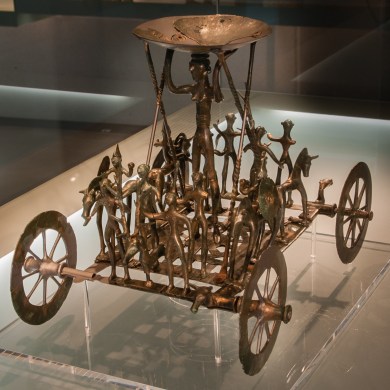 The Hallstatt Culture was discovered in Austria 1846, but the artifacts date as far back as 1200BC, from the Bronze Age to the Early Iron Age. Hallstatt Culture is also known as proto-Celtic. It is thought that there were a number of great migrations and mergers due to lack of resources and droughts, key in the developing culture making all Europeans Celts. These people seriously got around. As this site and others are uncovered there are more discoveries yet to be founds. For example, Le Tène culture which came at the end of the Hallstatt Culture. Was it a merge or a transformation? Outside some speculation of cannibalisms, not proven of course, family values were prominent throughout the culture. The Lectures on the Hallstatt Culture are always filled with a lively debate and often pull out some of the strangest notions. Their art and advances they made are astounding and fills the imagination.
.
.
Druids
The Elusive Mystic Druids & Drottes
Wizards of the Oak.
The ancient Druids, were diviners, magicians, priests, teachers. They believed in the immortality of the soul, that the soul, upon death, took over the body of a living person. Some later believed the soul crossed over into other worlds. Druids often met in caves to perform rituals, and a Druid Priest would build his doorways through his hut in alignment to the stars in order to travel. Priests also had the ability to turn into an oak tree at will. If you find an oak out of place in the woods, it might very well be a Druid.
.
Three Types of Druids
Bards – Poets – Songs and story tellers.
Ovates – Telepathic – Healers and seers
Vates – Priests – Philosophers, judges, and teachers.
Entrance –
Stones –
Mistletoe – a mysterious magical plant.
Picts:
Picts (native northern Britons) + incoming Scoti (Irish Gaels) → formed the Kingdom of Alba/Scotland (9th–10th centuries).
Language shifted from Pictish (Brittonic-like) to Gaelic dominance.
Religion transitioned from Celtic paganism to Celtic Christianity (monastic, artistic, with druid-like elements surviving in folklore).
Picts (Latin “Picti” = painted/tattooed people): Ancient inhabitants of northern/eastern Scotland (3rd–9th centuries AD). Non-Gaelic Celtic or pre-Celtic people known for body art, symbol stones, and resistance to Romans. Language likely Brittonic (P-Celtic). They merged with incoming Scots/Gaels.
Picts Scotty Picts Scotty These groups ( Scots/Scoti, broader Celts) interacted heavily in Scotland/Ireland:
—–
Picts Scotty
This seems to be a combined or variant reference to the Picts and Scots (Scoti).
Picts (Latin “Picti” = painted/tattooed people): Ancient inhabitants of northern/eastern Scotland (3rd–9th centuries AD). Non-Gaelic Celtic or pre-Celtic people known for body art, symbol stones, and resistance to Romans. Language likely Brittonic (P-Celtic). They merged with incoming Scots/Gaels.
Scots/Scoti (Latin name for Gaelic Irish): Originally the Gaelic people from Ireland who migrated to western Scotland (Dál Riata kingdom, 5th–9th centuries). They gave Scotland its name and Gaelic language/culture. “Scotty” may be a playful or misspelled shorthand for “Scots” or “Scoti.” The merger of Picts and Scots formed the early Scottish kingdom (Alba) around the 9th–10th centuries.
Celts (in Ireland & Scotland context)
Language: Two main branches — Goidelic/Q-Celtic (Irish Gaelic, Scottish Gaelic, Manx) in Ireland and Scotland;
Brythonic/P-Celtic (Welsh, Cornish, Breton) elsewhere. Gaelic (Irish/Scottish) became dominant in Scotland after Pictish absorption.
Religion: Pre-Christian polytheism (nature deities, sacred groves, druids, seasonal festivals like Samhain/Imbolc). Druids were priests, judges, poets. Christianity arrived early in Ireland (St. Patrick, 5th century) and Scotland (St. Columba, Iona monastery), blending with Celtic customs (e.g., high crosses, saints replacing gods). No central “Celtic church” — it was localized.
These groups (Picts, Scots/Scoti, broader Celts) interacted heavily in Scotland/Ireland:
Picts (native northern Britons) + incoming Scoti (Irish Gaels) → formed the Kingdom of Alba/Scotland (9th–10th centuries).
Language shifted from Pictish (Brittonic-like) to Gaelic dominance.
Religion transitioned from Celtic paganism to Celtic Christianity (monastic, artistic, with druid-like elements surviving in folklore).
—–
~Where as Ireland was the last piece of heaven that fell from the sky, Scotland was the first.
Ireland & Scotland
This seems to be a combined or variant reference to the Picts and Scots (Scoti).
Scots/Scoti (Latin name for Gaelic Irish): Originally the Gaelic people from Ireland who migrated to western Scotland (Dál Riata kingdom, 5th–9th centuries). They gave Scotland its name and Gaelic language/culture. “Scotty” may be a playful or misspelled shorthand for “Scots” or “Scoti.” The merger of Picts and Scots formed the early Scottish kingdom (Alba) around the 9th–10th centuries.
Celts
Ireland & Scotland
Irish Black – Black Irish — a term often used for people of Irish descent that are darker than the stereotypical fair skinned and red-haired Celt. These folk have a Mediterranean look about them with dark hair, dark eyes, and olive complexion. A few theories include pre-Celtic indigenous populations that came down with Atlantis, known as pre-Indo-European. The Spanish Armada survivors who suffered through and survived the 1588 shipwrecks washed up on shore. The Ancient Celtic-Iberian migrations, those traveling through the Hallstatt generation.
Celt’s Language: Two main branches — Goidelic and Q-Celtic: Irish Gaelic, Scottish Gaelic, Manx, in Ireland and Scotland. Brythonic and P-Celtic: Welsh, Cornish, Breton, elsewhere. Gaelic: Irish & Scottish, became dominant in Scotland after Pictish absorption.
Celt’s Religion: Pre-Christian polytheism, they were nature deities, sacred groves, druids, seasonal festivals like Samhain & Imbolc. Druids were priests, judges, poets. Christianity arrived early in Ireland, St. Patrick, 5th century, and Scotland, St. Columba, Iona monastery, blending with Celtic customs: high crosses, with saints replacing gods. There was no central Celtic church — worship was localized.
Celtic Seasons
The four main Gaelic cross-quarter days, tied to seasons and agricultural cycles in Irish, Scottish, and the Manx traditions.
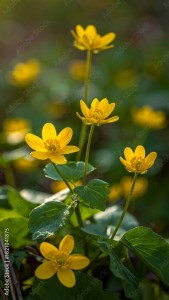 Latha Bealltainn – Latha Buidhe Bealltainn)
Scottish Gaelic for Beltane or May Day (1 May). Literally “the yellow/golden/fortunate day of Beltane.” It marks the start of summer, with bonfires, purification rituals, and celebrations of fertility and protection. “Buidhe” adds connotations of brightness, luck, or the yellow flowers/broom blooming then.
Samhain – Gaelic festival on 31 October–1 November, marking the end of harvest and beginning of winter (the “darker half” of the year). Seen as the Celtic New Year in some traditions. It’s a liminal time when the veil between worlds thins, honoring the dead, with bonfires, feasting, divination, and protective measures against spirits.
Imbolc – Imbolg – Gaelic festival on 1 February (or 31 Jan–2 Feb), marking the start of spring. From Old Irish “i mbolg” meaning “in the belly,” referring to pregnant ewes, lambing season. Associated with the goddess and saint Brigid embracing purification, fire, candles, and the first signs of new life. A time of renewal and hope after winter.
Lughnasadh – Lughnasa, Lúnasa – Gaelic festival on 1 August, marking the beginning of the harvest season. Named after the god Lugh, who established it to honor his foster-mother Tailtiu; she died clearing land for agriculture. It involves feasting, games, thanksgiving for the first fruits and grain, and preparations for autumn and winter.
Irish Harp – In Irish mythology, the harp is famously associated with the Tuatha Dé Danann, a supernatural race of ancient Irish gods. The most notable tale involves the magical harp Uaithne, which belonged to the Dagda, the chieftain of the Tuatha Dé Danann.
.

Irish Dance
Celtic Irish ~500 BC onward
The origin and ancient roots of Irish dance evolved over centuries in Ireland. Celtic folk dances were often in circular formations around sacred trees during religious rituals. These stem from the Druids who honored nature and the sun. Early dances emphasized group patterns, music, and seasonal celebrations. Traces of these formations survive in Irish dances today.
Early Christian & Medieval period, 5th–12th centuries
Christianity blended with Celtic customs. Dances began to appear in religious ceremonies, feasts, and social gatherings. In the 12th century, the Normans introduced new forms like the “Carol,” circular singing and dancing, which influenced many village traditions. Irish dance and music were tied to social gatherings, storytelling, and clan identity — seen by the English as potential sites of rebellion or Catholic resistance. Crossroads dances, wakes, and feast days were communal events that reinforced Irish identity. Traveling dance masters taught intricate solo steps across Ireland, including reels, jigs, and hornpipes influenced by Scottish and English styles.
Penal Laws 1695–1728, English Suppression of Irish Dances
It all began after the Tudor conquest and the Flight of the Earls, 1607. England tightened control over Ireland. The Plantation of Ulster – 1609, displaced native Irish landowners, and English and British authorities viewed Gaelic culture; language, music and dance, as a threat to loyalty and Protestant dominance. Penal Laws passed after the Williamite, 1689–1691, and the Treaty of Limerick. Key measures included: Banning Catholics from owning land, restricting Catholic worship and clergy, voting, holding public office, educating their children, the suppressing Gaelic culture, bans on Irish language in schools, restrictions on assemblies, and indirect pressure on music and dance as “popish” or seditious activities.
While no law explicitly banned Irish dance, the Penal Laws made public gatherings risky. Dance masters were often itinerant and Catholic, so they operated secretly. Dancing at wakes, weddings, or crossroads could be interpreted as unlawful assembly or rebellion. English authorities and local magistrates sometimes raided or fined such events.
Public gatherings were risky so Irish dance masters taught in secret — barns, kitchens, private homes, crossroads at night. Dancers had to be able to stop instantly if authorities approached. Arms held tight to the sides made the upper body look almost stationary from a distance or through a window and door crack — only the feet were moving fast below the waistline, so a passerby or spy might not immediately recognize it as dancing. Minimal upper-body movement became the norm. Over generations, this necessity turned into a stylistic feature. The arms-still, feet-blurring style became the “proper” way to dance — elegant, controlled, almost defiant in its restraint. The “arms glued to sides, feet going like mad” look was not an ancient Celtic tradition. It evolved as a survival mechanism during centuries of suppression, then got preserved and celebrated as “authentic Irish” when the culture was reclaimed.
The English, British suppression peaked under the Penal Laws driven by fear of Catholic, and Gaelic rebellion, but weakened as Catholic rights returned. Dance went underground for over a century, survived in secret, and emerged stronger in the Gaelic Revival. The rigid, upright posture, arms held close to the sides, often completely still or with minimal movement, and feet performing rapidly, with intricate steps in close unison are directly linked to the suppression of Irish dance during the Penal Laws era.
18th–19th Centuries – Gradual Relaxation,
Little by little the Penal Laws were slowly dismantled after Catholic Relief Acts, 1778, 1782, 1793, allowing Catholics limited rights: land ownership, education, etc… By 1829, the Catholic Emancipation Act, led by Daniel O’Connell’s campaign removed most major restrictions. Suppression eased in the late 1700s and early 1800s as enforcement weakened. Dance masters resurfaced openly, teaching in barns and homes.
In the late 1800s, when the Gaelic Revival and the Gaelic League, revived and codified Irish dance, they formalized this posture as the standard for competitive stepdance. It was no longer just practical — it became symbolic of Irish resilience and identity under pressure. Suppression eased in the late 1700s and early 1800s as enforcement weakened. Dance masters resurfaced openly, teaching in barns and homes.
Late 19th–20th centuries:
Gaelic Revival (1890s onward) revived and codified Irish dance. The Gaelic League (1893) standardized forms and created competitions. Sean-nós, “old style” improvised solo dance from western Ireland remained freer. Irish dance now reflected Celtic heritage, nature-based, communal, rhythmic, while blending influences; Norman, English, Scottish, and adapting through history. It’s both a living tradition and a global performance art today.
Celtic Tales – Every Saturday In October on PEACH Radio – 7PM

aes sídhe
nuckalavee
broonies
banshee
sìdh
Áine Chlair
kelpies
.
..bíodh eagla ort!
.
.
.
Stories
Tale of Jack Killian O’Sullivan, a.k.a. Stingy Jack – Man Who Tricked the Devil.
The Cailleach – Celtic Crone, Goddess of Winter.
Daniel O’Connell’s emancipation campaign
Gaelic League dance codification
More vivid storytelling tone
.
.
.
.
.
.
.
.
.
.
.
.
.
.
.
.

.
.
.
.
October 4th
Blessing of the Animals
October 4th is the celebration, Blessing of the Animals. This is also a celebration of the life of St Francis. One of the local priests comes to the farm and blesses all the animals, including the bees, butterflies, and worms. He will also take a walk through the Perma-forest and bless the animals living in the wood. Before this ritual, the priest will tell the story of St Francis and how he found his way from a life of opulence and sin to one in service of his people and the caring of the creatures. This small celebration begins at 10AM. People gather in the lobby by the fireplace. Father Timothy will tell the story, then he and the group will walk to the barn and through the wood, blessing all the animals. Members and residents will also bring their pets to be blessed. The guests and children will sing as they walk, All Creatures Great and Small, and The Canticle of the Sun.
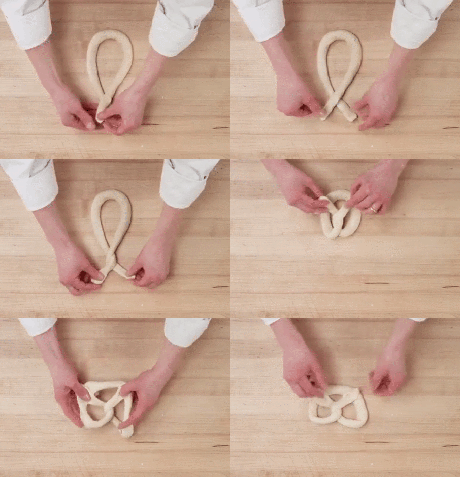
At the end of this event, there is an opportunity for the children to make hot pretzels in the cafeteria. Maidens from the Irish Heritage Center come to teach the children how to make the pretzels. She tells the story through the rhyme of the Celts and the Trinity.
spoken when rolling the dough

little leaves fall gently down
red and yellow, orange and brown
whirling, whirling, round and round
falling softly, to the ground
down and down and down and down
quietly now, without a sound
.
spoken when shaping the dough

in nomine patris et fillii et spiritus sancti
domine libera nos!
deo gratias

In ainm an Athar agus an Mhic agus an Spioraid Naoimh.
dia saor sinn
buíochas le Dia
.
.
.
in the name of the father, the son and the holy ghost
lord deliver us
thanks be to God.
.
Procession
After this delightful event, members and residents, along with Father Timothy, will walk some animal home that have been living with us throughout the spring and summer. Once they have arrived, we may take with us an animal that isn’t getting along well with others until arrangements can be made. Father Timothy will then bless those animals and be escorted around the area to other farms and homes of people who are unable to be out and about. On Sunday, after church, there is a little pet parade and, of course, a blessing given to all those animals, and their owners, who attend this local event.
.
.
.
.
.
.
.
.
A Rhyme For Francis
-Elenore Farjeon
The kinsmen of Francis 
Were not as another’s.
The birds were his sisters,
The beasts were his brothers.
These were his names
For the great and the small—
Was not God Father
Of him, and of all?
The night and the morning.
The water, the wind.
The star and the daisy,
Were each of his kind.
God was the Father
Of him and all others,
And flowers were his sisters,
And trees were his brothers.
“Brother, good morrow!”
He said to Friar Sun.
“Sister, good even!”
To Moon the sweet Nun.
“God is our Father,
We know of no other,
And Death is my sister,
And Life is my brother.”
.
.
.
.
.
.
.
.
.
October 15th – Third Harvest
Throughout the month of October, the harvest continues. All heirloom seeds collected, dried, and stored safely away for next year’s planting. Pickling, honey collection, silk, qiviut and wool spinning continue.
This is a season of unpredictability for plants, animals, and man. The days are noticeably shorter and the temperatures can change drastically from day to day, from warm and sunny to a humid bone-chilling cold at night. What is open standing in the garden needs to be brought in now. What is left in the fields and beds should be turned under or composted. The animals will need extra food and an alteration in their diet. We will begin feeling the seasonal drag, start dressing in layers and perhaps sleep in or hit the hay early. The fluctuation in life can change with the weather, yet as our bodies grow tired, our minds are waking up. Being in tune with nature at this time of year will help both animals and man, boosting our immune system as we prepare for the winter to come.
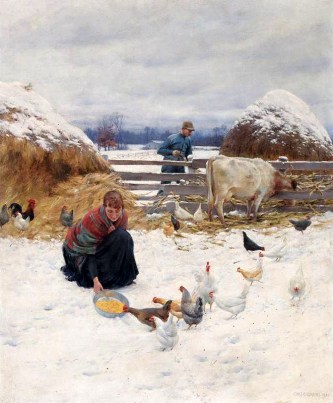 This is also the time of animal slaughtering for meat. In the past, this was done between mid-October through Martinmas. Choosing the number of animals that went to slaughter depended on the amount of food one had in store, along with the age of the animal.
If you didn’t have enough to feed over winter, the animals could starve. This took careful calculations of grains and hay-feed, along with hoping for an early spring. Once the farmer addressed the slaughter, the animals were sent to be butchered, and the meat smoked.
Age was usually the deciding factor. A sick animal in the dead of winter could infect other animals, so this was the proper time to skin and bone. Most of the animals were at their best this time of year, very fat and healthy, a perfect source of food. Since the invention of the icebox, and now the deep freeze, there will be plenty of meat to make it through the winter, and with good luck through next year’s kill.
Our particular farm is for growing crops, collecting eggs, and milk during the warmer months of the seasons. However, we purchase most of our meat, save fish, from a farm up the road. The animals are free roaming and organically raised. Those within our Community will often work with the farmer, picking the animals we will need, helping with the butchering of beef, pork, chicken, and turkey.
In November, it is deer season. A group of fathers and sons will go out into the wood hunting, deer, ducks, quail, and pheasants. Women and children will harvest and collect wild nuts, berries, roots, and mushrooms. It is also the time to thresh the seeds from the plants gathered in the barn from the harvest.
Our Community butts up to Federal and Native lands. In the middle of their reservation is a wide and fast-moving river. Many in the Community will venture out with the locals catching salmon, snagging carp and catfish. We trade labor for fish and work to share what we have between our Communities.
.
.
.
.
.
.
.
.
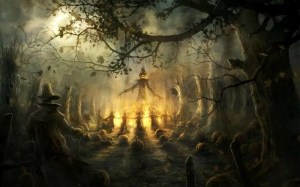
October 31st – Late Autumn Festival
The Perilous Path ~Samhaim – Hallowe’en
The threshold to other worlds, between the dusk and in the dawn, spirits, and elves have their way and their play. There’s a fresh chill in the air, the nights grow and the sun hangs low, and the snows are not far away.
How we celebrate.
All Hallows’ Eve has a long, somewhat convoluted, history. When and where did it begin? This topic has always been contentious for hundreds of years.
So where do we begin? Tricks n’ Treats in the US, since the 1960s, has been a purely commercial venture. Best we can tell, the origins of this festival may have been derived from the last Middle Ages. Perhaps, a few towns handed out treats at the end of harvest, or some wayward lads playing a few devilish pranks before All Saint’s Day, the last chance before being bad can be forgiven and forgot.
There are a number of Pagan stories passed down since time began. One such story is, taking the children to a nearby cave to sit through the night with the bodies of deceased relatives. A morbid notion now. Yet, it was thought of as a way to impart wisdom upon the children from those who had crossed over to the next life. A ghostly gateway to other worlds, or perhaps to have one last night with the dearly departed. Wonderful tales that now seem rather frightening.
This was also a time to clear the land, burning all that lay dead and drying on the fields. This is the time to burn the debris. The ash, however, was very good for the soil, snow was soon to follow, and this all made for what we would later call, poor man’s fertilizer.
During the great Irish migration to the USA, many brought with them their local or parish customs. These, no doubt, merged into what we call ‘Tricks or Treats’ today. According to my great-grandfather, you didn’t do both. You needed to pick one, either scare or surprise the local gentry, cause a ruckus, play a trick or prank, or go into the kitchen to make sweets to share at church for the holy days ahead. This seemed unfair since it was the boys who got into mischief and had all the fun. As the Irish established themselves in the New World, we see the many tribes merge all the elements from the Old World, rituals, both Christian and Pagan.
The idea of parties, dress-up, ghost stories, and apple bobbing developed mostly in the United States, many of these small festivals took place in the after school basements of the local parish. A way to keep the boys out of trouble on this night.
We have our own traditions at the PEACH. It is the Perilous Path, a series of dangerous twists and turns in the forest that one must undertake at night. Ghosts and goblins creep, trees and shrubs come to life, cackling witches and mysterious vampires slither about, whilst demons and trolls hover under bridges, guarding a secret cavern. To end your journey, a perilous deep pit to swing across with a hard and coarse rope, and a dimly lit fire to read your palm or listen to a spooky story.
This event is for children ages 4 through 14. After each successful trial is met on the path, the child is given a little treat to carry back in their sack. Each year, the challenges are different, designed by a team of older teens and adults. In the cafeteria there is apple bobbing, a show of homemade lit pumpkin and turnip carvings, a circle of seasonal songs, practice for the night ahead, and a scene from Beowulf in cut-out silhouettes.
 After these events, the evening draws to an end. Everyone gathers dry twigs, branches, wheel-barrels full of debris or whatever refuse they can carry from the garden. The traditional horn called, the Carnyx is then played, and all walk while singing the songs of the season. The sound of singing lures and draws the ne’er-do-wells out of the forest with lighted torches, they follow us all into the open field. Dancing and bouncing around, hooting and hollering, poking and prodding, trying to steal the sacks of treats from the children, as we go.
In the center of the field is a two-story pile of hay, surrounded by garden and field chafe. Everyone adds their refuse to the heap as they form a circle around the pile. If it’s not too windy or too wet, the demon architects run in circles round the hay, screaming like banshees while lighting the pyre. Once the flames have reached their zenith, the Carnyx is blown again.
The daemons drop and cower in fear. From the edges of the field, a band of angles and saints come toward the circle, descending from all sides. They surround the daemons. The daemons shiver and shake, they wail and cry. Then the choirs of angles and saints speak these words, first in Gaelic, then in English:
“Back! Back! Back! Back you go! Daemons and banshees, bogeymen and phantoms, zombies and poltergeists, shadows of the soul. Be Gone! [clap] Be Gone! [clap] Be Gone! [clap] Into your holes to hell!
Air ais! Air ais! Air ais! Air ais thèid thu! Daemons agus banshees, bogymen agus phantoms, zombies agus poltergeists, faileas an anam. Bi air falbh! [clap] Bi air falbh! [clap] Bi air falbh! [clap] A-steach ort tuill ifrinn!
The Carnyx is blown, again, and with the help of the saints and angels, the daemons run to the far edges of the field. The angels and saints surround the circle, then fly after the daemons to make sure they find their hole back into hell.
The Carnyx musicians then circles the periphery of our fields, blowing their horns, making sure the daemons do not return.
.
.
.
.
Devil In The Garden
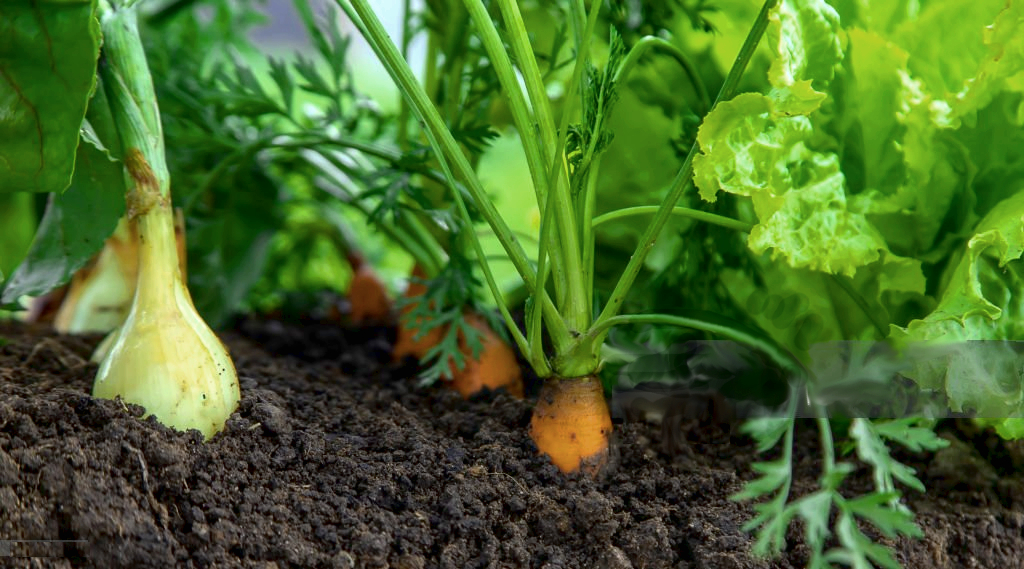
CURE for Carrot Fly – devils favorite food – onions radishes chickens oregano marigolds fly ash October harvest. Make a mock figure of the devil in the garden – use a fork carrot, stab him in the eyes, take a compound carrot [at least 5] twist this in through the heart, take a very large long and powerful carrot drive it through the brain. Mark the head hands and feet with the points of a star by planting the marigolds. Sow the perimeter with onions & garlic make an X with the onions. On the outer edge oregano [keep an eye on this herb, it mocks the ego]. After harvest line the perimeter with fly ash and if you hate rats use rat ash as well. plant carrots with friends, radishes onions & chickens.
Dryads – Hamadryás, pl: Hamadryádes is a tree nymph. They are born bonded to a certain tree on which their life depends. Some maintain that a Hamadryad is the tree itself, with a normal dryad being simply the indwelling entity, or spirit, of the tree. If the tree should die, the Hamadryad associated with it would die as well. For this reason, both dryads and the other gods would punish mortals.
One such mortal was King Erysichthon, who harmed trees. Erysichthon of Thessaly was also known as Aethon due to the “burning” hunger (aithôn limos) he was made to endure by Demeter.
The Curse of Erysichthon
Long ago, when the forests were thick with sacred trees a King named Erysichthon. He was clever, ambitious, and greedy, caring little for the whispers of the dryads or the laws of Demeter.
One day, in a fit of arrogance, he raised his axe against an ancient oak—a tree older than memory, its dryad trembling within. The wood cracked, the dryad screamed, and in that cry, a curse was born.
PART I
Some are transformed just once and live their whole lives after in that shape. Others have a facility for changing themselves as they please. Proteus, who haunts the shadowy seas that scarf this Earth, is glimpsed as a young man who becomes, of a sudden, a lion. That lion becomes a wild boar, ripping the ground, yet flows forward hidden through grass without sound as a serpent. The serpent emerges as a towering bull under down-bent horns, or hides among stones a simple stone, or stands as a tree alone, or liquefies and collapses shapeless into water—a pouring river. Sometimes he is the river’s opposite: fire. Another with a similar power was Aryon’s daughter, the wife of Aus. Her father gave to the gods nothing but mockery without qualm. He cut down every tree in the sacred grove of Ceres, an ancient wood that had never before that day jumped to the axe’s stroke. Among those trees, one prodigious oak was all to itself a tangled forest. Its boughs were bedecked with wreaths and votive tributes, each for a prayer Ceres had sometime granted. There, dancers formed a holy circle around its bole, or joined hands to embrace it—a circumference of paces. Aryon ignored all this as he assessed the volume of its timber, then ordered his men to fell it. Seeing their reluctance, he roared, “If this tree were your deity that every clown adores and not merely a tree, you think she favors—nevertheless, those twigs away there at the top would have to come down!” As the rest fell, he snatched an axe and hauled the weight of the broad head up and back. But in that moment, as the blade hung poised for the first downstroke, a shuddering swarm through the whole tree to its outermost twigs, and a groan burst out of the deep grain. At the same time, every bough went gray, every leaf whitened, and every acorn whitened. Then the blade bit, and the blood leaped as from the neck of a great bull when it drops under the axe at the altar. Everybody stared, paralyzed. Only one man protested—the Thracian Nymph turned with eyes stretched incredulous. “Your pious cares,” Aryon bellowed, “are misplaced!” and he followed that first swing at the oak with another at the protester’s neck. Whose head spun through the air and bounced. Then the oak, as he turned back to it, pronounced in a clear voice these words: “I live in this tree. I am a nymph, beloved by Ceres, the goddess. With my last breath, I curse you. As this oak falls on the earth, your punishment will come down on you with all its weight. That is my consolation and your fate.” Aryon ignored her. He just kept going, undercutting the huge trunk till ropes brought the whole mass down, jolting the Earth, devastating the underbrush around it. All the nymphs of the sacred grove mourned it, dressed in black. They came to Ceres crying for the criminal to be punished, bewailing the desecration. The goddess listened. Then the summer farms, the orchards, the vineyards, the whole flushed, ripening harvest shivered as she pondered how to make his death a parable of her anger. If his cruelty, greed, and arrogance had left him a single drop of human feeling, what the goddess did now would have drained mankind of its pity. She condemned him to hunger—but infinite, insatiable hunger, the agony of hunger as a frenzy. Destiny has separated hunger so far from the goddess of abundance they can never meet. Therefore, Ceres commissioned a mountain spirit, an Oread…
[ Ovid’s Metamorphoses]:
…to embody this curse. The Oread infused Aryon with an unquenchable appetite, driving him to devour his own wealth, then his kin, until, maddened by starvation amidst plenty, he turned to gnawing his own flesh, a hollow man felled by his own hubris.
Notes on Fixes [Speaker]:
PART II
Hear what I say and do not be afraid. Far away to the north of Cyrene lies a barren country—leafless, dreadful ice, permanent as iron, air that aches, a howling land of rocks, gales, and snow. There, mad hunger staggers. Go, bid Hunger take possession of Aryon’s belly. Tell her she has power over all my powers to nourish Aryon. Let all I pour or push down this fool’s gullet only deepen his emptiness. Go—my dragon-drawn chariot will make the terrific journey seem slight. The nymph climbed away, and her first halt was the top of Caucasus. She soon found Hunger raking with her nails to bare the root of a tiny rock wart till her teeth could catch and tear it. In shape and color, her face was a skull—bluish, her lips a stretched hole of frayed leather over bleeding teeth. Her skin, so glossy and so thin, you could see the internal organs through it. Her pelvic bone was like a bare bone; the stump wings of her hip bones splayed open as she bowed. Her rib cage swung from her backbone in a varnish of tissue. Her ankle joints and knee joints were huge bulbs, ponderous, grotesque on her spindly shanks. The read knew danger when she saw it. She proclaimed the command of the goddess from a safe distance. The whole speech only took a minute or so, yet a swoon of hunger left her trembling. She got away fast, all the way back to Thessaly, giving the dragons their head. Now hear me: Though Hunger lives only in opposition to Ceres, yet she obeys her. She soars through darkness across the Earth to the house of Aryon and bends above the pillow where his face snores with open mouth. Her skeletal embrace goes around him. Her shrunk mouth clamps over his mouth, and she breathes into every channel of his body a hurricane of starvation. The job done, she vanishes, hurtling away out of the lands of plenty as if sucked back into the vacuum of deprivation’s hollow territories that belong to her—and that she belongs to. There is soon snoring on, but in spite of the god of sleep’s efforts to comfort him, he dreams he sits at a banquet where the food tastes of nothing—a nightmare. He grinds his jaws on air with a dry creaking, dreaming that he grinds between his jaws a feast of nothing, food that is like air. At last, he wakes in twisting, knotted cramps of hunger. His jaws seem to have their own life, snapping at air with uncontrollable eagerness to be biting into food and swallowing—like a cat staring at a bird out of reach. His stomach feels like a fist, gripping and wringing out the mere idea of food. He calls for food—everything edible out of the sea and Earth. When it comes, dirt is all he sees where tables bend under spilling plenty, emptying bowls of heaped food. All he craves for is bigger bowls, heaped higher. Food for a whole city cannot sate him; food for a whole nation leaves him faint with hunger.[Assumed continuation based on Ovid’s myth]: Desperate, Aryon sells his daughter into slavery to buy more, but Ceres’ curse twists even that—her shape-shifting power (inherited from her father) lets her escape each buyer, returning to mock his endless need. His wealth gone, he turns to gnawing his own limbs, a hollow shell of a man, felled by the goddess’ wrath.
PART III
Transcript: Part 3 – The Daughter’s Shape-Shifting and the Father’s Doom[Speaker]: As every river on Earth pours its wealth toward the ocean that is always sweeping for more, draining the continents, and as fire grows hungrier the more fuel it finds, so famished by food, the gullet of Aryon gulps down whatever its diameter can manage. Through every weak moment, he spares a mouthful only to shout for more. This voracity, this bottomless belly, as if his throat opened into the void of stars, engulfed his entire wealth. His every possession was converted to what he could devour until nothing remained except a daughter—this only child deserved a better father. His last chattel, he cashed her in for food. He sold her at the market, but she was far too spirited to stay as a bought slave. Stretching her arms toward the sea, she cried, “You who ravished my maidenhead, save me!” Neptune knew the voice of his pretty victim and granted the prayer. Her new owner, who minutes ago was admiring the girl he had bought, now saw only Neptune’s art—featured and clothed like a fisherman. Perplexed, he spoke to this stranger directly: “You with your fishing tackle, hiding your bobs in tiny gobbets of bait—may you have good weather and plenty of silly fish that never noticed the hook till it’s caught them. Can you tell me where is the girl who was here a moment ago? Her hair loose and dressed in the cheapest things, she was standing right here where her footprints look to stop and go no further. Where is she?” The girl guessed what the god had done for her. She smiled to hear herself asked where she might be, then to the man parted from his money, “I’m sorry, my attention has been fixed on the fish in this hole, but I promise you by all the help I pray for from Neptune, nobody has come along this beach for quite a while, and certainly no woman.” The buyer had to believe her; he went off baffled. The girl took one step and was back in her own shape. Next thing, she was telling her father, and he, elated, saw business after that. On every market, he sold her in some new shape: a trader bought a horse, paid for it, and found the halter empty where a girl sat selling mushrooms; a costly parrot escaped its purchaser into an orchard where a girl picked figs; one bought an ox that vanished from its pasture where a girl gathered cowslips. So Aryon’s daughter plied her talent for taking any shape to cheat the buyer—straight and crooked alike—all to feed the famine in her father. But none of it was enough. Whatever he ate maddened and tormented that hunger to angrier, uglier life—the life of a monster, no longer a man. And so, in the it will be inevitable: he will began to savage his daughter ad then his own limbs. There, at a final feast, he will devoured himself.
.
.;
—THE CURE – onions radishes chickens oregano marigolds fly ash – aim for October harvest [late]. After you first harvest is you see the signs of the flies, prepare two gardens for next year. Make a mock figure of the devil in the center of the main infested garden – use a fork carrot, stab him in the eyes, take a compound carrot [at least 5 forks] twist this in through the heart, take a very large long and powerful carrot drive it through the brain. Mark the head hands and feet with the points of a star by planting marigolds. Sow the perimeter with onions & garlic make an X with the onions. On the outer edge plant oregano [keep an eye on this herb, it mocks the ego, keep it medicinal]. After harvest of the cure, line the perimeter with fly ash and if you hate rats use rat ash as well. Leave bare to winter – fill it with snow if you can. Next growing season dig you garden deep and fine plant carrots with friends; radishes, onions & let the chickens in after a fortnight from the first sprout that shows cage them in until they scratch – then move them- if there is still damage try planting the 2nd garden. Fill this one with onions garlic peppers and radishes for 2 growing seasons- If it doesn’t work – plant an oak.
This manual is harsh because the problem it answers is harsh. It is not promise but pact: the land remembers, and it demands justice or labor in return. Perform the rite, tend the soil, plant the oak if needed—and the curse will be less for your children. Erysichthon is still hungry; let him find no banquet in your patch.
.
.
.
.
.
Cultural & Historical Foundations Outline – Druid & Celtic Mysteries and The Arthurian Dawn
Ancient Celtic Roots, c. 1200–54 BC
-
- Hallstatt (proto-Celtic, c. 1200 BC) and La Tène cultures
- Advanced art, migrations across Europe, trade with Etruscans & Greeks, family values, iron innovations.
Druidic Wisdom & Roman Encounter, c. 54 BC–410 AD
- Druids as bards, ovates, vates.
- Soul immortality, oak & mistletoe rituals, shape-shifting lore, mystical sight.
- Caesar’s invasions (54 BC); Roman withdrawal leaves Celtic tribes resisting invaders.
Post-Roman Britain & Arthur’s Legend, c. 410–600 AD
- Saint Patrick spreads Christianity, c. 385–461 AD
- Arthur, c. 400/500 AD, son of Uther, raised by Merlin.
- Unites Britons against Saxons & Picts.
- Round Table knights quest for Holy Grail in Christ’s name; fatal battle at Camlann, mystical Avalon burial—”once and future king.”
Anglo-Saxon Era, c. 500–1066 AD
- Villages with priests & smiths
- Beowulf epic recited
- Viking raids intensify
- Alfred the Great, 849–899 AD
- defends, ends with Harold Godwinson’s fall at Hastings, 1066 AD.
Key Pillars
Threshold Realms: Samhain veils thin—spirits, fairies (aes sídhe, banshee), perilous paths between worlds.
Immortal Soul & Grail Seeds: Druid rebirth beliefs echo in Arthur’s Avalon sleep and Holy Grail quest; Last Supper vessel.
Harvest Perils: As light fades, legends preserve ancient fires—mirrored in our forest challenges, pyre rituals, Celtic tales radio, and Merlin’s mysteries.
From oak groves to Avalon’s mist, October opens the veil: Celtic endurance births Arthur’s eternal dream, guiding us through Samhain’s shadows..
.
.
 .
.
.Festivals Celebrations
Blessing of the Animals. Samhain ~ Hallowe’en: the threshold to other worlds in the dusk and the dawn. The Reading of Beowulf. Final Harvest.Lecture Series
Celts and Druids, Anglo, Saxon, Pict and Jute – The Celts Continue Part II – 376 through 871. Superstition and the wretched curse, time of the faeries. Indo-Europeans, The Celts. Christianity, Surfs and Fairies. Death Of Merlin.Arts
Knotted Borders, Flax and Reed Weaving, Silk and Wool-Spinning & Dying.Clubs
Member’s and Residents Clubs: Book Clubs. Father and Son’s Club. Mom and Tots Club. Elder’s Club. Cooking Club.
Folk Arts Clubs:
Fine Arts Clubs:
Skilled Arts Clubs:
Sports and Movement:
Book Club Friday: Every week the reading of Beowulf.Writer’s Club
Description – The Legend and Mythical Hero – 1. His physical features. 2. His mission, what lay in his heart. 3. His cunning and wit. 4. His adventures and legacy, a biography.Businesses
Workers Businesses:
Private Businesses:Events
Third Harvest. Description of events and festivals, businesses, sports, all clubs, lectures, history, educational classes, admin meeting, all skills, arts and folk arts.Other Topics
foods, work, hygiene, rituals, clothing, death, language, buildings, animals, education, play-leisure, social structure, technology.there’s never nothing to do..
.

.
.
.
.
.
.
.
.
.
.
.
.
.
Living Pan-European and American Cultural and Heritage Community Center
 SEEDS Projects
- SUBSCRIBE STAR.
- EMAIL: peachcommunity yahoo.com.
.
.
.
.
.
.
.
.
.
.
.
.
.
quicklink
 PEACH COMMUNITY