
.
.
.
MAY
History 19c Western Civilization
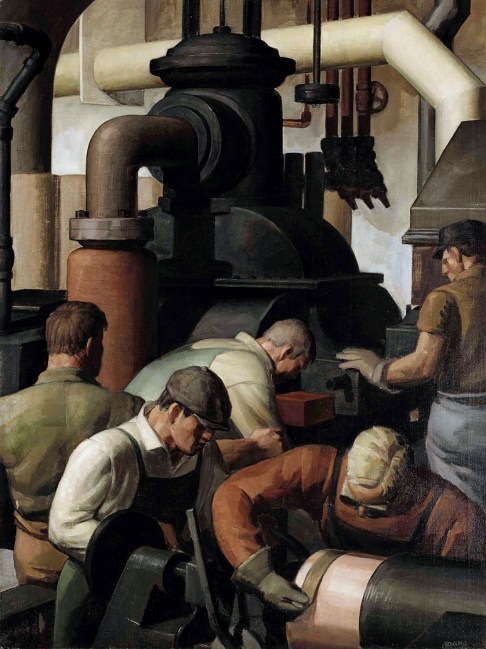
.
May
May is a temperamental month. It can be expected, predictable and, more often than not, has the ability to express itself as typically seasonal, then with the turn on a dime, it can drop 12″ of snow overnight, all melting into puddles within the next three days. It can also shoot up into the 90s, frightening all the blossoming tulips and daffodils, who will resort to hiding for the rest of the season. Therefore, much thought and organization needs to be put into the month of May.
If we are lucky, May can be the perfect month for working outdoors, yet, it is a month that reminds you to take a jacket or sweater. It’s also a break-out month, and it will invite you to sit on a warm bench in the afternoon. Have a delightful conversation with someone who is out for the same reason of, ‘nothing in particular, just felt like I should be outside.’ However, as the sun begins to set, the cold from winter’s ground will seep up, reminding you to go back inside for a cup of hot tea.
In May, we begin to shed the burdens of winter, roll up our sleeves and start to dig, get busy doing all manner of work outside in the sun, along with other physical activities. May is the month when all the skilled-arts are in full motion: farming, metal-smithing, woodworking, pottery, printmaking, glassblowing, and masonry. The doors are wide open, the sun is warm, and the light is just right. Time to pull the workbenches out, and let the things we are working on, the things that have come out of nature, bask in the glow of the sunlight, and say, “with your help, look what I made!” It’s a month to stretch and find the balance between our inner life and our outer struggles. An inner Revolution can seize the moment as we begin to open up to the nature of nature, for we know in our hearts, the unfolding of May, albeit unpredictable, also holds all the promises to come.
\\.

.
Labor and Revolution
Labor and Revolution in Western Civilization has many faces, big and small, and near misses. Towards the end of the Enlightenment, three Revolutions stood out in force: The American Revolution, The French Revolution, and The Russian Revolution.
What do we regard as Labor? In a Western Society, labor is an exchange of energy for energy, trade for trade, barter for barter. I give you 10 chickens that I raised, you give me one pig that you raised. That exchange is called a market. Value is determined and exchanged by the demands of that market. Outside of theft, scams, or other illegal activities, most markets trade with equitable value. Understanding the value of a market will bring about fair trade or exchange for labor and for the products produced.
What is Revolution? Revolutions have many meanings, but what they all have in common is to bring about great change. Revolutions are closely tied to class structures. A Labor Revolution comes about when there is an imbalance between society and the working class. Balance is never equal or perfect in any society. However, when the balance is so far off, suppressed, or strained so tightly, a reaction, oftentimes violent, occurs. Under a Revolution in Labor, Organized Societies can fall completely apart.
How do Labor Markets Fall into a Revolution? Outside the structure of a master and slave relationship, fair markets are disrupted when market equity falls over to one side or the other: I give you 1 chicken for 1 pig. Intuitively, this is a bad market. One pig may be a month’s worth of food, whereas 1 chicken is good for one, perhaps 2 meals. With no other food for the remainder of the month. This inequity often creates hunger and starvation, followed by theft and crime, and in a labor market, often denotes poor and unsafe working conditions.
When these conditions spread to enough markets, this will create a breaking point, especially within the area of labor exchanges. These types of conditions can also build fertile grounds for a *black swan event. Panic and anger then ensue, and violent revolution becomes inevitable.
A Black Swan What is a black swan? It is an event… History — Examples — Outcomes. [tbc]
In this Lecture Series, three Revolutions will be discussed in great detail, along with the history of money, markets, and the value of labor. The Fourth Lecture in the series will cover ways to avoid Labor Revolutions and alternative forms of economics, including the structures used at the PEACH. Fridays 6:30PM. Theatre
European Industrial & Social Change – 1750s through 1870
Like America, the European Industrial Revolution started in the mid-18th century. Although similar to the American shift, the European movement was far greater and faster from rural to urban as people moved to cities for factory work. This led to new forms of labor, improved transportation, greater wealth, and increased consumption, creating not only a large urban working class, but the emergence of a new middle-class. Regardless, living in close quarters created its own challenges: crowded and unhealthy living conditions, pollution, unemployment, which all sparked a rise in the development of the trade unions. This period transformed social structures, challenging traditional working conditions and the elite. It also saw massive growth in new forms of management, clerical, and business oversight, influencing every aspect of daily life, and paving the way for a more modern society, On the rise,
Social Reform Movements – 1850-1870 labor unions, socialism, early feminism
19th-century European social reform movements addressed industrialization’s impacts, focusing on issues like child labor, working conditions, public health, education, and women’s rights. Key areas of reform included labor laws
The Factory Acts and the Mines and Collieries Act, 1842
Public Health ACT, 1848
Education Reform, 1930
Abolitionism, 1838
Women’s Rights and Feminism, 1850
The ever-increasing and evolving Legislative Action through Political Organizations, International Cooperation, and Ideological Influence. These movements often worked through mass-based political parties, international congresses, and legislation, laying the groundwork for welfare systems and a more inclusive society.
Second Industrial Revolution –1870 -1914
The Second Industrial Revolution, also known as the Technological Revolution, was a period of rapid technological advancement and industrialization from 1870 to 1914. It was characterized by innovations in steel production, electricity, communication. like the telephone and telegraph, and transportation, railroads and the internal combustion engine, leading to mass production, the growth of cities, and the rise of global economics.
Early labor Movements and Socialist Parties Gain Strength
Europe – During the late 19th and early 20th centuries, early labor movements and socialist parties gained strength in Europe primarily due to the social upheaval and harsh conditions caused by the Industrial Revolution. As they matured, these movements utilized mass unionization, political action, and unifying socialist ideologies to fight for workers’ rights
America – Early labor movements and socialist parties gained strength by organizing workers to demand better conditions, higher pay, and shorter hours, often through collective action like strikes and political campaigns. Socialists saw unions as essential for workers to gain political power and social reform, leading to the founding of parties like the Social Democratic Party and the Socialist Party of America, which successfully lobbied for legislation and won political offices. Key figures like Eugene V. Debs and Mary Harris “Mother” Jones embodied this connection between organized labor and socialist politics, advocating for workers’ rights and a more just society.
Drivers of Growth.
Knights of Labor (1869): This early, broad-based union included both skilled and unskilled workers. The Knights promoted the idea of a “cooperative commonwealth” and championed causes like the eight-hour workday. The union’s influence waned after it was unfairly associated with the Haymarket bombing in 1886.
American Federation of Labor (AFL) (1886): The AFL was a more conservative federation of craft unions, focusing on the needs of skilled workers through collective bargaining and strikes. Led by Samuel Gompers, it generally distanced itself from radical politics.
Industrial Workers of the World (IWW) (1905): The IWW, or “Wobblies,” was a more radical union that advocated for “One Big Union” to organize all workers, regardless of skill, race, or gender, and favored direct action over political reform.
Socialist Labor Party (SLP) (1877): One of the first socialist organizations in the U.S., the SLP was influential among some immigrant workers but was often seen as too dogmatic and eventually declined.
Socialist Party of America (SPA) (1901): Formed by a merger of the Social Democratic Party (founded by Eugene V. Debs) and other socialist factions, the SPA gained significant support in the early 20th century, electing local and state officials.
.

.
Labor
Activity, apprentice, bear down, birth, birth pangs, blue collar, breadwinner, childbearing, chore, contractions, cultivate, daily grind, delivery, diligence, drive, drudge, drudgery, effort, employee, employment, endeavor, energy, exercise, exert oneself, exertion, giving birth, grind, grunt-work, hack, hand, hard hat, help, helper, hireling, industry, instrument, job, laborer, learner, moonlight, operation, operative, pains, parturition, plod, plug away, pour it on, prentice, proletariat, pull, push, rank and file, slave, strain, stress, strive, struggle, sweat, tend, throes, toil, toiler, travail, work force, work oneself to the bone, worker, working people. What negates and nullifies all these words is the phrase, with purpose.
.
.
.
History Of Labor – An Eight-Week Series on the History of Labor, Economics and Revolution.
April – Dawn of Time through 1740. Labor and Life on the Farm.
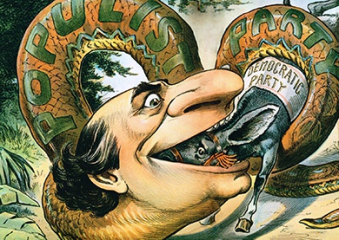 May 1740–1840
Week 1 – From Farm to Factory, Barter to Sovereigns – The transition from a life of agriculture and serfdom to the life in the factory. From home-built mechanical machines, like the loom and water power mills, to the coal-driven steam engine. From barter, to script, to sovereign coins used as trade. The creating of new markets.
Week 2 The Slippery Slop – Industry to Automation, how did it start? The history of automation. Moving away from the farm, to the growing and exciting cities full of opportunities.
Week 3 – Labor and Revolutions – Economics will be discussed in great detail, along with the history of money, markets in conjunction to the value of labor. The Fourth Lecture in the series will cover ways to avoid Labor Revolutions and alternative forms of economics, including the structures used at the PEACH.
Week 3a – Home Life and Work – Home and work were once the same. What changed and how? Lecture, Marie Cassel. Wednesday, 7PM. Lecture Hall I.
Week 4 – Industrial Revolution – In Full Swing! The opportunity to create and develop new products, markets offered more of a selection of goods and food, educational opportunities, growing wealth. In contrast, the beginning of over-crowed cities, escalation of crime, homelessness, filthy air and streets.
Week 1 – Science & Industry – Enlightened no more, the Age Of Science.
Week 2 – Labor and Community – The perfect balance between work and home.
All Lectures are held in the theatre with Prof, Burke. Fridays 6:30PM.
During the month of May, Film Friday will focus on Labor and Industry.
Skilled Labor Lecture Series – Lectures, orientation, and demonstration with our Master Craftsmen.
Print – Last Thursday in April, 7PM.
Clay – First Thursday in May. 7PM.
Wood – Second Thursday in May. 7PM.
Metal – Third Thursday in May. 7PM.
Glass – Forth Thursday in May. 7PM
Stone – First Thursday in June, 7PM.
.
.
List of Key Inventions:
1800 — J.M. Jacquard invents the Jacquard loom.
1800 — Count Alessandro Volta invents the battery.
1804 — Richard Trevithick develops a steam-powered locomotive.
1809 — Humphry Davy invents the first electric light.
1810 — Peter Durand invents the tin can.
1814 — The first successful steam locomotive, designed by George Stephenson, makes its debut.
1814 — Joseph Nicéphore Niépce took the first photograph. The process takes eight hours.
1816 — René Laënnec invents the stethoscope.
1819 — Samuel Fahnestock patents the soda fountain.
1823 — Charles Mackintosh invents his eponymous raincoat, “the Mac” in Scotland.
1824 — Professor Michael Faraday invents the toy balloons.
1824 — Joseph Aspdin takes out an English patent for Portland cement.
1825 — William Sturgeon invents the electromagnet.
1826 — Joseph Nicéphore Niépce created the first permanent photograph from a camera image.
1827 — John Walker invents modern-day matches.
1827 — Charles Wheatstone invents the microphone.
1829 — W.A. Burt invents the typographer, the precursor to the typewriter.
1829 — Louis Braille develops his eponymous method of raised printing to be read by the blind.
1830 — Barthelemy Thimonnier invents a rudimentary sewing machine.
1831 — Cyrus H. McCormick invents the first commercially viable reaper.
1831 — Michael Faraday invents the electric dynamo. generator.
1834 — Jacob Perkins invents and ether ice machine, a precursor to the modern refrigerator.
1835 — Solymon Merrick patents the wrench.
1835 — Charles Babbage invents a mechanical calculator.
1836 — Francis Pettit Smith and John Ericcson team up to invent the propeller.
1836 — Samuel Colt invents the first revolver.
1837 — Samuel Morse invents the telegraph. Morse code arrives the following year.
1839—Charles Goodyear invents vulcanized rubber.
1839—Louis Daguerre invents the daguerreotype – Photography.
1844—John Mercer invents a process to increase the tensile strength and affinity for dyes in cotton thread.
1845—Elias Howe invents the modern sewing machine.
1845—Robert William Thomson patents pneumatic tires made of vulcanized rubber.
1845—Massachusetts dentist Dr. William Morton is the first to use anesthesia for a tooth extraction.
1847—Hungarian Ignaz Semmelweis invents antiseptics.
1848—Waldo Hanchett patents the dentist’s chair.
1849—Walter Hunt invents the safety pin.
1851—Isaac Singer invents his eponymous sewing machine, patents a sewing machine motor.
1852—Jean Bernard Léon Foucault invents the gyroscope, crucial to the development of navigation systems, automatic pilots, and stabilizers.
1854—John Tyndall demonstrates the principles of fiber optics.
1856—Health science pioneer Louis Pasteur develops the process of pasteurization.
1857—George Pullman invents his eponymous sleeping car for trains.
1858—Hamilton Smith patents a rotary washing machine.
1858—Jean Joseph Étienne Lenoir invents a double-acting, electric spark-ignition internal combustion automobile engine fueled by coal gas, which he patents two years later.
.
Technological and Cultural Developments up to 1800 -1890
Advances in photography, telegraphy, steamships
Invention of the telephone (1876)
Growth of urbanization and modern city life
Art and literature: Romanticism, Realism, Impressionism
Foundations of modern science: Maxwell’s electromagnetic theory, periodic table
.
.
FESTIVALS & CELEBRATIONS
May Day
Beltane, in most parts of Europe, was an ancient festival celebrated as the halfway point from the Spring Equinox to Summer Solstice. It is generally felt to be a safe time for planting crops, especially in the north. Today there are still festivals celebrated in European cultures with daisy chains and May Pole Dancing, singing, plenty of food and, of course, the May King and Queen. In Rome, it was the last day of a week-long celebration of Flora, the goddess of flowers.
In 1889, May Day was chosen as the date to celebrate International Workers’ Day. This was to commemorate the Haymarket Riot in Chicago, a part of history that led workers from 12 to 16 hour work a day to the eight-hour working day it has become. Ironically, it is not celebrated in the US or in Chicago, where it originated. At the PEACH, we honor a part of the ancient celebration and offer a lecture on the history of the working class and the political struggles between Unions and Corporations or the working class and the elite. Each year, we invite guest speakers to “talk” about history from their political perspectives. It’s quite an enlivening evening.
.
 May Day Celebration Festival
At the PEACH, this Day is more of a holiday for young people. There are two dances. The May Pole for girls, and the Morris Dance for boys. The girls don their hair in flowers and ribbons. The boys decorate their vests with ribbons and metals. The May King and Queen are chosen the night before. In the morning, her court dresses her. They lead her to the center of the May Pole (birch tree). At the bottom of the pole there is a circular twig wreath with 24 ribbons fastened to the wreath. At the top of the pole are two ribbons dangling in the breeze. She stands inside the wreath as her court dances around her.
Meanwhile, the drums start to beat, the boys and men led by the King make their way to the pole doing the Morris Dance. When he reaches the pole, he extends his hands to invite her to his side. She steps over the wreath to join him. He crowns his Queen, and they join hands. Their courts hands each a glass, and before they speak, they filled the glasses with homemade sima.
The King speaks of his intentions in a firm, precise and practical manner. The Queen then speaks of her intentions through a poetic song. Once their promises for the growing season are announced, they lock arms and drink from the glasses. The court collects the glasses as they are handed their ribbons from the Pole, she with a yellow ribbon, and he with a blue. Standing at opposite ends of the Pole, east to west, the music begins to play, and they dance with the ribbons around the Pole. She’s moving clockwise, he’s moving counter. They wrap the ribbons in a conjoined spiral. This is the sealing of their promised intentions. When the ribbons meet at the bottom, a witness in the crowd ties the knot. The witness bows to the King and then curtsies and kisses the Queen’s hand, then the witness ties the knot. “Tie is tight!” The crowd beckons. The promise is now complete.
This gesture will remain tied from now throughout the harvest. The Queen and King retire to their thrones in the south to watch the others dance and play. The wreath of twigs, greenery, and flowers at the bottom of the pole it pulled to the top, and the ribbons dance in the breeze. The court then takes a ribbon and dances around the pole. The children follow, and then the adults. The contract is now made, and the deal is struck. The dancing represents the spiral of life and the union between the earth and the sky. All the colors of the flowers and ribbons have special meaning: Green represents fertility, growth, and abundance. Red represents vitality, passion, and strength. White represents cleansing, nurturing, positivity, and the purification of the earth.
On the patio, by the cafeteria, are trays and trays of funnel cakes covered in lemon and sprinkled in powder sugar. There are also tents set up with games of chance and skills to master, with prizes for the winner. The children most enjoy a ride on the squirrel runner, bubble tub, and face painting. Make sure you keep an eye out for the pocket lady walking about. She will ask you a question, and if you answer correctly, you can dig into one of her large pockets for a prize. No matter your skill, no one goes home empty-handed. There are also ongoing games of horseshoes, badminton, kubb and softball, if the field is dry, if not, a game of dodgeball is probably in the cards.
Dances are taught a few weeks before the celebration, ages 7 and up. There is a special Traditional May Pole Dance for the adults as well.
Music for the dance is always provided for by Banjo Cat and Fiddle de dee, the Irish Bodhrán and Penny Whistle Band. Jim’s Fun Time Accordion and Concertina will roam the grounds, a delight to our ears and hearts.
May Day Festival – May 1st, Noon – 4PM. Held at the large open area next to the Garden..
Lecture
April 30th, 7PM. From the ancient past to the Working Class. Speaker, Marie Cassel. Lecture Hall I.
.
.
.
.
.
.
.
.
.
.
.
SKILLED ARTS
Garden Workshops
April Showers bring May flowers, and how true that is. All the little gardens around the Community are bursting with beautifully painted bulbs, crocuses, tulips, daffodils, hyacinths. It’s spring, and taking a walk through the woods feels like a trip through a fairy tale, and, oh, the aromas! A delight to all the senses.
From May Day onwards, Families, and Clubs tend all the little gardens on the property. Everyone, big and small, put their hand into the earth. This is one of the best ways to go about making our Community beautiful, a chance to learn useful skills and how to care and work with nature. There are so many garden choices at the PEACH and, of course, everyone has their favorite. There are pots and planters; indoor and out, building gardens, Shakespeare garden, lily pond, herb garden, medicinal gardens, edible forest, the restoration land and, of course, the farm. In the open shed, there are shovels, hoes and rakes, trowels, forks, watering cans and garden gloves. Everyone is free to use what tools we have, or if you like, bring your own. We ask only three things: return the tools to the shed when done, rinse them with the hose on the side of the shed, and hang them up to dry. For those who are new to gardening, on May Day, there is an orientation and the opportunity to sign up as a caretaker and helper. Everyone is expected to do some gardening, even if it is simply watering the plants, clear through to managing and designing a seasonal landscape. Try a different garden every year, it is good exercise, and the earth loves it!
Farmer’s Front Porch Lecture Series, Tuesdays at 7PM
What Is Bio-dynamic Farming and Gardening
Small Animal Husbandry
Bee, and Butterfly Keeping.
.
.
The Farm
Adaptation To The Soil
 Animals are important in the community. The children love to visit, feed, pet and sometimes chase them around the yard. Sometimes close relationships develop between a particular animal and a child. Such relationships teach responsibility and help to develop a respect for nature. Although we have a few animals on the property: chickens, ducks, rabbits, a koi pond, and a pair of goats, we also house several other animals who visit us from time to time for a variety of reasons.
Save a day or two at the most, the animals need constant care. They aren’t difficult to tend to, but constancy is most essential. Food, water and their good health are very critical to their well-being. We have both day and night watchmen and a third person who checks in on the weekends. We also have many volunteers on call, and we encourage everyone to sign up for a week or two throughout the year. This is a great way to spend time, learn about and look after the animals.
Our Farmer, Johann Huber and his wife Emily, keep and manage the schedule for the Animals, Farm, Triangle, Orchards, Farmer’s Market and Gardens. Emily conducts all the orientations while Johann offers several lectures on the importance of food, plant life, bio-dynamic agriculture, and animal husbandry. We also have an Apprentice, John Ailes, who manages the bees, butterflies, and worm farm. He, along with Johann and Emily’s teenage sons, help to manage the gardens and farm on the property.
We use the farming method known as Biodynamic Agriculture here at the PEACH. Biodynamic Farming is a form of organic farming and gardening based on an ethical approach to farming, gardening, food production, and nutrition. It is an ancient form of planting crops based on the cycles of the moon in conjunction with the nature of the plant. Moreover, chemical fertilizers are replaced with various microbial agents: bacteria, algae, fungi, mycorrhiza, and actinomycetes. Chemical pesticides are replaced with natural options of plant symbiotic, neem, salt, and other natural and biodegradable repellent sprays. Overall, there are seven principles guiding the practice of Biodynamic farming and Gardening: Plan Diversity, Crop Rotation, Animal Husbandry, Composting, Natural Sprays and Solutions, Planting based on Celestial and Seasonal Cycles and Rest.
It is truly a wonderful way of growing food. We feed ourselves from everything we grow and raise. There are many people involved in the care of the farm, in the foods we grow and the animals we raise. We also have a relationship with the farms adjacent to our land, and we trade in both goods and labor. Our goal is to eventually form a Grain Co-Op and restore the family farm and community throughout the area.
In late May, it is easy to see the tiger lilies starting to poke through the soil and the violets spreading across the forest floor. The fallow fields are dandelion and nettle-rich, their flowers about to burst, just waiting to be picked. In the right compost, the leaves are large, sweet, and delicious! Grab a red onion from the garden, one of the bio-dome hothouse tomatoes and some aquaponic spinach, along with fresh olives sent from our friends in Crete. Some feta cheese made from our resident goats, a touch of mint growing in the perma-forest, a few magic herbal sprinkles on top of what amounts to a wonderful and delicious salad! Add a side of fish cakes deep-fried in olive oil and bread crumbs, resting on a blanket of skordalia, draped in slices of sweet orange garden peppers, a few stuffed grape leaves on the side. Served with a lovely white wine or homemade cold glass of lemon lime-aid …and for dessert, a sliver of fresh baked baklava. Followed by a walk through the woods to the herb garden for a sprig of fresh mint or parsley. Then it’s back to work in the gardens.
.
.
Skilled Shops
Industry & Labor – Work With Purpose
Clay
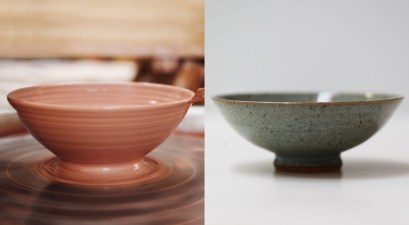 Clay is a natural earth material used for many things in the world. However, for our purposes, we use the substance to make pots and other works of art. It is an ancient art that has changed little, but has always served a valuable purpose.
Clay is made up of tiny particles of rock and minerals mixed with water, producing a compact mud like substance. When sculpted by hand, it becomes stiff and pliable enough to hold the shape created. When the clay dries, it hardens, but retains its shape, and most of its size. Heated at high temperatures in a kiln, it hardens even more to a coarse like substance called a bisque (Fr, twice baked). Adding a glaze and heating the bisque once again at an even higher temperature vitrifies the piece, turning it into a glasslike substance. Using different glazes or flashing it with different materials makes the piece truly one of a kind.
Clay is also simply fun to work with, whether throwing the clay on the wheel, shaping it with your hands, or simply rolling it out like bread. Adding and experimenting with glazes brings more creativity to the processes of creating the piece you are working on.
Clay or ceramics is considered a skilled art, a practical art and a fine art. On a practical level, one must work with the materials safely. On a skilled level, it is knowing how to work with the materials, develop the dexterity and gather experience to create what you see in your head or on paper. To refine the piece into a work of Fine Art takes time and years of practice.
A lecture on the myths, history, skill, and art of clay will be given on the First Thursday in May. 7PM. The Lecture will be in the studio and a demonstration in the Ceramics room.
If you are thinking of starting ceramics in the fall, this is a wonderful orientation. Lastly, like all the skilled arts, there must be a Skilled Master Craftsman in the room at all times for your safety. Absolute supervision for children under age 14.
.
.
Wood
Woodworking is another ancient art. From grasses to hardwoods, there’s plenty to learn about trees and plants and, for some inlays, minerals. The basic tools are important: a saw, a sharp knife, and a few files. For larger projects, the saw, the knife, and the files get bigger, more specialized, and eventually electrified.
One of the most enjoyable parts of woodworking is the effect it has on the sense of smell, touch, sight, and sometimes the ear. The process from beginning to end takes the Craftsman to a different place. Time disappears.
Woodworking is considered a skilled art, a practical art, and a fine art. On a practical level, wood is fairly universal as a foundational structure. Still, one must learn to work with the materials safely, and understand their function.
Although there are many modern electric tools and gadgets, all very handy tools, our craftsmen have the ability to work with simple basic tools. We feel understanding the old ways helps us know how the wood wishes to be shaped and carved.
There’s knowledge, and then there is experience, there is slapping something together, and then there is quality. Form, function, strength, and beauty.
A lecture on the history, skills, tools and materials, and spiritual aspects of this art will be given on the Second Thursday in May, 7PM. The Lecture will be in the studio and a demonstration in the Woodworking Shop.
If you are thinking of starting Woodworking in the fall, you will enjoy this lecture. Lastly, like all the skilled arts, there must be a Skilled Master Craftsman in the room at all times for your safety. Absolute supervision for children under age 14.
.
.
Ink – Print
 Printmaking is one of the few ancient arts that has been around in many forms for thousands of years. Today we use it exclusively as a fine art. In the past, its practical method was, in the 1400s, cutting-edge technology, with the development of Gutenberg’s Printing Press. However, even using that method today is considered a fine art. All practical aspects of printing have transformed and fallen to the computer.
At The PEACH, we still run a print shop, though we use the computer for everyday printing. Our monthly newsletter is done the old fashion way, on a Gutenberg Press. In the Print Shop, we also have several printing beds for single and large works, and we also incorporate both block printing and etching.
As an introduction, our Printmaker uses tile printing in the Spring, especially if you are new to this art. It is a great way to learn how to handle the tools, become familiar with the inks, and, of course, the press. For more advanced users, we add more tools for carving, more methods of pressing, and the making of plant-based inks.
 Printmaking may be one of the oldest arts on the planet, at least as a creative art. Placing ink or plant colors on any piece that contains varying levels of depth, then pressing this onto a flat surface, will create a positive and negative impression once the piece is removed. This likely led to all sorts of creative impressions.
Printmaking, Papermaking, Book-Binding, and Framing often cross over into many of the other arts. Once you understand each, skies, the limit. There’s little to understand once you become comfortable with the tools and how it all operates. Demonstrations of other approaches happen every month.
A lecture on the history, skills, tools, and materials will be given on the Last Thursday in April, 7PM. The Lecture will be in the Printing Studio.
If you are thinking of taking up Printmaking, you will enjoy this particular lecture. Lastly, like all the skilled arts, there must be a Skilled Master Craftsman in the room at all times for your safety and because most of the tools are very delicate. Absolute supervision for children under age 14.
.
.
 Metal
Metal
My, my, where does one begin with a craft and skill that works with the light of the blazing sun and passes the gates of fiery hell, and can turn metal into liquid fire?
The history of fire and all that it has brought is a long story indeed. I dare say, there isn’t a blacksmith who doesn’t know one or 20 good stories about fire, and brimstone, forging mental using the tooth and claw of a dragon to create weaponry, or who knows the guarded secrets of casting an iron pot that will last forever. Hephaestus, Vulcan, and The Devil himself are reasons enough to learn, or at least watch the Smythe at his work. Listening to the clank, clank, clanking of his hammer against the anvil like the gnomes and dwarfs of old.
Far, far, into the ground, past the soil and clay, coal, and feldspar, very deep into the ground, before the earth had cooled enough to walk barefoot upon steaming grass, surrounded by fog, did these elements exist. Working night and day, creating all the metals we use today.
Even the anvil itself is made into the likeness of the gnome Goibhniu. The stories and gifts he brought to the Smythes have been passed down and are still used today.
Blacksmithing is considered a skilled craft. It has many practical purposes, and only a master can shape the mental into a fine art. Like all skilled arts, one must work with the tools and materials safely. It takes years of practice and patience to bend and twist metal to exactly where it wishes to go.
A lecture on the myths, history, tools, and skills of blacksmithing will be given on the Third Thursday in May. 7PM. The Lecture will be in the Blacksmith’s studio along with a deamon-stration.
If you are thinking of Smything in the fall, this is a wonderful orientation. Lastly, like all the skilled arts, there must be a Skilled Master Craftsman in the room at all times for your safety. Absolute supervision for children under age 16.
.
Stone
 When speaking about Masonry, we look to the Foundation Stone, the very first stone placed on the ground. The gesture itself is making a claim on where this structure will be built, and from that stone all things with expand. Placing this stone is a profound moment, it is a commitment to putting down roots. To watch this structure grow stone by stone, and brick by brick, it is a grand effort. To see this edifice grow, built by men with the purpose of will, through careful and thought-out planning, while always considering the esthetic of the building, it is such a wonder. A structure that will be used and enjoyed for many generations.
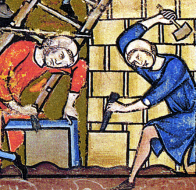 The foundation is everything, and knowing the stones and the weight they will bear. When chiseling marble, how to choose and use the correct tools and materials to express what is in the mind and heart of you as the artist. Understanding the mineral world, whether biomorphically or a-morphically takes a great deal of time, effort, and heavy lifting.
The stories of Stonecutters and Masons go far back in our history. Our Master Mason will give a lecture on the topic of that history. He will cover the types of rocks used to build great and small structures. When he hands you the tools to hit a stone in the right way, you will find out if your aim is true.
Demonstration and Lecture will be offered on the First Thursday in June, 7PM. Café Patio around the Fire Pit. Also, feel free to sign up for the Summer Mosaic Project – ages 9 and up.
.
.
Glass
Buried in Terra’s depths, the gods ignite their alchemy of earth and fire, creating pellucid vessels holding fast to the sacred flame. Shards of obsidian, Vulcan’s words cut narrow and sting dark red, or was glass discovered by mistake? The Phoenicians let their pots linger too long on the fire as they slept, and one night the earthen flux and sand fused to the cast iron, and in the morning, when they broke it off the pot, it shattered. Our glassblower explains how it all came about, and he will demonstrate the process and tools needed to create all sorts of glass pieces and beautiful creations.
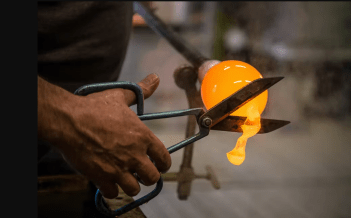 Glassblowing is considered a skilled art, but it also creates many practical pieces for everyday use: dishes, windows, lightbulbs. Like all the skilled arts one must work with the tools and materials safely. It takes years of practice to move and shape liquid glass. It is like working with thick water.
A lecture on the history, tools, and skills of glassblowing will be given on the Forth Thursday in May, 7PM. The Lecture will be at the Swan Light Bulb Factory, along with a full demonstration on free glassblowing and lightbulb making. There will also be a chance to see some combined work the artists at the PEACH have made and a chance to design your own piece.
If you think Glassblowing might be something you are interested in, the club begins in the fall, this lecture is a wonderful orientation. It is also a good time to find out about stained-glass making, or perhaps a job producing incandescent lightbulbs at the factory. Lastly, like all the skilled arts, there must be a Skilled Master Craftsman in the room at all times for your safety. Absolute supervision for children under age 16.
To be a glassblower takes great skill, agility, patience, and attention to detail. One must be quick, understand the elements of design, form and function, and have a keen sense of depth of perception. Once the process begins, there’s no stopping it. The work is dangerous and hot, which is actually quite nice in the winter.
.
.

.
.
Skilled Shops Lecture Series Dates & Time
Print – Last Thursday in April, 7PM.
Clay – First Thursday in May. 7PM.
Wood – Second Thursday in May. 7PM.
Metal – Third Thursday in May. 7PM.
Glass – Forth Thursday in May. 7PM
Stone – First Thursday in June, 7PM.
.
...
.
.
.Whitsun
 In the center of the garden is a tower. At the top of the tower is a large rain barrel. Under the barrel is a pulley. A large rope is attached to the pulley. At the end of the rope is a botafumeiro. On Whitsun, charcoal and incense are placed into the body of the botafumeiro. Like a pendulum, it is pulled 12 times so that the botafumeiro flies back and forth across the garden while emitting smoke from the incense and resins placed inside. This is a form of purification. Elements in the soil that are lost are lifted into the heavens, while the elements, alive and growing, are pulled upward to be spiritualized. This is the atmosphere and feeling of Whitsun.
In the Christian Tradition, Whitsun (White Sunday) is the day of the Holy Spirit, or Holy Ghost, the day of Baptism. It is also regarded as Pentecost, 50 days after Easter, which makes it a movable day of celebration. Movable days are closely connected to either the cycle of the moon or the sun, the solar and lunar calendars.
We see in the painting the Holy Spirit, represented by the dove, descending, and enlightening the head of each individual, but also as a particular group, who then go forth to spread the word of Christ.
The dynamic in this painting is similar to every depiction of this event. Light cast upon the heads of the individuals, which disperses, illuminating the room surrounding the group and the movement of color or the flame, the forces that drive them to spread the word from their own personal experience.
If you are interested in how it all works, the topics covered will be from the POV of the Catholic and Byzantium Churches, along with Traditional and Christian Pagan lore. There will be a Lecture held on the Last Sunday in May in the Chapel. 6PM.
.
.
.
.

.
[tbc]
.
MAY SCHEDULE
May, swelling like a crescendo from spring into warmth, summer. The light grows, more flowers bloom. The Promise of Summer We busy ourselves with play and work and the world opens up, both inside and out. Mid to late Spring planting is everywhere. Nature becomes nature. All rehearsals are in full swing, sports, planting shops, everyone, and everything is nothing, but busy.
Administrative Offices
Administration – Business Hours, 9AM- 3PM. Office Meeting, Thursdays, 2PM – Conference Room.
Community Events Committee – 1st and 3rd Weeks, Thursday, 1PM – Library Room 1.
Elder’s Club and Guardians – The Elders Meet Every Thursday at 3PM in the Conference Room. Half year in-review. Potluck dinner.
Festival & Seasonal Events Calendar Committee – Members meet M-W-R, 9AM- Noon. Festival’s Office, Library Room 2. All participating leaders will meet the night before the Event at 7PM, for updates or any last minute changes. Pot Luck Dinner at 6PM.
Guardians – The Guardians Meet the First Thursday of each month at Noon, Lunch is Served in the Conference Room.
Maintenance – Cleaning, list and repair. Leave a phone message, fill out a form at the Post Office, or contact the Maintenance Office online. Please reserve the Emergency number only when the Offices are closed.
Residents – Residents are asked to keep a watchful eye out for any problems or emergencies and report them to the police if necessary, but always report these to the office or maintenance emergency immediately. Please use common sense, do not put yourself in harms way. Never try to speculate, report as many physical and factual details as possible, including any numbers, times, and date. We want everyone who lives, works and visits our community to remain safe and secure and always feel that they can enjoy our community without Eris or Discordia (strife or discord).
May is Gallery Month! – Finish up all projects and submit to the curator, so they can be properly hung in the Gallery. If you wish to sell your works at the Co-op or Thrift Shoppe Fensalir, the curator will offer you a hand with the process.
.
.
Arts
Fine Arts
Theatre: Wilde, Dorian Gray. Music: Civil War through 1920s Ensemble rehearsals. Dance – Film – Painting
May Day Festival, May 1st – Members and those in the Broader Community who are participating in the set-up and organizing of the May Day Festival.
Folk Arts
Puppetry. Folk Arts. May Day Continuing Folk Arts Gardening, Animal Husbandry, Wool Washing Bookbinding, Leather Tanning, Sinew, Hemp, and Silk Sewing. Cordwaining. Cooking, Collecting Materials from Nature. Making Plant Dyes, Stained Glass, Papermaking gets underway, and Bamboo Basketry. There’s never nothing to do.
Skilled Arts – Indoor/Outdoor
Woodworking – carving. Blacksmithing – horse shoes. Ceramics – throwing vases. Glass-Blowing – vessels.
Garden – Workshops Bio-dynamic Plant, Small Animal Husbandry, Planting, Bee, and Butterfly Keeping.
Studio – Open to all members based on skill level and attendant present.
.
Philosophy & History: Labor, Work, Risk – Industry, Swan Factory & Mining – Nietzsche.
Victor-Marie Hugo, 1802–1885 – French.
.
.
Artist’s Events
May Day – May 1st
May Pole Dancing & Puppet Show –
Contra Dancing Begins –
White Sunday –
Decoration Day Picnic – Last Monday in May.
Strolling Musicians – Throughout May, there are a verity of strolling musicians playing or singing an old and familiar tune. They’ll get your toes atappin’ and your hands aclapin’. Feel free to grace them with a few sovereigns if you can. They will also do birthday, anniversary or just because greetings. Catch them around the grounds to make any arrangements.
.
.
Businesses
Apothecary – Store Hours: R-F-S 10AM – 4PM – Classes T – W, D – Closed – Mail Order and Local Delivery Available.
Clinic – Clinic Hours: M-T-W Appointment Only.
Cordwainer – Regular Hours: T- Farmer’s Market. W-F 10AM – 4PM, R- 10AM – 8PM. Classes, S, 9AM- Noon. Table at the Fair and Market. Closed D, M & Holidays.
Book-Binder – Regular Hours: T- Farmer’s Market. W-F 10AM – 4PM, R- 10AM – 8PM. Classes, S, 9AM- Noon. Table at the Fair and Market. Closed D, M & Holidays.
Bicycle & Ski Co-Op – Spring Hours T-W-R-S 10AM – 6PM. F 10AM – 10PM. D 10AM – 4PM for do-it-yourself emergencies repairs or simple studio time only. Closed Monday.
Co-Op – Regular Hours T-W-R-F-S 9AM – 9PM, D – 11AM – 4PM, Closed Mondays.
Bakery Hours Regular Hours T-W-R-F-S – D, 7AM – Noon, D – 7AM – Noon, Closed Monday.
Café Four Seasons – Regular Hours T-W-R 11AM – 8PM, F- S 10:AM – 9PM. D, Brunch 11AM- 2PM. Closed M.
Northern Europe Menu, Month Of May
Appetizers – Artichoke & Butter Garlic Dip, Fried Spinach, Artichoke White Farmer’s Cheese Dip Balls
Lunch and Dinner – Norwegian Fish, Asparagus, Roasted Potatoes with Nettle Leek Soup.
Desert – May Cake and Brandy Fruit, Custard w/ fresh fruit
Refreshment – Coffee, Tea, Ginseng Soda
Gallery – See Library Hours.
PEACH Farm – Regular Hours: Sun Up til Sun Down. In May there’s always something to do, but morning and afternoon chores start at the crack of dawn, followed by breakfast. There are endless projects throughout the day and of course closing things up before the sun sets.
All food shares, including Fruit Share, will be ready for pickup at the Farmer’s Market. Also, the weekly Farmer’s Market will be open to all food vendors.
Farmer’s Markets – Every Tuesday From May through October The Farm participates in the Farmer’s Market Located at the end of the road in the parking lot, from 10AM – 3PM. If the weather is harsh, all vendors will move to the gym. Always check the monthly schedule for any updates or changes
Post Office – Regular Hours M- F 9AM – 4PM. S, 9AM- Noon.
Swan Glass Factory – Regular Hours. M – F 9AM – 4PM. Closed: Lunch, Noon – 1PM. Closed May
Tè Chay Tea Room and Confectionery – Regular Hours T-W-R-F-S 2PM till 10PM. D – 11AM till 9PM
Closed Monday, May Features: Gelato
Tea Room May Events
Tuesday, 6:30PM till Close – Chess, (6 tables). Contact: General Chief for closet storage and schedule.
Wednesday, 8PM till Close – Live Open Poetry, (6 tables). Contact: Emily Dickinson.
Thursday, 6PM till Close – Candle-light Conversations, (12 tables). Contact: Staff
Saturday, [TBA] – Conversation With The Author, (10 tables) Contact: Silvia Zelts.
Sunday, 11AM Until 2PM – Musical Trios, Duets, Solo. Contact: Staff
Sunday, 2PM till 4PM – Trivia, (10 tables). Contact: Greg Smith. 4PM 6 PM The Stoics. (staff dresses for the occasion).
Sunday, 6PM till 7/8PM – Epic Poetry Reading – Iliad and the Odyssey, Beowulf, Gilgamesh,
In The Closet: Chess Boards, Backgammon, Mancala, Hounds and Jackals, Hnefatafl, Scrabble, Cribbage, Go, Chinese Checkers, Tarot, and a bookshelf full of Poetry are available at all time.
Thrift Shoppe Fensalir– Regular Hours: T-W-R- F 10AM – 4PM. S & D, 10AM until 3PM. Closed Monday. Drop-Offs by Appointment.
.
.
Clubs
Baker’s Club
Breads: Whole Grains, Baguette, Brioche, Cornbread, Focaccia, Pumpernickel, Rye Bread, Soda Bread,
Sourdough. Bread Pudding, Fruit Breads, Nut Breads. Vegetable Breads. When to use Yeast or Soda. The importance of working in a clean environment when making bread. How to store bread, how not to waste bread. Baking tools needed. Best Spreads.
Book Club
Book Clubs – Fielding, Tom Jones. Franklin, The Private Life of the Late Benjamin Franklin. Voltaire, Candide. Book Club meets Tuesdays and Thursday – 7PM. See Book Club Schedule for details.
Teen Book Club 0 Swift, Gulliver’s Travels. 1st Floor Conference Room, Thursdays. 7PM – 9PM
Dance and Movement Club
May – 18th and 19th Century dances. Saturday Afternoon at 2 PM – 4 PM. Thursday Evening at 7 PM. 9 PM. Dance Studio.
Rehearsals for Theater and Cultural Dances, Rounds, Revolutionary American and French, Ancient Greek and Rome, and The Roman Circus will continue to meet Saturday mornings at 10AM. Check schedule for any changes, days, and times.
Father & Son’s Club
Continue with responsibilities in the areas of Animal Husbandry and Gardening. Ongoing classes for Spring and Summer in Marksmanship, Archery, Sailing and Fishing, see schedule for dates and times. On Property Overnight Camping begins Decoration Day Weekend throughout the summer, there are limits to the number of participants, make sure you register early. Note: Camping in the woods, on property, is for the purpose of introduction and experience only or the August Week long trip. Energy Club, Meetings are Monday, 7PM, 1st Floor Conference Room, Check the schedule for any changes.
Festivals and Celebrations Club
May Day – May Pole Dancing. May 1st, Noon – 4PM. Open Area next to the Garden.
Film & Photography Club
Photography Club meets Sunday Afternoon at 4 PM. through 6PM. The Dark Room is open 24/7 to Residents and Members. Only three working members at a time, so sign up on the schedule early.
Film Friday May Films: Labor and Revolution. 8PM, and Saturday Matinée 2PM. Cultural, Seasonal and Historically based films will always be the theme. Theatre.
Folk Arts Clubs
Ongoing studio folk arts is open 24/7 to Residents and Members. Nature Collecting Field Trips will have dates, times, and materials posted on the schedule. The making of natural pigments for painting and dying, along with silk & wool washing, will be introduced in late May and early June. Look for dates and times online and on the bulletin-board. General Meeting and orientation for the folk craft season are held 4 times a year, a week before the solstice and equinox, along with signing up for any particular folk arts class that is of interest. Art building, 2nd floor.
Garden Club
Ongoing Bio-dynamic gardening and farming, small Animal Husbandry, bee, and butterfly keeping. Continuation of planting, arrival of the animals. We encourage people to look after and care for their garden projects every few days, good to have a back-up partners to make sure all are cared for.
Introduction and Observation of the Perma-Forest and Land Restoration, Planting and Trimming always needs an extra hand.
The Garden Landscaping and Animal Care are very important responsibilities to members who committed to their upkeep. If you will be out of town, please make arrangements with our Farmers or the lead Members in the Club.
Check the schedule for weekly, and daily impromptu guests speakers who talk about such topics as Off-Grid Living, nature, gardening, the care of both domestic and wild animals and insects.
There’s always something that needs doing on the farm and if you got a hankering to work find one of our farmers or check the list on the shed for what needs doing without supervision or direction, but If you’re still not sure, don’t do it, sit back and enjoy the gardens and nature instead.
Home Life Club
This club is for everyone. Home Life meetings are every Wednesday at 7PM. Home Life offers topics and experiences that focus around the home. This is a time and place for people in the community to meet and share their life experiences, find help with any number of problems or tasks. There’s plenty of helpful information regarding everything domestic. It is also a good place to sign up for jobs and volunteer opportunities within the community.
A few times a month invited guest speakers will visit and talk about the life challenges and how to balance family life, personal goals, work, economics, and the importance of creativity. If you have suggestions for speakers or issues you think might be of interest to other folks in the community, this is the place to find them.
At least once a month, Handyman Hank drops in to point out a few easy fixes you might need around the house. This is also a good time to bring your questions on how to DIY, or drop your questions off in advance in Hank’s mailbox at the post office.
May Topics
Week 1: Guest Speaker, Topic. Health & Wellbeing.
Week 2: Handyman Hank
Week 3: Guest Speaker, Topic, How to use the PEACH Data Base.
Mom & Tots Club
Regular Schedule M- T-W-R, 9AM – Noon. Outside Water and Sandbox Play, Baking, Nature Walks, Storytime.
Music Club
Ongoing Rehearsals and sight-reading. Small Cultural Group Rehearsals. Roaming Musicians. Modern Chamber Rehearsals. Traditional Drum and Reed Rehearsals. Summer Band Rehearsals. Choir Rehearsals. Wind Ensemble meets every Tuesday at 7:30–9:30 – Sight–Reading.
See Schedule for Small Group Rehearsals.
Painting Club
Watercolor & Pastels continue. There are a number of artists in the community who will get you started in anyone of the painting mediums. Painting is usually done independently and at your leisure, however, there are ongoing classes in each topic. If you are interested, check the schedule and grab a list of materials you will need for the projects. At the beginning of each season, there is a lecture and a demonstration on the medium covered. Painting is an experiential creative endeavor. However, there are always people around to help or answer a question you may have. Further, the instructor of the current medium will be around once a week to answer your questions and offer further demonstration and instructions on techniques used. At the end of the season, there will be a gathering of artists who wish to show their work to the other painters. Critiques and feedback is very important and mostly welcomed.
Printshop Club
Using the Press and Nature Material Collecting. Saturday 9AM – Noon
There are also opportunities for collecting work, editing, design and Key-line pin-ups for the Newsletter. See schedule.
Participation in the weekly Farmer’s Market.
Philosophy & History Club – Lectures
History and Philosophy, 1740 – 1840. The Age of Enlightenment. The beginning of Victorian Era. Topic: The Industrial Age – Social and Economic Structures. Speaker, Prof Burke. Every Monday in May. Location: Theatre.
Skill Shop Series Lectures and Demonstrations
Print – Last Thursday in April, 7PM. Location:
Clay – First Thursday in May. 7PM. Location: Pottery Shop
Wood – Second Thursday in May. 7PM. Location: Woodworking Shop
Metal – Third Thursday in May. 7PM. Location: Smithy Shop
Glass – Forth Thursday in May. 7PM. Location: Factory
Stone – First Thursday in June, 7PM. Location: Café Patio
(Check local schedule for any changes in location)
Sewing Club
Quilting continues, as does the creating, mending and fitting of costumes. Meetings are M-W 9AM – Noon, and at will. The Sewing Room is in the Fine Arts Building, top floor, and in Mom and Tots room off the patio.
Theatre Club
University Collaboration Theatre – May – The Picture of Dorian Gray, Oscar Wilde.
Theatre Practice and Rehearsals for Summer Events, M- F 5PM – 9PM. S, 9AM- 4PM.
Roman Circus Rehearsals.
The Making of Costumes is Coordinated with the Sewing Club. See Schedule and tasks.
Spring Cleaning, list of all costumes in need of repair or cleaning.
Writer’s Club
Book Festival – Visiting Author Workshops.
Speaker – Reading and Selling your works.
Finish all writing projects
Wednesday 7PM – 9PM
.
.
Community Events
Contra Dancing and Pot Luck. S, 7PM – 10PM. Gym or Swan Factory Lunchroom.
Farmer’s Market – Tuesday, 10AM – 3 PM.
.
.
Sports and Movement – Check Schedule. No Sports in this area during Festival Times.
At Will Field Sports
Tennis, volleyball, hiking, camping, fishing. biking. Spring equipment is available between 8AM and 6PM, M-D.
Contra Dancing
From May Day through Thanksgiving, there will be Contra Dancing every Saturday night, 7PM – 10PM. Gym or Swan Factory Lunchroom.
Father and Sons
Archery, Fishing, Sailing. With permission, other’s in the community may join through the St. Joseph Foundation. See Schedule.
Softball
May softball Tuesday 4PM (Age 12 through 16) Thursday 4PM (Mixed Ages & picnic) Men’s softball, Thursday 7PM Gym
Spatial Dynamics
Saturday Mornings tiny dancers ages 9 AM – 10:30 AM (Ages 6 through 9 and 12 through 15).
Saturday Morning 11:00 AM – 12:30 PM (Ages 16 and up). revise
Sun Walkers
Independent Group, Daily, 15min before Sun Rise, meet at the Chapel Door.
Yoga
Dance Studio Independent Group, M-F 8AM – 9AM.
.
.
Physical Activity: Spring Cleaning, House and Shelter Building, Bothmer Gymnastics.
Book Clubs: Mennonites, Lewis, Tolkien, Lewis, Fitzgerald.
Film – Cocteau, La Belle et la Bête
Celebrations & Festivals: May Day Fair, White Sunday, Decoration Day Picnic, Puppet Show.
radio – The Enchanted Tsarévich (A Russian Tale)
Zelinda and the Monster (An Italian Tale)
.
.
.
.
.
.
.
.

.
.
.
.
.
.
.
.
.
.
.
.
.
.
.
.
.
.
.
.
.
.
.
.
.
.
.
.
.
.
.
.
.
.
.
Living Pan-European and American Cultural and Heritage Community Center

.
EMAIL: peachcommunity yahoo.com
.
.
.
.
.
.
.
.
.
.
.
.
.
.
quicklink
 PEACH COMMUNITY