
.
.
.
JANUARY
I amar prestar aen
Han mathon ne nen
Han mathon ne chae
A han noston ned wilith.
January is the time to go deep within the self when the thinking forces are at their best. When it is time to travel to far away places of long ago in dreams. January at the PEACH is the time for great mysteries.
None now live who remember.
Some things that should not have been forgotten, were lost,
History became legend,
Legend became myth. – JRR Tolkien
.
…men lived for 4000 years and once in a life time they had children; they were born in pairs out of their thoughts. -Song of Creation
truth, beauty, strength
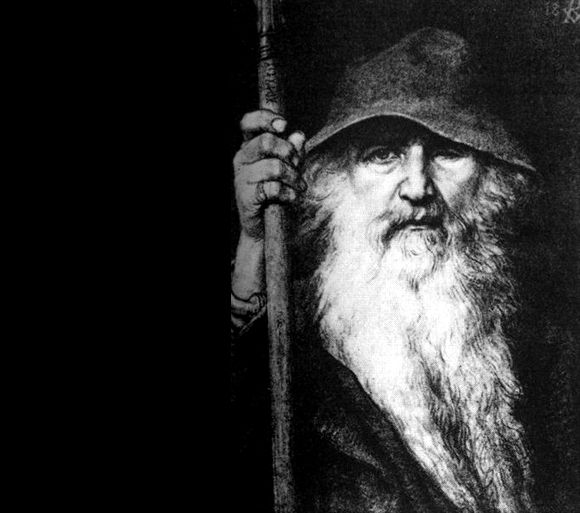
Great Mysteries – Mysteriosophy
The Sun at Midnight – Inspiration
First initiation: Throne of Necessity – The secret of all initiation is to give birth to the higher human being within oneself. What the priest accomplishes more quickly, the rest of mankind must undergo in long stages of development. To become leaders of the rest of mankind, the Druids had to receive this initiation. Druids were priests of the Sun. Through time, the eternal always appears again in a new incarnation.
Lifting the Veil – Imagination
Second Initiation: Handing over the Serpent by the Hierophant – Learning to penetrate and see the astral substances, to clearly witness the weaving of passions and desires, to lift the veil and see their actual spiritual forms beyond their material components, which would look hideous with only material sight. Develop a spiritual backbone. In creative thinking, objects are permeated with spiritual forces. The power of Imagination. Imagination is clairvoyance. To imagine is to see. Cleverness and trickery – Tantalus curses. Truth above all else, or the dangers of the lie which leads to black magic.
Source of Power – Intuition
Third Initiation: The journey into the Labyrinth – What is thus spoken is then forgotten, and only the merest vestige of it survives death. Convolutions of the brain. Eternal truths remain the longest after death. At that time, men experienced the truth through fairy stories; thus, today our spirit bodies have been prepared, and if we are able to grasp higher truths today, it is because we have been prepared.
.
.
Spiritualism vs Materialism
Materialism is the belief that only the physical world matters in life, what we can see, and what we can touch. In the material world, people serve out of need. The social culture of materialism includes productivity connected to this force of need. However, once a person no longer exists, dies, they no longer have any need, want or desire for the culture or the forces of need.
Spiritualism is based on the belief that there is more to come in the afterlife and that we are all connected to a larger and more powerful force. In the spiritual world, service is manifested through love and devotion. The culture of the spiritual is expressed through the arts, religion, science, and philosophy. However, there is no need for the material in the end, because everything in the spiritual world is complete.
.
.
Mysteriosophy –Thursdays 7 PM
Greek – μυστήριον – mysterion, mystery – sophy, knowledge or wisdom. Esoteric doctrines concerning ancient mysteries. Concerning secret rites or doctrines. Often regarded as an enigma. Connected to mysticism, Greek – μυστικός, mystikos. An initiate to a mystic or ancient religion. In pursuit of communion with, identification with, or conscious awareness of an ultimate reality, divinity, spiritual truth, or God through direct experience and visions. A mystical experience, an extraordinary insight beyond all expression. Stories and examples will be given.

Communion of ideas among the higher beings. The slightest movement of activity stirred, caught in the peripheral vision of the el, man was created.
.
All reality streams from the luminous point of hovering -Novalis
.
.
.

Please keep in mind many of the pages are still in process. – the outlines are complete, unless I discover something new or old and good. Littlie by little, this book is pushing forward, if you are interested in being part of this project drop me a line – always full credit given. This is fun! [tbc]
.
.
The Ancient Worlds
…It begins with the unknown, the unnameable, reality is beyond human comprehension, existing outside the bounds of time, space, and causality, this is called, The Akasha…
.
.
~The Sacred Unknown – Mystical Explorations of Ancient India
…this is called, The Akasha. The Akasha represents the infinite, unchanging, and all-encompassing expanse from which time and space emerge…
 ~India, 3300BC to 1300BC – India’s history, now spanning over 5,000 years, is rooted in one of the oldest known civilizations, originating in the Indus Valley, which now includes parts of Pakistan and Afghanistan. This ancient land has nurtured profound philosophies and spiritual practices that are unique to its culture. The Vedic texts, along with the evolution of Hinduism and Buddhism, introduce fundamental concepts such as karma and dharma, emphasizing the importance of inner development for the individual within this distinct societal context.
In their quest for higher consciousness, practitioners engage in meditation, yoga, and asceticism, which serve as pathways to deeper spiritual realities unique to this heritage. The belief that the material world is an illusion (Maya) highlights a belief that true wisdom lies in comprehending the unseen aspects of existence.. This ideology gives rise to the aspirations for moksha; liberation, and nirvana; enlightenment—concepts that resonate deeply within this culture, reflecting a profound desire to transcend the material realm.
According to Hindu belief, there are 33 crore (330 million) gods in India, most prominent are: Brahma, Vishnu, and Shiva, known as the Trimurti. India’s enduring legacy serves as a reminder of the rich spiritual tapestry within its own societal framework. This heritage invites contemplation of the mysteries of existence, fostering a profound connection to the spiritual dimensions inherent in their cultural identity. Exploring this legacy, many have contemplated the deeper mysteries of existence and our connection to the spiritual world.
There is more of what we do not know regarding India, than what we do know. Shrouded behind a veil of great mystery, we start here at the beginning, a hint of the spiritual world and evolving cultural life of the ancient past. Ancient India is a culture where the dreaming life was more real than the waking life. Waking life was concerned with prayer and meditation. The idea and longing was to return to the spiritual world away from this harsh material world, however, as time moved forward the faithful were encouraged to find harmony between the two worlds.
The Vedas – (c. 1500-500BC)
Earliest reference to the caste system in the Rigveda
Development of the four main Vedas: Rigveda, Samaveda, Yajurveda, and Atharvaveda
The Vedas are ancient sacred texts of Hinduism, they consist of four main texts: the Rigveda, Samaveda, Yajurveda, and Atharvaveda. Among these, the Rigveda is cited as the most well-known and foundational.
Vedas – Gayatri Mantra, Rigveda (3.62.10). This is a chant for spiritual awakening, self-realization and enlightenment. It is dedicated to Savitr, the sun deity, it is a prayer for guidance and wisdom.
In Sanskrit:
“Om Bhur Bhuvaḥ Svahaḥ
Tatsaviturvareṇyaṃ
Bhargo Devasya Dhimahi
Dhiyo Yo Naha Pracodayāt”
“Let us meditate on that excellent glory of the divine light, which has created the universe, and may it illuminate our intellect.”
The Upanishads – (c. 800-300BC)
Philosophical concepts of Atman, Brahman, karma, and rebirth
Composition of the Isha Upanishad and other Upanishads
The Isha Upanishad written in ancient Sanskrit is a rich and complex text that offers insights into the nature of reality, the self, and the ultimate goal of human existence.
This is an text that is part of the Yajurveda. It is one of the oldest and most influential Upanishads, its teachings have had a profound impact on Hindu philosophy and spirituality.
The unity of the self (Atman) and the universe (Brahman): The text discusses the idea that the individual self is ultimately not separate from the universe, but rather an integral part of it.
The concept of karma and rebirth: The Isha Upanishad explains the law of karma, which states that every action has consequences, and that the soul (Atman) is reincarnated based on its karma.
The importance of self-realization: The text emphasizes the need for self-realization, or the understanding of one’s true nature as a spark of the divine.
.In the Isha Upanishad, one of the most quoted sections is Adhyaya 2, Verse 1-4. This section is often referred to as the “Brahmajnana” or “Self-Knowledge” section. This is considered the most profound and revered thoughts.
Verse 1: “Sa yathā Indrahaṃ Vajraṃ Tasya bhrātā Ayajñastad yadi Vidyutkramād api Grīhamāṇaḥ | Sa yathā Indrahaṃ Vajraṃ Tasya bhrātā Ayajñastad vijñātā Prathamam ātmani vedaḥ”
“Just as a thunderbolt is born of lightning, The universe is born of the unmanifest Brahman.”
Verse 2: “Yatha āgnir bhasmaṃ yatha vāyur garbhaṃ yatha vṛkṣaḥ phalaṃ yatha Mrtyur marīciḥ | Yatha indro varunau prithivīḥ sarit tat sarvāṃ sthūlaṃ jagat savām”
“Just as fire burns down to ash, just as air converts the seed into the plant, just as trees produce fruit, and just as death gives rise to rebirth, so too in the universe, all gross and subtle things arise from the ultimate reality.”
Verse 3: “Tattvamasi: Tat tvam asi: Tadvan mā Tadvan me | Tadvan mā Tadvan me Tadvan mā Tadvan mā tattvamasi”
“You are that. You are the ultimate reality. You are the same as the universe, you are the same as Brahman.”
Verse 4: “Aham brahmasmi: Aham sarvasya Pratyakcittasya jagato ‘ham sarvam | Aham sarva tanu visvato’ham tasmād Ekam eva advitiyam Brahma”
“I am Brahman. I am the consciousness of all beings. I am the universe. I am all that exists. I am the only one, eternal, and without a second. I am Brahman.”‘

The Mahabharata and the Bhagavad Gita (c. 400BC-400 AD)
The Mahabharata is one of the two major Sanskrit epics composed during this period. The Bhagavad Gita, which is part of the Mahabharata, contains the teachings of Lord Krishna to Arjuna on the battlefield of Kurukshetra.
The Mahabharata is dvided into 18 books (Parvas) “The Beginning”, “The Assembly Hall”, “The Forest”, etc., each deals with different phases of the epic, and each book contains numerous chapters
The Bhagavad Gita is part of the Mahabharata’s (Bhishma Parva), but stands alone as a philosophical text with 18 chapters. Chapters are named by theme, “The Yoga of Knowledge”, “The Yoga of Action”, etc. Each chapter contains verses (Shlokas) in couplets discussing Krishna’s teachings to Arjuna.
These segments not only provide insight into the philosophical and ethical teachings of these ancient texts, but also reflect on human nature, duty, morality, and the divine.
From The Mahabharata -The Great Story of India.
~The Game of Dice – Sabha Parva
This segment sets the stage for the war. It explores themes of fate, gambling, and the consequences of one’s actions. The scene where Yudhishthira loses everything, including Draupadi, is intense, illustrating moral dilemmas and human weaknesses.
“The man who is swayed by anger is like one who has seized a sharp sword by its blade. He hurts himself more than he does others.”
~Bhishma’s Discourse on Dharma – Shanti Parva
After the war, Bhishma, lying on his bed of arrows, imparts vast wisdom on dharma, politics, economics, and social ethics to Yudhishthira. This is one of the longest discourses in the epic, touching on governance, the duties of a king, and the complexities of righteous conduct.
“Dharma is subtle; one cannot define it, yet everyone knows it when they see it practiced.”
~The Conversation between Karna and Kunti – Udyoga Parva
This happens moments before the war begins, it is deeply emotional. This is where Kunti reveals to Karna his true lineage. He offers him the kingdom if he joins the Pandavas. This story covers identity, loyalty, and the pain of moral choices.
“I am giving you your brothers; take them, but do not take away their lives.”
卍
From The Bhagavad Gita = The Song of the Divine
~Chapter 2 – Sankhya Yoga
Krishna begins to counsel Arjuna on the battlefield, addressing his doubts about fighting his kin. Here, Krishna introduces concepts like the immortality of the soul and the necessity of performing one’s duty without attachment to the results.
“You have a right to perform your prescribed duty, but you are not entitled to the fruits of action.”
`Chapter 4 – Transcendental Knowledge
Krishna explains the concept of divine incarnations and the path of knowledge –Jnana Yoga. This chapter also discusses the importance of sacrifice and how all actions should be performed as offerings to the divine.
“Whenever there is a decline in righteousness and an increase in unrighteousness, O Arjun, at that time I manifest Myself on earth.”
~Chapter 11 – The Vision of the Universal Form
Arjuna’s request to see Krishna’s divine form leads to one of the most dramatic and awe-inspiring chapters. Krishna reveals His cosmic form, showing the universe within Himself.
“Time I am, the great destroyer of the worlds, and I have come here to destroy all people.”
The Six Schools of Indian Philosophy – (c. 200BC-400 AD)
The six major schools of schools Indian philosophy are considered “orthodox” due to their acceptance of the Vedas as a source of knowledge. They are: Samkhya, Yoga, Nyaya, Vaisheshika, Mimamsa, and Vedanta. These are diverse perspectives on the nature of reality, the self, and the path to liberation. Each school has a distinct focuses on metaphysics, epistemology, and the path to liberation (moksha). Samkhya explores the duality of consciousness and matter. Yoga emphasizes self-discipline through practice. Nyaya focuses on logic and reasoning, Vaisheshika on atomic theory. Mimamsa on the proper interpretation of Vedic rituals. Vedanta on the ultimate reality of Brahman and the nature of the Self – Atman.
Samkhya – This dualistic school views reality as composed of two independent principles: Purusha – consciousness, and Prakriti – matter, with liberation achieved by understanding the distinction between the two.
Yoga – Considered an extension of Samkhya, Yoga focuses on practices like meditation and physical postures to attain self-realization, this is believed to unit the individual consciousness with the universal consciousness.
Nyaya – Emphasizes logic and epistemology, developing a system of reasoning with various sources of knowledge like perception, inference, and comparison to understand the nature of reality.
Vaisheshika – Proposes an atomic theory of the universe, where all matter is composed of tiny particles called “paramanu” and explores the categories of substance, quality, action, and inherence.
Mimamsa – This school of thought is primarily concerned with interpreting the Vedic rituals, aiming to understand the proper performance of religious duties, and the concept of Dharma.
Vedanta – Considered the “end of the Vedas,” this school focuses on the philosophical interpretations of the Upanishads, exploring the nature of Brahman – ultimate reality, and the Atman – individual soul, with various sub-schools like Advaita – non-dualism, Vishishtadvaita – qualified non-dualism.
Points to remember – These schools developed over long periods of time, with significant contributions from various philosophers like, Kapila (Samkhya), Patanjali (Yoga), Gautama (Nyaya), Kanada (Vaisheshika), Jaimini (Mimamsa), and Adi Shankara (Vedanta). While distinct, there is overlap and interaction between the schools, especially in terms of their shared goals of liberation from the cycle of rebirth (samsara).
Glossary
-
Akasha – Infinite expanse, the cosmic soup where time and space bubble up—pure mystical juice.
-
Atman –The inner self or soul, one with Brahman in the Upanishads—“I am Brahman,” it whispers.
-
Brahman – Ultimate reality, the unchanging All behind the universe—“You are that,” says the Isha Upanishad.
-
Dharma – Duty or cosmic law, the glue of life—Bhishma’s “subtle, yet known when seen” in the Mahabharata.
-
Karma – Action’s ripple, tying soul to rebirth—“You’re not entitled to the fruits,” Krishna tells Arjuna.
-
Moksha – Liberation from rebirth’s cycle, the big escape—India’s spiritual endgame.
-
Rigveda – Oldest Veda (c. 1500BC), hymns like the Gayatri Mantra—“May it illuminate our intellect.”
-
Samsara- The wheel of birth and death, what yogis dodge—trapped ‘til you crack moksha.
.
On Friday, 7 January at 7 PM, Professor Burke will give an overview lecture on Ancient India. He will go deeper into the meaning of the religions life and the consciousness of the people. In addition, he will discuss the following topics:
The Ramayana – An overview of this Sanskrit epic, its impact on the culture, religion, and philosophy of India.
The Caste System – Examining the four main castes (varnas) and their roles in ancient society.
The Maurya (322–185BC) and Gupta (320–550 AD) Empires – A brief historical context on the political, cultural, and scientific achievements of these two empires.
Buddhism and Jainism – The rise of Buddhism and Jainism. A Brief Biography of Siddhartha.
At the end of the presentation, there will be time for questions, answers, and a discussion from members of the audience and those who continue to study and practice a number of the religions and their history.
Professor Burke will also have his books available for purchase in the lobby, and he is always happy to sign copies for those who wish a remembered greeting.
His lectures are free, but donations to the History and Philosophy Club are always welcomed.”
.
.

.
.
The Akasha represents the infinite, unchanging, and all-encompassing expanse from which time and space emerge.
Inside the Akasha is the Void. The Void in Aryan Zoroastrian cosmology is the primordial emptiness, but the Void is not just the absence of being, it also the state that contains the potential for all existence.
.

~Aryan Persia, Beacon of Wisdom – All Religions Begin Here
Inside the Void are the Primal Waters, the Great Sea. It is the original source of all creation, giving rise to the cosmos and the first gods. Ab-Zohr is the god born of the Primal Waters; he is the strength of the Primal Waters. He is the creative, generative force that gives rise to new life and reality. Created from these waters is the cosmic order.
There is also The Great Mystery, an ineffable reality that precedes all existence, and within this is The Great Silence, the Eternal Silence and stillness. In this silence contains the seeds of all potentiality. From this Eternal Silence emergence Zurvān. Zurvān is the embodiment of all time and space; he is eternity and the infinite. This
is the milieu in which the creation of all things arises and unfolds, the drama of existence, and the God Zurvān.
.
.
Time and Space
Zurvān (Zrvan) embodies infinity and timelessness. He is the eternal expansion of time and space, existing beyond the dualities of good and evil, light and darkness. Zrvan is the source of time itself, where it originates. Zrvan encompasses all possibilities and manifestations in the cosmos.
Zrvan transcends the reality from which Ahura Mazda, the supreme god of Zoroastrianism, emanates. This relationship emphasizes Zrvan’s role as the foundation of divine authority and wisdom.
Zrvan also gives rise to the two opposing forces, Spenta Mainyu (the Holy Spirit) and Angra Mainyu (the Evil Spirit) the manifestations of moral dualism are present within Zoroastrianism. Zrvan is the primordial substance that is beyond all concepts. He is the universe and the divine order.
Zurvanism
In ancient Persia, there was a sect known as Zurvanism. These worshipers placed Zrvan as the central concept, the ultimate deity. This sect often led to interpretations that blurred or nuanced the strict dualism typically emphasized in Zoroastrianism, leading to discussions about the nature of Ahura Mazda and Angra Mainyu as equal, but opposing forces rather than strictly good and evil.
It must be said that there are several ways of looking at this story of creation based on the changes over time. However, what is most important in Zoroastrian is the concepts of duality and the importance and rewards of being good.
Zurvan’s Goodness and the Birth of Ahura Mazda
Zurvan’s Nature is the infinite source of time and space. Zurvan’s Nature is often associated with a more neutral, overarching state of existence. While it embodies creative potential, the idea is seen as giving rise to both good and evil. The emergence of Ahura Mazda represents a focus on the ethical and benevolent aspects of existence.
Creation, An Act Of Goodness
.
Birth of Ahura Mazda
Ahura Mazda – Wise Lord, is the embodiment of divine wisdom, light, and goodness. Ahura Mazda signifies the purposeful intention in creation and the inauguration of order and harmony in the cosmos. At the same time, it risks the descent into chaos or nothingness, to one imbued with ethical significance. Ahura Mazda is the creator. Ahura Mazda’s nature is the creator, he is the Supreme Deity of Zoroastrianism.
“To Mazda, the Wise Lord, with my mind and my tongue do I offer my praise; with my actions and my whole being do I serve Him. Grant me, O Mazda, the strength to bring to realization the vision of Truth (Asha).” Yasna 28:1
..
Cosmic Dualism
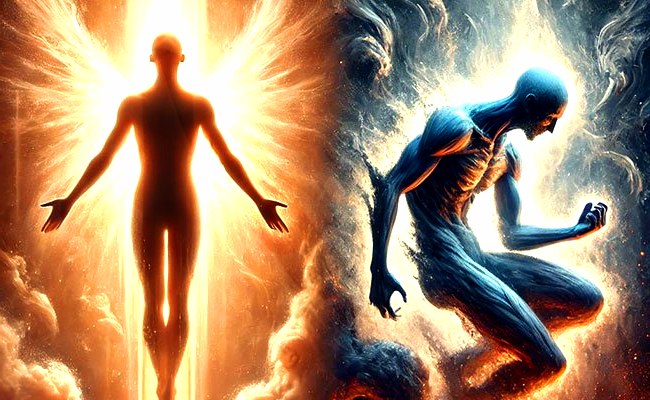
The creation of Ahura Mazda sets into motion a dualistic structure. As the manifestation of good and wisdom, Ahura Mazda’s existence necessitates the presence of its counterpart, Angra Mainyu, representing the evil and destructive Spirit. This duality is an essential part of Zoroastrian cosmology, reflecting the ongoing struggle between creation and order on one hand, and destruction and chaos on the other.
Zrvan manifesting Ahura Mazda is a crucial turning point in Zoroastrian thought. This establishes the dualistic architecture that delineates the nature of existence. It gives rise to goodness, represented by Ahura Mazda, who actively engages in a struggle against chaos and evil, embodied by Angra Mainyu.
Ahura Mazda is the spiritual light and wisdom; he embodies the principles of order and harmony in the universe. Ahura Mazda is the higher spiritual being; he is the force of good.
Speaker Aside: In my interpretation, the existence of an all-good deity like Ahura Mazda necessitates the presence of an evil counterpart, Angra Mainyu, due to the dualistic nature of the Zoroastrian worldview.
This understanding aligns with the central theme of the ongoing struggle between good and evil, order and chaos, which is fundamental to the cosmic drama. However, it is essential to acknowledge that there are other interpretations and understandings within the Zoroastrian traditions, along with the graying of the lines that evolve over time.
Ahura Mazda, he is full of wisdom, and righteousness, he s representative the forces of creation, truth, and harmony. He is the positive expression of creation.
From the one, comes two. How duality comes about is reflected in the nature of two. In the cosmic order of dualism, the creator creates the opposition from the creator himself. The nature of dualism requires opposition, there we discover the Twins.
.
.
The Twins
Ahura Mazda creates Spenta Mainyu, The Holy Spirit, the divine emanation of himself. Spenta Mainyu is the will of Ahura Mazda; he is responsible for creating life and goodness. Spenta Mainyu protects the sky, water, earth, plants, and children. Spenta Mainyu rewards those who follow the path of purity and truth with long life and happiness. Spenta Mainyu, the Holy Spirit, represents the divine qualities and virtues that counteract evil. Spenta Mainyu is a force that brings about creation, wisdom, and harmony, aligned with the light and all the positive intentions of Ahura Mazda.
Angra Mainyu (The Destructive Spirit) counters Spenta Mainyu. Angra Mainyu is the embodiment of greed, wrath, and envy. He is an agent of chaos, discord, and suffering. He represents destruction, falsehood, and evil.
Angra Mainyu’s opposition to Spenta Mainyu exemplifies the moral and existential struggles within the universe. He is often compared to Satan, Lucifer, and Iblis. In the Middle Persian age he is known as Ahriman, while Ahura Mazda becomes known during this period as, Ormazd.
While Ahura Mazda creates the world and all that is good, Angra Mainyu seeks to corrupt and destroy it. In the final battle, Ahura Mazda is expected to defeat Angra Mainyu at the end of time.
“Thus are the primeval spirits, who as a pair, yet twain, have revealed themselves in vision; the Better in thought, the Worse in thought; as regards their fame and as regards their glory.” Yasna 30:3
.The Cosmic Drama
The relationship among these three figures illustrates the central dualistic theme in Zoroastrianism, where the battle between good – Ahura Mazda and Spenta Mainyu – and evil – Angra Mainyu – is fundamental to existence. This duality also affects the moral choices of individuals, emphasizing the importance of choosing good over evil.
.
.Creation and the Elements
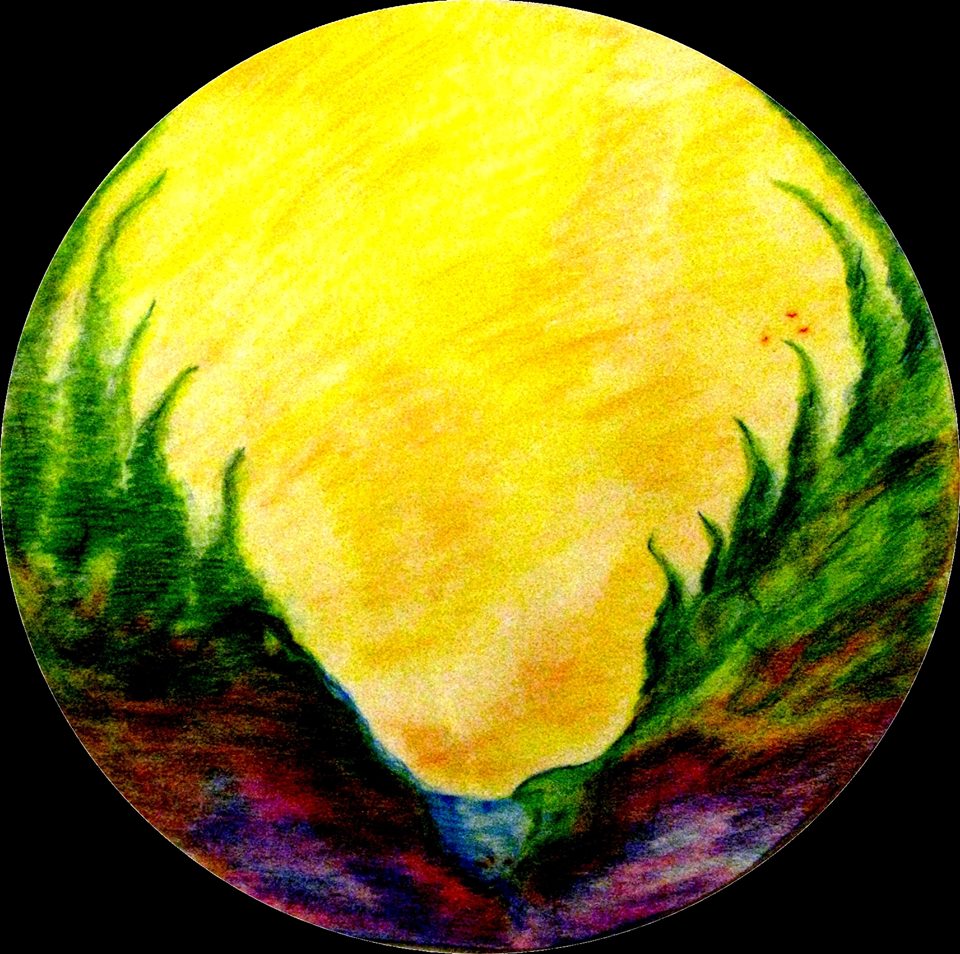
According to the prophet Zarathustra, the creation of the elements follows the emergence of Ahura Mazda. The Elements: mineral, water, air, and fire are considered sacred. These are then followed by: the sky, the earth, the rivers and oceans, the plants, the animals, and humanity. These all spring from the sacred divinity of the four elements.
.
.
Compelled To Create – Human Beings
In the creation of the sacred elements, the mountains, the sky, rivers, and the sun all come about through the creative powers of Ahura Mazda. The mountains rise, plants spring forth, animals form, and human beings stand upright.
Speaker Aside: The development of the elements came about through the creative powers of Ahura Mazda. The four sacred elements, and the duty regarding their task: Water, the rivers and the oceans. Air, the sky and wind. Earth, the mountains and minerals; Fire, the sun and the warmth of the inner earth. Then come the plants that absorb all the elements: root, stem, leaf, and fruit. The animals that have all of those elements built in, with the expression of duality, instinct, the reaction for survival. Man comes about, and he has all of that, plus he is given his own gift, freedom. Freedom to choose, to decide in this dualistic reality, that he has a choice.
Ahura Mazda is compelled to create, like all of nature; it is a natural gift, like breathing, it is built in. Ahura Mazda has bestowed this gift on human beings, and the idea of wisdom which all of humanity possesses, if they choose, out of freedom, to awaken. Every human being’s approach to creativity is different. This difference comes about according to the sacred elements. This is now something every human is born with, and they can express this gift through acts of will and share the result of their creative forces with others. As the story unfolds, each of these creations contributes to the establishment of order against the disruptive forces represented by Angra Mainyu.
“This I ask Thee, tell me plainly, O Ahura: How shall I bring purity to the Fire, O Mazda, through the deeds born from good mind?” Yasna 34:4
.
Human Duality-The Cosmic Struggle
Ahura Mazda, as creator, establishes order between the forces of good and evil. Ahura Mazda is represented by Spenta Mainyu -The Holy Spirit. He is the representative of Ahura Mazda. In order to teach humans the truth, Asha is created. Asha is truth and order. Asha is The Truth.
Opposed to Asha is of Druj, who is created by Angra Mainyu. Druj embodies chaos and falsehood.
Thus, battle for human spiritual development begins. It is now between good; exemplified by Ahura Mazda and Spenta Mainyu, and evil, represented by Angra Mainyu. The emergence of Asha and Druj marks the beginning of a more dynamic force in the universe. In the Zoroastrian faith, it is essential for humanity to strive towards greater spiritual awakening and alignment with the forces of good. This is the struggle for humanity.
Asha
good thought
good words
good deeds
.
.
.
Ahura Mazda Creates Asha and Druj
Asha Vahishta
Avestan: The Excellent Order, Truth. For human beings, Asha is the cosmic truth. Asha guides creation. Asha emphasizes harmony, justice, hope, and life, the ideal path of existence. Asha presides over fire. Fire is sacred to the inner nature of reality. Asha abides by the principle of righteousness, ‘rightness.‘ Rightness is all things exactly as they should be. This rightness is embodied by Ahura Mazda, and Spenta Mainyu, Asha is the Law Immutable, the Law Eternal, the Cosmic Law of Order and Harmony on which the entire Universe is based.
“Whosoever, both men and women, shall give to me the best righteousness according to their power, they shall, verily, in accordance with the law of Asha, gain for themselves the Kingdom of Good Mind, O Mazda.” – Gathas of Zarathustra, S. Insler
It is through Asha that Ahura Mazda created the universe, and it is through Asha that guides human conduct, and that through Asha mankind will attain perfection, and be one with Ahura Mazda. Ahura Mazda’s plan is a world created to evolve to perfection according to the law and plan of Asha, the divine order of all things. Asha serves as a guiding principle for moral and ethical behavior. Asha represents the natural order of the universe and the foundational truth that underlies creation.
.Druj
The Embodiment of Falsehood and Chaos, Deceit, and Disorder. Druj is the antithesis to the principles of truth, order, and righteousness, embodying the forces that lead to discord, moral decay, and the disruption of the divine order of Ahura Mazda.
Druj is associated with Angra Mainyu – Ahriman, the spirit of destruction and chaos. Together, they represent the malevolent forces in the cosmic struggle between good and evil. While Ahura Mazda seeks to maintain harmony, truth, and justice, Druj and Angra Mainyu work to undermine these principles, leading individuals away from the path of righteousness and towards moral corruption.
The mere simple presence of Druj manifests as obstacles to truth and order, influencing human decisions and the world around us. Druj is seen in the various forms of deception, lies, and unethical behavior that individuals encounter or engage in themselves. Druj is often personified as a spiritual adversary or demon, evil spirits or entities that propagate falsehood and corruption.
.
.
Asha Contrasts Druj
Dualism is fundamental to Zoroastrian cosmology. The struggle between Asha – truth, and Druj -lies, is the central conflict in the universe. Asha contrasts Druj, at every turn. The opposition is clear. Druj is darkness, chaos, falsehood, and deception. Asha is light, order, truth, righteousness. Asha serves as a moral imperative for individuals, urging them to live in accordance with what is true, to promote justice, and contribute to the order of the world.
Following Asha leads to spiritual growth and alignment with the divine will. Following Druj only leads to evil, and disorder. Asha is the principle of duty, accountability, fairness, and responsibility. Druj is the principal of immorality, deceit, abandonment, injustice, and irresponsibility.
Druj serves as a moral warning against the dangers of deceit, falsehood, and unethical behavior. This creates deception. Thus, the teachings emphasize the importance of personal responsibility in resisting the temptation to follow the path of Druj and striving instead to embrace Asha for the virtues associated with truth, order, and righteousness. This builds trust.
All of the above plays no small role in the effects and challenges humans face. By remaining vigilant against the influence of Druj and Angra Mainyu, individuals can contribute to the ultimate triumph of good over evil in the cosmic struggle. Asha brings the triumph of Ahura Mazda’s plan in the Universe
..
.
Humans and Dualism
Human Beings have the inherent ability to choose between alignment with Asha—representing truth and order—or Druj, which signifies lies and chaos. Fundamentally, the importance of ethical decision-making contributes to either the greater balance or imbalance of the cosmos, with each action taken. Individuals are compelled to make a definitive choice, aligning themselves with one side or the other.
The dichotomy of Ahura Mazda and Angra Mainyu establishes a moral dimension integral to existence itself. Within this cosmic design, the ultimate fate of human souls hinges upon their choices the make and they must do this out of freedom.
The influence of Druj can sway a soul’s path, as judgment comes based not only upon loyalty to Asha but also on the strength shown in resisting the temptations of Druj. This duality elucidates the significance of moral choices, human agency, and the intentions underlying creation.
The final impact on human souls is all important. Druj influences the fate of souls. Souls are judged based on their adherence to Asha and their resistance to Druj, which determines their place in the afterlife.
In the end, through freedom, despite the presence of duality, Zoroastrianism conveys a hopeful vision where good, embodied by Ahura Mazda, will be the leading impulse to the triumph of Asha over Druj and the restoration of the Cosmic Order.
Thus, the ultimate purpose of humanity is a hopeful one: to actively choose and embody the principles of Asha, steering away from the chaos of Druj. In fulfilling this purpose, individuals not only contribute to the balance of the cosmos, but also pave their path to heaven in the afterlife. Through freedom of choice and ethical engagement, humans become integral players in the divine narrative, participating in the overarching victory of good over evil.
Responsibility and Consequence
Humans are seen as active participants in the cosmic struggle. Their choices have consequences, not just in their lives but also in shaping the world around them. This imbues life with purpose and responsibility, as each being’s actions contribute to the triumph of good or the perpetuation of chaos. Humans must align themselves with the forces of good, with Asha. The reward is heaven in the afterlife
..
Human Beings must strengthen their powers of perception in order that they may look around and upon all things, the plants, the animals, that which lives in the air and in the water, upon the mountains, and in the depths of the valleys. Cast your eyes upon the world.
‘Whenever we experience perceptual manifestations in the outer physical world, we realize that therein lies, concealed and beyond our sense perceptions, the workings and achievements of the spirit. Do not draw away from the material world, sharpen Truth, Wisdom, Perception, Apprehension and Cognition.
…
.Eschatology Vision
The triumph of Asha and the final judgment is where souls are assessed if they are aligned with truth and righteousness, for this leads to a restoration of balance in the universe. The cycle of life, death, resurrection and judgment serves as the final triumph of good over evil.
“This I ask Thee, tell me plainly, O Ahura: How shall I fulfill the vision of Asha, O Mazda, through the deeds born from good mind, by word and by deed?” Yasna 43:1
.
Ancient Aryans and Persia
In the depths of Zoroastrian cosmology there are ideas and thoughts shrouded in mystery. The Persian Empire, home to Zoroastrianism—a religion that introduced the first monotheistic god to the masses as a vital concepts of dualism and ethical responsibility influenced the establishments of religious thought and contributed laying the foundation of truth and morality throughout its history.
The story and history of The Ancient Aryan [Noble] Culture, begins with the dawn of the deity Ahura Mazda and nearly ends in the twilight of the Islamic Conquest, which latter led to Shia Islam (1500AD).
Aryan [Iran] was known as the the Aryan People during the time of Zoroaster, founder of the religion Zoroastrianism, 1000BC. It was renamed by the Greeks during the reign of Cyrus the Great. The empires was located in the region called, “Persis” [Pérsēs] the Greeks called the land, “Persia.”
The principles of Zoroastrianism is the endless struggle between light and darkness, individual moral responsibility, and free will.
.
.
Who was Zarathustra?
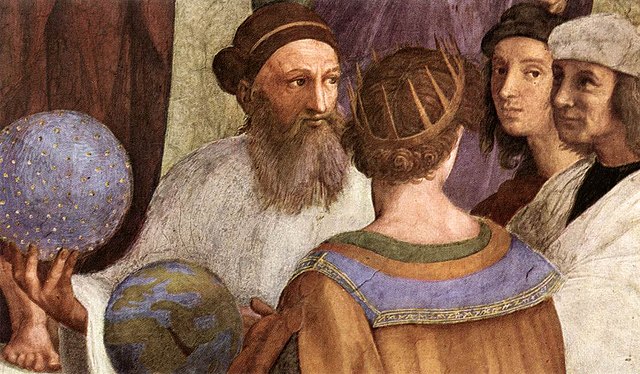
Zarathustra, also known as Zoroaster, is a pivotal figure in ancient history and is believed to have lived in the 2nd millennium BC, though the exact dates remain a subject of scholarly debate. He is traditionally thought to have been born in the region of Media, in present-day northwestern Iran. Much of his life remains shrouded in mystery, with scant historical documentation to illuminate his existence. The name “Zoroaster” derives from the Greek version of his Persian name, “Zarathustra.”
As the founder of Zoroastrianism, Zarathustra’s teachings are primarily recorded in the Avesta, the sacred scriptures of the religion, which highlight a profound dualistic worldview. Central to his philosophy is the struggle between good and evil, manifesting in the eternal conflict between the benevolent deity Ahura Mazda, the Wise Lord and creator of the universe, representing all that is good, and the malevolent force of Angra Mainyu (Ahriman), embodying chaos and evil.
Zarathustra introduced key concepts that continue to shape Zoroastrian thought:
- Dualism: The emphasis on the contrasting forces of good and evil, light and darkness.
- Free Will: The belief in personal choice and moral responsibility, underscoring the importance of individual agency in the battle between good and evil.
- Afterlife: Zoroastrian views on the afterlife diverge from those in Abrahamic religions; rather than a binary heaven and hell, it emphasizes judgment based on one’s choices in life.
- Amesha Spentas: Zarathustra also spoke of the Amesha Spentas, six divine beings embodying virtues such as truth, justice, and wisdom, which are central to Zoroastrian ethics.
Zarathustra’s profound insights not only laid the foundations for Zoroastrianism but also influenced subsequent philosophical and religious thought throughout history.
“The man of wisdom, he who has chosen the good, let him teach and let him guide with the word of Asha; for he is the shepherd of the people.” Yasna 53:2
.
.
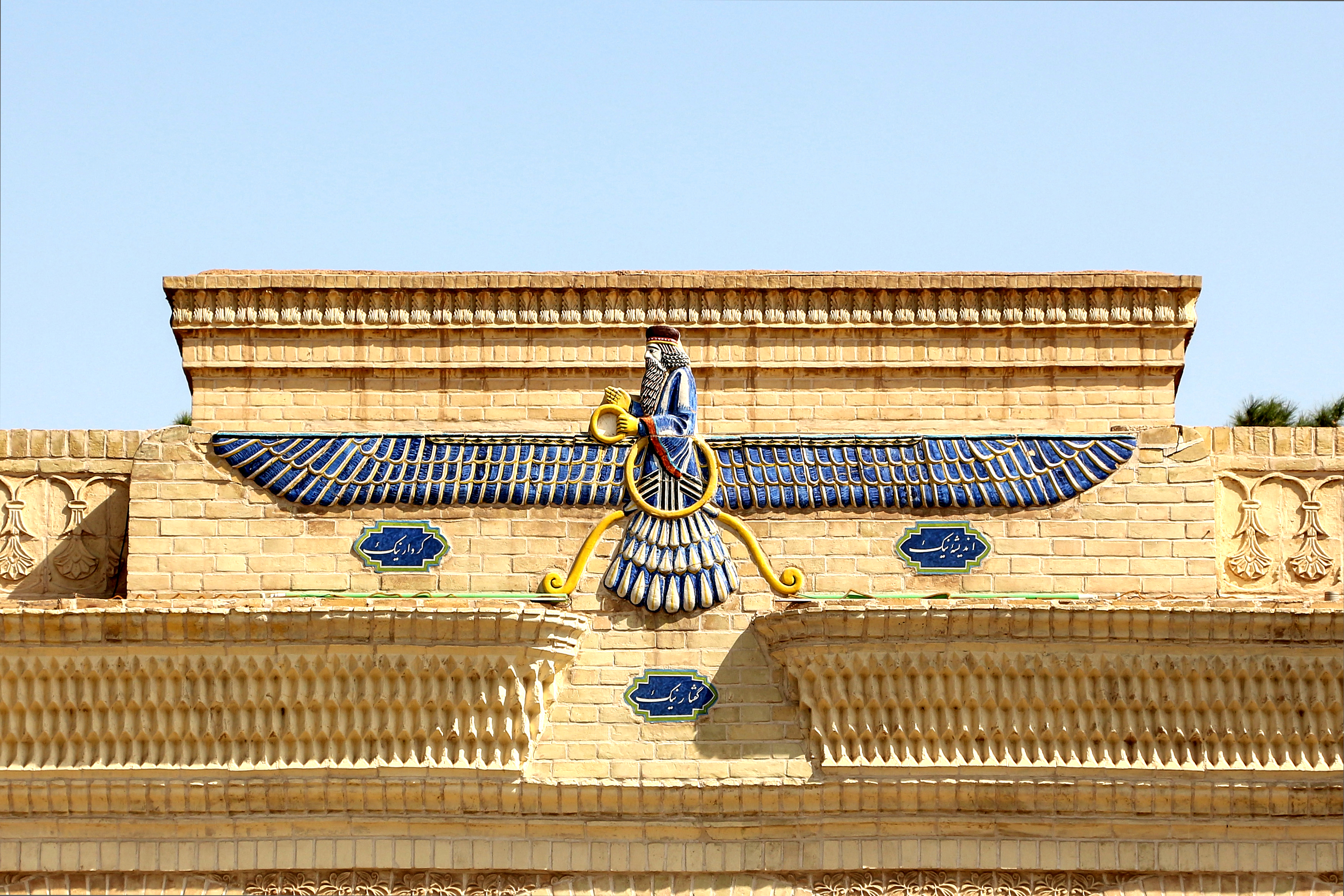
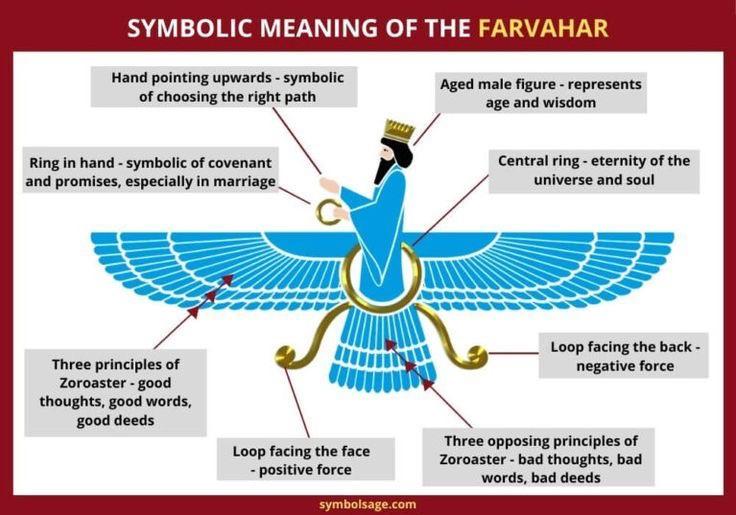 Farvahar – Around the man are a pair of wings with transpires for those who do righteous deeds for its own sake, not for the search of reward three layers of feathers., each standing for one of the three pillars of Good Thoughts, Good Words and Good Deeds.
The term “Faravahar” (Farravahar – Farrahvar) is a Persian word that translates to “divine messenger” or “good mind.” It comes from two components: “fra” meaning “good” or “exalted” and “vahara” meaning “mind” or “spirit.”
In the context of Zoroastrianism, the term Faravahar refers to the Fravashi, which are guardian spirits or the essence of a person. They are believed to be the divine aspects of each individual, watching over them in their earthly life and assisting in their spiritual journey.
The term Faravahar can also be interpreted as a symbol of protection, wisdom, and righteousness. It’s a powerful emblem of Zoroastrian philosophy, representing the ideal path toward goodness, truth, and spiritual growth.
According to the old Persian conception beings, called Fravashi (Feruers), were immediately above man. Thus during the old Persian evolution it was conceived that behind the covering of the sense-world there were successive stages of spiritual beings rising higher and higher up to Ormuzd [Ahura Mazda].
.
Zoroaster and Ahura Mazda
In Zoroastrian tradition, the teachings and revelations of Zoroaster (or Zarathustra) are foundational to understanding the relationship between the prophet and Ahura Mazda, the supreme god. Several key texts and concepts reflect this connection, detailing Zoroaster’s conversations with Ahura Mazda and their significance.
The Avesta
The Avesta is the primary collection of Zoroastrian sacred texts. Within it, particularly in the Gathas—the hymns attributed directly to Zoroaster—there are verses that reflect his direct conversations and revelations from Ahura Mazda. The Gathas embody Zoroaster’s teachings, his understanding of the divine, and the moral and ethical principles he advocated.
Divine Revelation
The nature of Zoroaster’s relationship with Ahura Mazda is often depicted as one of direct revelation. In the Gathas, Zoroaster expresses a personal dialogue with Ahura Mazda, seeking wisdom, guidance, and understanding of the universe’s moral structure. This relationship emphasizes Zoroaster’s role as a prophet—chosen to convey the divine message about truth (asha) and righteousness.
The Concept of Asha
Asha is a fundamental concept in Zoroastrianism, representing truth, order, and righteousness. In his teachings, Zoroaster conveys that Ahura Mazda embodies Asha and imparts this principle to humanity. Conversations with Ahura Mazda often center on understanding and upholding Asha in the world, emphasizing moral choices and the importance of living according to truth.
Zoroaster’s Quest for Understanding
Zoroaster’s spiritual journey is marked by a quest for understanding the nature of good and evil, the purpose of existence, and the role of humanity in the cosmic struggle. His dialogues with Ahura Mazda reflect this quest, as he seeks clarity on the duality of existence, the presence of Angra Mainyu, and the ultimate victory of good over evil.
The Visperad and Yasna
Other portions of the Avesta, including the Visperad and Yasna, also describe rituals and invocations that reflect the relationship between worshippers and Ahura Mazda. These texts highlight the communal aspect of Zoroastrian worship, illustrating how Zoroaster’s teachings are embedded in practices aimed at honoring Ahura Mazda and reinforcing the principles of good thought, word, and deed.
Moral Responsibility:
A key aspect of Zoroaster’s dialogue with Ahura Mazda involves the concept of moral responsibility. Zoroaster teaches that every individual has the power to choose between good and evil—embodied in the actions of Ahura Mazda and Angra Mainyu. In this way, the conversations with Ahura Mazda are not just theological but also deeply ethical, encouraging followers to live in accordance with divine principles.
Conclusion
The conversations between Zoroaster and Ahura Mazda, as depicted in the Gathas and other Zoroastrian texts, illustrate a profound and personal relationship through which the prophet received divine wisdom and guidance. This connection serves as the foundation for Zoroastrian ethics, cosmology, and the understanding of the ongoing struggle between good and evil. The emphasis on personal revelation and moral responsibility reflects Zoroaster’s role as a pivotal figure in shaping not only Zoroastrianism but also the broader discourse on the nature of divinity and ethical living in human life.
.
.
Ancient Aryans and Persia
In the depths of Zoroastrian cosmology there are ideas and thoughts shrouded in mystery. The Persian Empire, home to Zoroastrianism—a religion that introduced the first monotheistic god to the masses as a vital concepts of dualism and ethical responsibility influenced the establishments of religious thought and contributed laying the foundation of truth and morality throughout its history.
The story and history of The Ancient Aryan [Noble] Culture, begins with the dawn of the deity Ahura Mazda and nearly ends in the twilight of the Islamic Conquest, which latter led to Shia Islam (1500AD).
Aryan [Iran] was known as the the Aryan People during the time of Zoroaster, founder of the religion Zoroastrianism, 1000BC. It was renamed by the Greeks during the reign of Cyrus the Great. The empires was located in the region called, “Persis” [Pérsēs] the Greeks called the land, “Persia.”
The principles of Zoroastrianism is the endless struggle between light and darkness, individual moral responsibility, and free will –
.
Ancient Persia – Iran
The dawn of Persian civilization is marked by a profound and enduring legacy: the spirituality of Ahura Mazda and the teachings of Zarathustra shaped the identity and culture of this ancient land. It is the first Religion monotheist being, guided by a duel belief syste, between good and evil. All religions to come with follow this ordwr.
From the mystical beginnings of Zoroastrianism to the grandeur of the Achaemenid Empire, and from the conquests of Alexander the Great to the Sasanian renaissance, Ancient Persia’s story is one of continuous evolution, rich diversity, and unyielding resilience.
The Early Dawn of Ahura Mazda
In the misty dawn of history, the concept of Ahura Mazda emerged, a divine force that embodied wisdom, justice, and truth in an age of myth and ritual. This ancient deity, often depicted as a benevolent god with benevolent intentions, would become the cornerstone of Zoroastrianism, a monotheistic faith that posits an ultimate struggle between light and darkness, truth and falsehood. The dualistic nature of Zoroastrianism – with Ahura Mazda as the supreme force of good – would profoundly influence Persian thought and spirituality, influencing not only the empire’s policies but also the very essence of its culture.
The Birth of Zoroastrianism
Against this backdrop, the life and teachings of Zarathustra (Zoroaster) burst forth, like a radiant star illuminating the darkness. This enigmatic figure, often regarded as the founder of Zoroastrianism, infused the ancient faith with the principles of free will, individual moral responsibility, and the cosmic dualism of good vs. evil. Through the revelation of a higher divine reality – Ahura Mazda – Zoroaster provided a spiritual guide for living a virtuous, moral life amidst a world filled with uncertainty and turmoil. The Achaemenid Empire, which would soon rise to power, found in Zoroastrianism a powerful force for cohesion and governance.
The Rise of the Achaemenid Empire
As the Medes united their tribes under the leadership of King Cyaxares, the stage was set for the emergence of the Achaemenid Empire in 550BC. With Cyrus the Great at its helm, the Achaemenid Empire expanded with incredible speed and diversity, encompassing a vast and complex tapestry of cultures, faiths and human rights. At the heart of this empire was Zoroastrianism, which infused its policies, law, and culture with a profound sense of purpose and morality. As the empire flourished, so too did art, literature, and architecture, with the magnificent city of Persepolis standing as a testament to the ingenuity and creativity of the Achaemenid period.
Cyrus the Great, Cyrus II, 559-530BC
Cyrus II, known as Cyrus the Great, was born around 600BC in Persis, now near Shiraz, Iran, to Cambyses I, King of Anshan, and Mandane, daughter of Astyages, King of Media, centered in western Iran. Astyages, fearing a dream that Cyrus would overthrow him, ordered his death as an infant. He instructed Harpagus, a Median general, to kill the baby, but Harpagus gave Cyrus to a shepherd instead, who raised him until age 10. Around 590BC, Cyrus’s noble bearing was recognized during a childhood incident, and Astyages, advised by priests that the threat had passed, allowed him to return to Persis under Cambyses I.
At age 21, around 579BC, Cyrus became King of Anshan, a vassal state of the Median Empire. In 550BC, he launched a revolt against Astyages, defeating the Medes at Pasargadae, near Shiraz, Iran, where Median nobles defected to his side. In 549BC, he captured Ecbatana, now Hamadan, Iran, ending Median rule, and declared himself King of Persia. In 547BC, he attacked Lydia, ruled by King Croesus, who misinterpreted an oracle predicting the fall of an empire—his own. Cyrus won the Battle of Pteria, in central Turkey, and the Battle of Thymbra, near Izmir, Turkey, followed by a siege at Sardis, also near Izmir, annexing Anatolia, western Turkey, in 546BC. In 539BC, he marched on Babylon, near Baghdad, Iraq, taking it without a fight from the weak king Nabonidus.
Cyrus issued the Cyrus Cylinder in 539BC after conquering Babylon, a clay decree freeing captives, including Jews from exile, and ordering temple reconstruction across Mesopotamia. This act, preserved in the British Museum, is considered an early human rights declaration, as it allowed local populations to retain their religions and customs, ensuring loyalty through tolerance rather than force. He began constructing Naqsh-e Rostam, near Shiraz, Iran, a rock-cut necropolis intended for Achaemenid kings, though his tomb was completed at Pasargadae. Dedicated to Ahura Mazda, the Zoroastrian supreme deity, Cyrus promoted this faith, integrating it into his governance and military campaigns.
In 530BC, Cyrus died fighting the Massagetae, near the Aral Sea in modern Uzbekistan. He pursued them beyond the Jaxartes River, now Syr Darya, after they killed his troops. Queen Tomyris, seeking revenge for her son’s death, ambushed his army, killed Cyrus in battle, severed his head, and submerged it in a wineskin filled with blood. He was buried in a simple tomb at Pasargadae, near Shiraz, Iran. His Achaemenid Empire, stretching from India to Egypt, became the largest of its time, noted for its stability and innovative administration.
Cyrus the Great’s Family
Family members of Cyrus the Great—his wives and children—extending to Xerxes I’s immediate family, with names and approximate dates where available. This is based on historical sources, Herodotus (Histories), Xenophon (Cyropaedia), and the Nabonidus Chronicle.
Exact dates are scarce—Persian records pin deaths not births—so some are estimates tied to Cyrus’s reign (559-530BC) and events.
Born: Around 600BC, Persis (near Shiraz, Iran).
Died: 530BC, fighting the Massagetae (near Aral Sea, Uzbekistan).
Parents
Father: Cambyses I, King of Anshan (r. ~600-559BC). Born around 630BC, died around 559 C. Ruled Anshan under Median vassalage.
Mother: Mandane, daughter of Astyages, King of Media (r. ~585-550BC). Born around 620BC, death date unknown—likely after 550BC when Cyrus took Ecbatana.
Wives
Cassandane: Primary wife, from the Achaemenid nobility (possibly daughter of Pharnaspes). Born around 600-590BC, died around 538-537BC—Herodotus (2.1) notes Cyrus mourned her deeply, suggesting her death post-Babylon (539BC).
Most scholars agree she was the mother of his key children.
Unnamed Wife: Some sources (e.g., Ctesias via Photius) suggest a second wife, possibly Median or Babylonian, but no name or firm evidence exists—often dismissed as speculation.
Children
Cambyses II: Son of Cyrus and Cassandane. Born around 560-558BC, ruled as King of Persia (530-522BC), died 522BC in Egypt under unclear circumstances (wound or poisoning). Succeeded Cyrus, conquered Egypt (525BC).
Bardiya (Smerdis): Son of Cyrus and Cassandane. Born around 555-550BC, died around 522BC—executed by Cambyses II before his Egypt campaign, though some argue a usurper (Gaumata) took his place and was killed by Darius I in 522BC. Briefly ruled (if real) in 522BC
.
Atossa: Daughter of Cyrus and Cassandane. Born around 550-545BC, died around 475-470BC. Married Darius I after his 522BC coup, mother of Xerxes I. Influential queen—Herodotus (7.2) credits her with securing Xerxes’s succession.
Artystone: Daughter of Cyrus and Cassandane. Born around 545-540BC, death date unknown—lived past 500BC. Married Darius I alongside Atossa, favored by him (Herodotus 3.88). No ruling role, but prominent in Persepolis records.
Roxane: Daughter of Cyrus and Cassandane (per Xenophon, Cyropaedia 8.5). Born around 540-535BC, death unknown—less documented, possibly died young or minor. Some debate her existence—could be conflated with others.
==
Side Note: This covers Cyrus’s immediate family and Xerxes’s line
Births are estimates—based on Cyrus’s reign (559-530BC), Cambyses II’s rule (530-522BC), and Xerxes’s birth (519BC). Death dates align with known events (e.g., Cambyses II’s 522BC end, Xerxes’s 465BC assassination).
Family Ties: Atossa bridges Cyrus to Xerxes—her marriage to Darius I was strategic, not succession-based (no female kings in Persia).
Sources: Herodotus, Xenophon, Babylonian records—gaps filled with scholarly consensus (e.g., Encyclopaedia Iranica).
—
How Darius I Took the Throne
Darius did not inherit the thrown, he grabbed it through force and marriage.
Cyrus the Great died in 530BC, leaving the Achaemenid Empire to his son, Cambyses II, who ruled from 530 to 522BC. Cambyses II had no children and died under mysterious circumstances—possibly poisoned or wounded—in Egypt in 522BC, while returning to Persia to deal with a revolt. Before his death, he had ordered the execution of his brother Bardiya (also called Smerdis), fearing a rival claim, though some sources suggest Bardiya was already dead or replaced by an impostor.
After Cambyses II’s death, a power vacuum emerged. A man claiming to be Bardiya—likely an impostor named Gaumata, a Magian priest—seized the throne in March 522BC, supported by some nobles and regions like Media and Egypt. This “False Bardiya” ruled for about seven months. Darius, a distant relative of Cyrus through the Achaemenid line (his father was Hystaspes, a noble), led a coup against him. With six co-conspirators, Darius killed False Bardiya in September 522BC at a fortress in Media, possibly near Ecbatana, now Hamadan, Iran.
Darius then declared himself king, taking the title Darius I (r. 522-486BC). He justified his claim in the Behistun Inscription, a rock relief near Kermanshah, Iran, stating he restored the rightful Achaemenid line after defeating the usurper Gaumata and nine other rebel kings in 521-520BC. His connection to Cyrus was through a shared ancestor, Achaemenes, though he wasn’t a direct descendant. To solidify his legitimacy, Darius married Atossa, a daughter of Cyrus, after taking power, linking himself to Cyrus’s bloodline.
Why Not Cyrus’s Daughter?
Atossa, Cyrus’s daughter, didn’t take the throne because Persian succession favored male rulers—there’s no record of a female king in Achaemenid tradition. After Cambyses II and the Bardiya chaos, power went to the strongest male claimant. Atossa was influential—later the mother of Xerxes I—but her role was as a queen consort, not a ruler. Darius’s coup and military backing trumped any potential claim through Cyrus’s daughters.
Darius I and Atossa: Marriage and Power
Darius I seized the Achaemenid throne in 522BC after killing False Bardiya (Gaumata), as detailed in the Behistun Inscription near Kermanshah, Iran. To legitimize his rule, he married Atossa, daughter of Cyrus the Great, soon after—likely within months of the coup.
Atossa had been married before: first to her brother Cambyses II (r. 530-522BC), then possibly to Bardiya (or Gaumata) during his brief reign in 522BC. These marriages were standard Achaemenid practice to keep power in the family, but Darius, a distant cousin, used her to tie himself to Cyrus’s direct line.
Atossa bore Darius four sons, including Xerxes I (born 519BC), who became king in 486BC. Her influence is clear—Herodotus (Histories 7.2-3) states she pushed Xerxes as heir over Darius’s older sons from his first wife, a daughter of Gobryas. Her elite status as Cyrus’s daughter gave her clout, but it was a tough spot—married off to secure each king’s reign, her loyalty shifted to her sons, especially Xerxes, to preserve her family’s power. Darius’s “forced” marriage wasn’t love—it was strategy, and Atossa played the game to protect her line.
Timeline:
- 530BC: Cyrus dies; Cambyses II becomes king.
- 522BC: Cambyses II dies; False Bardiya (Gaumata) takes over.
- 522BC (Sept): Darius I kills False Bardiya, claims throne.
- Post-522BC: Darius marries Atossa, cements rule.
Xerxes I (r. 486-465BC)
Xerxes I was born in 519BC in either Susa or Persepolis. He was the son of Darius I and Atossa, daughter of Cyrus the Great, making him part of the Achaemenid elite. Groomed as heir by his mother, Xerxes demonstrated his strength early on by crushing revolts in Egypt and Babylon (486-484BC).
Like his father and grand father Xerxes imposed and enforced tax collection, 20 percent on all agriculture and manufacturing of the lands conquore.He taxed religious institutions, which despite their wealth had previously not been taxed. The Persians themselves paid no taxes.
King Xerxes I was a firm believer in Ahura Mazda, the supreme deity in the Zoroastrian religion. He also destroyed temples of other religions and made sacrifices to local deities. He worshipped Ahura Mazda in places where he previously believed demons were worshipped. He declared himself an adversary of the daevas, ancient pre-Zoroastrian gods.
During his ongoing wars with Greece (480-479BC), Xerxes attempted to bridge Asia Minor into Europe. He initially tried to cross the Hellespont (Dardanelles). Xerxes had his engineers build massive pontoon bridges across the Hellellispont Strait. When a storm rolled in and destroyed the bridges. Xerxes did not blame the engineers or the weather. He blamed the sea. He then ordered his soldiers to punish the ocean by wiping the water 300 times with chains and poking it with red-hot irons, all while shouting curses at the waves. He then successfully cut a canal through Mount Athos, allowing him to march into Greece with an army of 200,000 men. At the Battle of Thermopylae, Greece, Xerxes defeated King Leonidas’s Spartans. However, during the Battle of Salamis, Greece, he witnessed the destruction of his navy. After suffering another loss in Plataea, he returned home, marking the end of the Persian-Greek Wars.
Xerxes completed the Grand Hall, or Apadana, at Persepolis which was started by his father Darius. The Apadana was an immense square hall with 36 columns, each over 20 meters tall. The columns were topped with elaborate capitals in the shape of bulls’ heads, symbolizing the power and strength of the Achaemenid Empire. The walls were adorned with intricate carvings depicting scenes of tribute-bearers from various subject nations, as well as guards, nobles, and the king himself. The grandeur of the Apadana reflected the might and prestige of the Persian Empire under Xerxes I.
In 465BC, Xerxes was assassinated in Persepolis. According to some ancient sources, Xerxes was assassinated by Artabanus, a courtier and the commander of the royal bodyguard. Artabanus reportedly killed Xerxes with the help of several co-conspirators, including a eunuch named Aspamitres. However, other sources suggest that Artaxerxes himself may have been involved in the plot to kill his father.
Xerxes I is buried at Naqsh-e Rostam, Iran, The Behistun Inscription is a remarkable artifact that provides valuable insight into the reign of Darius the Great and the Persian Empire.This atobiographical inscription is believed to have been written by Darius himself, recounting his accomplishments and the events of his reign.
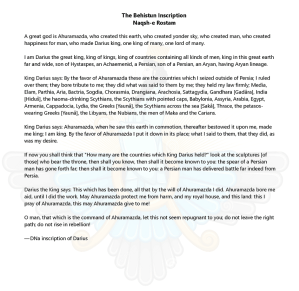 the DNb inscription
Xerxes’ legacy is mixed. He held the empire’s peak, stretching from India to Anatolia, but his campaigns against Greece ultimately scarred him and ended in defeat. The Greeks called him a tyrant, but the Persians regarded him as a symbol of strength.–
Xerxes I’s Family
Xerxes I: Son of Darius I and Atossa (Cyrus’s daughter). Born 519BC, ruled as King of Persia (486-465BC), died 465BC, assassinated in Persepolis by Artabanus. Grandson of Cyrus, led the Greek invasion (480-479BC).
Xerxes I’s Parents
Father: Darius I, King of Persia (r. 522-486BC). Born around 550BC, died 486BC at Persepolis. Took throne via coup, married Atossa to link to Cyrus.
Mother: Atossa (see above)—Cyrus’s daughter, key in Xerxes’s rise.
Xerxes I’s Wife
Amestris: Primary wife of Xerxes I, daughter of Otanes, a Persian noble. Born around 520-515BC, died around 440-425BC—lived past Xerxes’s death. Mother of his heirs, known for ruthlessness (Herodotus 7.114).
Xerxes I’s Children
Darius: Eldest son of Xerxes and Amestris. Born around 500-495BC, died 465BC—executed by Artaxerxes I after their father’s assassination, accused of plotting.
Artaxerxes I: Son of Xerxes and Amestris. Born around 495-490BC, ruled as King of Persia (465-424BC), died 424BC. Succeeded Xerxes after killing Darius.
Hystaspes: Son of Xerxes and Amestris. Born around 490-485BC, died around 465-460BC—killed in a revolt against Artaxerxes I.Achaemenes: Son of Xerxes and Amestris. Born around 490-485BC, died 459BC—murdered by Egyptians during a revolt while satrap of Egypt.
Amytis: Daughter of Xerxes and Amestris. Born around 485-480BC, death unknown—married a noble, per Ctesias, but details are thin.
==
Alexander the Great (356BC, Pella – 323BC, Babylon)
The fall of the Achaemenid Empire to Alexander the Great (334-330BC) marked the beginning of a new era, one in which Greek culture and ideas merged with the rich spiritual traditions of Persia. The Parthian Empire (247BC – 224AD) and Sasanian Empire (224AD – 651AD), which succeeded the Achaemenid, preserved and renewed many elements of Persian culture, including Zoroastrianism, which experienced a revival under the Sasanians. During these periods, art, literature, and spirituality continued to flourish, with the epic poetry of the Shahnameh capturing the essence of Persian identity and its enduring struggle against the forces of darkness.
.
The Islamic Conquest and the Birth of Shia Islam
In the 7th century AD, the Islamic Conquest transformed the spiritual landscape of Persia, bringing forth a new era of monotheistic faith and spiritual renewal. As Islam spread and Shia Islam emerged, the legacy of Zoroastrianism blended with Islamic teachings, creating a unique and vibrant culture that continues to influence the identity of the Iranian people. The Safavid dynasty, which arose in the 16th century, solidified Shia Islam as the dominant faith of the region, while preserving the rich heritage of Persian culture and spirituality.
Do not do unto others whatever is injurious to yourself.
.
Glossary of Avesta
- .Yasna (Yazishn)- Definition: The primary liturgical text of the Avesta, consisting of 72 chapters. Significance: It includes the Gathas, which are the hymns attributed to Zarathustra himself, and other important prayers and rituals used in Zoroastrian worship.
- Visperad – Definition: A collection of 23 additional chapters that supplement the Yasna. Significance: These texts are used in the performance of high liturgies and elaborate rituals, particularly during the seasonal festivals (Gahambars).
- Yashts – Definition: A collection of 21 hymns dedicated to various divine beings, such as Ahura Mazda, the Amesha Spentas, and other Yazatas (divine entities). Significance: The Yashts are used in Zoroastrian worship and provide insight into the mythological and devotional aspects of the religion.,
- Vendidad (Videvdat) – Definition: A collection of texts primarily focused on purity laws, rituals, and moral codes. Significance: The Vendidad provides guidance on maintaining spiritual purity and avoiding contamination by evil forces. It also contains mythological and legendary material.
- Khordeh Avesta – A collection of shorter prayers and texts used for daily devotion and personal prayer. Significance: The Khordeh Avesta is an essential resource for Zoroastrians in their daily spiritual practice, containing prayers for various occasions and purposes.
- Fragments- Definition: Various fragments and miscellaneous texts that are not part of the main sections mentioned above. Significance: These fragments provide additional insights into Zoroastrian beliefs, practices, and history, although their specific origins and context may be unclear.
Glossary
- Zoroaster- Definition: The historical figure believed to be the founder of Zoroastrianism. The extent of his historical existence is debated. Significance: Considered the prophet and spiritual leader who introduced the teachings that form the basis of Zoroastrianism.
- Zoroastrianism- Definition: The religion or spiritual tradition that emerged from Zoroaster’s teachings. Significance: Zoroastrians believe in the sacred texts (the Avesta) and adhere to the rituals, practices, and dogmas of the faith. It is one of the world’s oldest monotheistic religions, emphasizing the struggle between good and evil and the importance of human agency in this cosmic battle.
- Zarathustra (Zoroaster) – Definition: The Persian name used in ancient texts and traditions to refer to the historical figure, often translated as Zoroaster by Greek and Roman writers. Significance: The name Zarathustra is used interchangeably with Zoroaster, both referring to the same prophet and spiritual leader who founded Zoroastrianism.
On Friday, 10 January at 7 PM, Professor Burke will give a lecture on Zarathustra & Ancient Persia. He will cover the following points: Zoroastrian cosmology. The belief system then and now; The effect of this system on other religions and throughout history. The modern congregation. The longevity of the religion and the challenges it has faced. The period between ancient Persian and Mesopotamian civilizations. Documented history of Zoroastrianism (time permitting).
At the end of the presentation, there will be time for questions, answers, and a discussion from members of the audience and those who continue to study and practice a number of the religions and their history.
Professor Burke will also have his books available for purchase in the lobby, and he is always happy to sign copies for those who wish a remembered greeting.
His lectures are free, but donations to the History and Philosophy Club are always welcomed.”
.

Enuma Elish
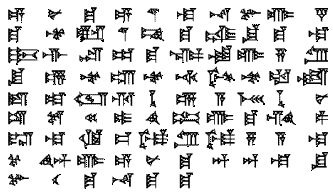
When heaven above was not yet named
Nor earth below pronounced by name,
Apsu, the first one, their begetter
And maker Tiamat, who bore them all,
Had mixed their waters together,
But had not formed pastures, nor discovered reed-beds;
When yet no gods were manifest,
Nor names pronounced, nor destinies decreed,
Then gods were born within them.
.
~Mesopotamia: The Cradle of Civilization
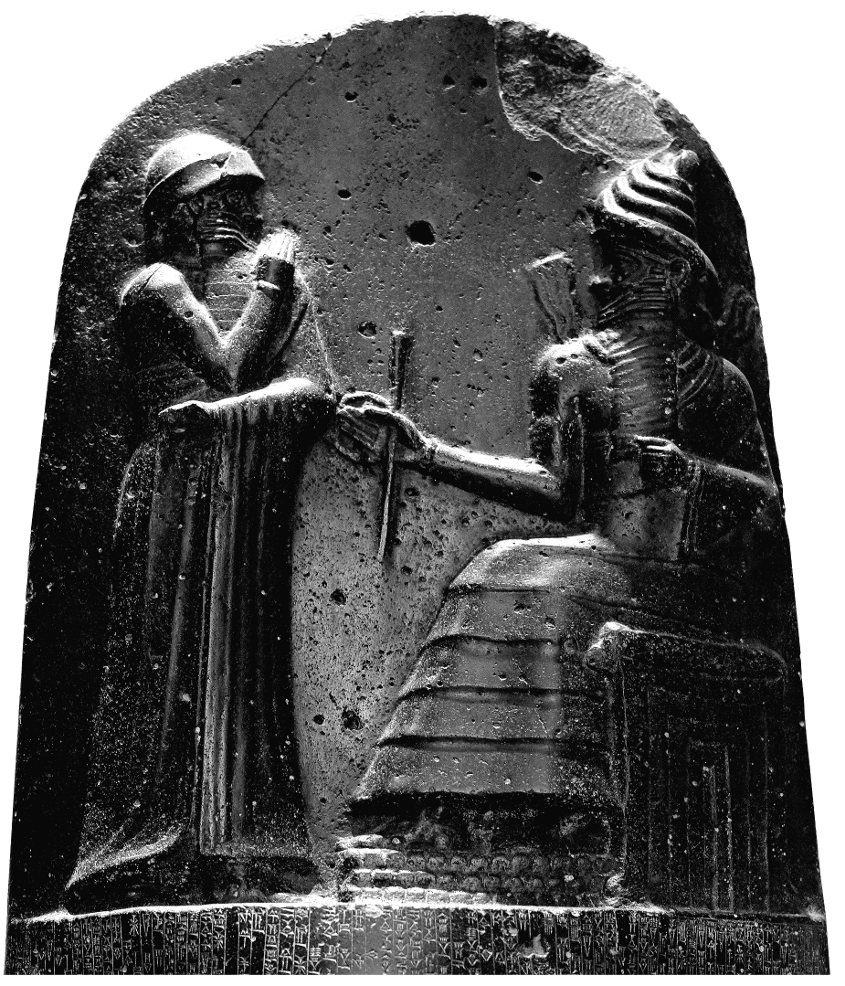 (11700 – 600BC) Located in present-day Iraq. Mesopotamia is referred to as the Cradle of Civilization, which emerged between the Tigris and Euphrates rivers, 3500BC. It is often characterized by the rise and fall of city-states and empires. This region is remembered for its advancement in agriculture, writing cuneiform, and its system of laws, the Code of Hammurabi.
Through the ancient lands, city-states like Sumer, Akkad, Babylon, and Assyria, all contributed to the rich cultural developments. The invention of writing and the wheel, to the creation of the first cities and empires. Innovations in mathematics, astronomy, and architecture, including monumental structures like Ziggurats.
Mesopotamia also has been regarded as a significant phase in human spiritual evolution, where the development of complex societies, marked the transition from ancient spiritual insights, to developing more organized forms of religion and individuality. From the Babylonian Epic Creation Story, Enuma Elish, to the Epic of Gilgamesh offers great insights into the spiritual world of ancient Mesopotamia,
Along with the the invention of writing, material consciousness of the period pushed forward urbanization, along with the ancient mystery schools aimed to guide individuals in realizing spiritual truths. These cosmic forces connected and allowed them to engage with the zodiac and unexplained celestial phenomena., This brought forward a profound advancement in self-consciousness and individuality. Over time the people became acutely aware of the interplay between the spiritual and material worlds.
Shedding light on the rise and fall of powerful empires this has allowed us to explore the complex political and social structures that governed these early societies, and the enduring legacy of Mesopotamian Civilization.
“He came to the gate of the city and encountered Enkidu, the wild man from the hills. They fought like bulls in the great courtyard, and the walls of the city trembled.” -Gilgamesh and Enkidu.
Mesopotamian Ancient Periods
- Ubaid Period: c. 5500 – 4000BC – Development of irrigation systems, early examples of pottery and mud-brick buildings, and the emergence of social hierarchy.
- Uruk Period: c. 4000 – 3100BC – Invention of writing – cuneiform, the development of cylinder seals, and the construction of monumental architecture, such as the Anu Ziggurat and the White Temple in Uruk.
- Early Dynastic Period: c. 2900 – 2350BC – Advancements in art and sculpture, the creation of the Stele of the Vultures – earliest known historical document, and the construction of the Ziggurat of Ur.
- Akkadian Empire: c. 2334 – 2154BC – Standardization of weights and measures, the spread of Akkadian language and culture, and the creation of the Victory Stele of Naram-Sin.
- Gutian Period: c. 2150 – 2050BC – Not much is known about this period, but it is believed to have been a time of cultural and artistic decline.
- Neo-Sumerian Empire (Ur III Dynasty) 2112 – 2004BC – Construction of the Ziggurat of Ur, advancements in mathematics and astronomy, and the creation of the Code of Ur-Nammu – one of the earliest known law codes.
- Old Assyrian Empire: c. 2025 – 1750BC – Development of a extensive trade network, particularly with Anatolia, and the establishment of the first Assyrian colonies.
- Old Babylonian Empire: c. 1894 – 1595BC – Creation of the Code of Hammurabi, advancements in mathematics and astronomy, and the flourishing of Babylonian literature, such as the Epic of Gilgamesh.
- Hittite Empire: c. 1650 – 1200BC – Development of iron metallurgy, the use of the chariot in warfare, and the establishment of a legal system based on the concept of “an eye for an eye.”
- Middle Assyrian Empire: c. 1365 – 1020BC – Expansion of the empire through military conquests, the development of a centralized administrative system, and the construction of the city of Kar-Tukulti-Ninurta.
- Neo-Assyrian Empire: c. 911 – 609BC – Creation of the Library of Ashurbanipal (the first systematically collected library), advancements in military technology and tactics, and the construction of the city of Nineveh.
- Neo-Babylonian Empire: c. 626 – 539BC – Construction of the Ishtar Gate and the Hanging Gardens of Babylon (one of the Seven Wonders of the Ancient World), and the development of the first known maps of the world.
- Achaemenid Persian Empire: c. 550 – 330BC – Standardization of weights, measures, and coinage; the construction of the Royal Road (an extensive highway system); and the development of a complex administrative system to govern the vast empire
“The life that you seek you will never find. When the gods created man they allotted to him death, but life they retained in their own keeping.” – Human struggle to accept mortality.” -Siduri, the tavern keeper.
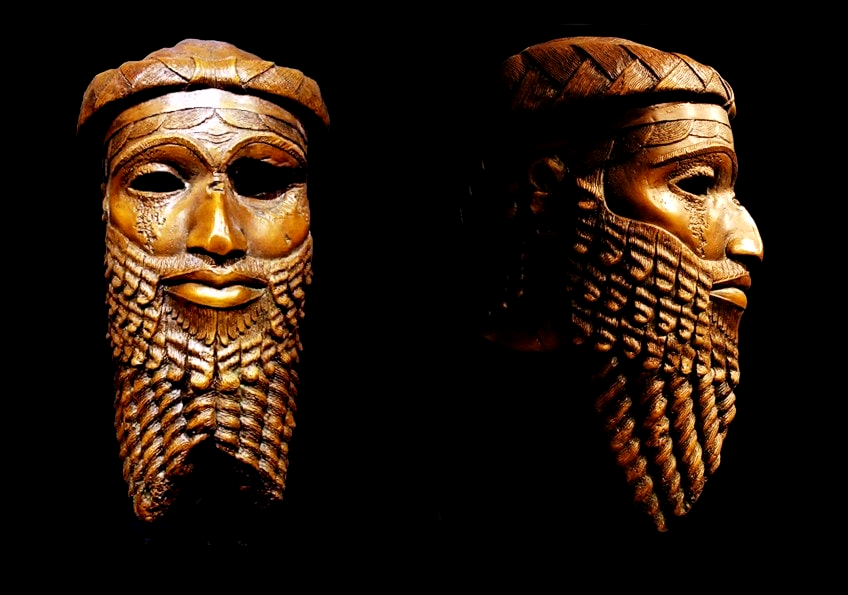
.
.These following five periods and events, represent significant developments and achievements in mathematics, writing, law, science, literature, and architecture, The preservation, of all knowledge, governance which has had a lasting impact on Mesopotamian civilization and the world.
Mesopotamian Historical Markers
Uruk Period -4000-3100BC – Invention of writing (cuneiform) which laid the foundation for the development of written communication and record-keeping, essential aspects of modern life. The rise of urbanization, which laid the foundation for the development of complex societies and the emergence of city-states.
Old Babylonian Empire -2000-1595BC – Creation of the Code of Hammurabi, one of the earliest and most complete law codes in history, which influenced legal systems in the region for centuries, and emphasized the concept of presumed innocence until proven guilty.
Neo-Sumerian Empire – 2112-2004BC – Advancements in mathematics and astronomy, including the development of the sexagesimal system (base 60), which is still used today for measuring time (60 seconds in a minute, 60 minutes in an hour) and angles (360 degrees in a circle).
Neo-Assyrian Empire – 911-609BC – Establishment of the first systematically collected library, the Library of Ashurbanipal, which preserved thousands of cuneiform tablets containing literary, scientific, and historical texts, demonstrating the importance of collecting and preserving knowledge, a practice continued by modern libraries and institutions.
Achaemenid Persian Empire – 539-331BC – Development of a complex administrative system to govern the vast empire, including the use of satraps (provincial governors) and a network of roads for efficient communication and transportation, which influenced the organization of later empires and modern nation-states.
“What you seek you shall never find, for when the gods created man, they kept immortality for themselves. Let your every day be full of joy, love the child that holds your hand, let your wife delight in your embrace, for these alone are the concerns of humanity.” -Siduri, the tavern keeper.
.
Mesopotamian Major Ancient Gods
Anu – The sky god and father of the gods, associated with authority and kingship.
Enlil – The air god and leader of the gods, responsible for creation and natural disasters.
Ea (Enki) – The water god, associated with wisdom, magic, and craftsmanship.
Inanna (Ishtar) – The goddess of love, beauty, fertility, and war, known for her complex character and relationships with other gods.
Utu (Shamash) – The sun god and god of justice, associated with truth, law, and order.
Nanna (Sin) – The moon god, associated with time, fertility, and the night.
Ninhursag – The earth and mother goddess, associated with fertility, growth, and birth.
Ereshkigal – The goddess of the underworld and death, ruling over the realm of the dead.
Marduk – The national god of Babylon, associated with creation, order, and the defeat of chaos.
Ashur – The national god of Assyria, associated with war, kingship, and the Assyrian empire.
.
.

Epic of Gilgamesh
The story of Gilgamesh is one of the oldest known written works of literature in the world. originating from ancient Mesopotamia around the year 2150BC. The story follows the journey of Gilgamesh, the arrogant king of Uruk, who is two-thirds divine and one-third human. Despite his strength and accomplishments, Gilgamesh feels a profound emptiness and dissatisfaction with his life, it seems he is taking his anger out on all those within his kingdom for this emptiness. The people pray to the Gods for relief. The Gods hear their cries and in turn they create a wild man named Enkidu to set Gilgamesh right. Enkidu hears of the immorality caused by Gilgamesh, eventually their paths cross and Enkidu challenges Gilgamesh to a fight, he plane is to teach Gilgamesh humility. After a long and protected fight the two become friends. This friendship transforms Gilgamesh and leads them together on a series of adventures that test their bravery and bond, including battles with divine beings and a quest for immortality.
As the narrative unfolds the quest for understanding the human condition are slowly realized. Loyalty, friendship, mortality, and the profound sadness of a great loss. As we follow Gilgamesh on his journey we too realizes the true lessons of immortality. The epic serves as a timeless meditation on the human experience, grappling with life, death, and the search for meaning.
.
Gilgamesh
“…He saw the deep, the secret heart of the land, and knew the secrets of the gods. King Gilgamesh, two-thirds god, one-third man, ruled with brutal strength in the mighty city of Uruk, his arrogance echoing through its towering walls. The people cried out under his harsh rule, their lives consumed by his demands. But then, the gods, hearing their pleas, crafted a wild man from the clay of the earth – a rival, a counterweight to Gilgamesh’s power. This creature, Enkidu, would challenge the king, and in their clash, a bond would be forged that would change the course of both their lives, leading them to the ends of the earth in search of immortality itself…”
.
.
Glossary
- Apsu: In ancient Mesopotamian mythology, Apsu is the god of freshwater and the husband of Tiamat. He is often associated with the primordial waters from which creation begins.
- Cuneiform: An ancient writing system used in Mesopotamia, characterized by wedge-shaped marks made on clay tablets with a stylus. It was one of the earliest forms of written expression.
- Enkidu: A central character in the Epic of Gilgamesh, Enkidu is created by the gods to be a companion and foil to Gilgamesh. Initially a wild man, his interactions with civilization lead to his transformation.
- Enuma Elish: A Babylonian creation myth that outlines the origins of the world and the rise of the god Marduk. It describes the battle between Marduk and the primordial goddess Tiamat and the subsequent creation of humanity.
- Gilgamesh: The protagonist of the Epic of Gilgamesh, he is a semi-divine king of Uruk, known for his extraordinary strength and adventures, including his friendship with Enkidu and his quest for immortality.
- Marduk: A major god in Babylonian mythology, Marduk is associated with wisdom, magic, and the storm. He becomes the chief deity after defeating Tiamat and is credited with creating the world.
- Sumer: An ancient civilization in southern Mesopotamia, known as one of the earliest urban societies. It is marked by significant developments in writing, governance, and culture.
- Tiamat: A primordial goddess of the saltwater ocean in Mesopotamian mythology, often depicted as a dragon or serpent. She personifies chaos and is defeated by Marduk in the Enuma Elish.
- Utnapishtim: A character in the Epic of Gilgamesh who survived a great flood and was granted immortality by the gods. He serves as a wise figure who imparts knowledge about the flood and the nature of life.
- Ziggurat: A massive terraced structure built in ancient Mesopotamia, typically serving as a temple or religious site. Ziggurats were designed to connect heaven and earth and were central to Sumerian, Babylonian, and Assyrian cities.
Lecture
On Friday, 17 January at 7 PM, Professor Burke will give a lecture on Mesopotamia. He will cover the following points: Ancient Periods. Lasting innovations we still use today. and [Religious overview & transition] Along with Gilgamesh the worlds oldest written story.
At the end of the presentation, there will be time for questions, answers, and a discussion from members of the audience and those who continue to study and practice a number of the religions and their history.
Professor Burke will also have his books available for purchase in the lobby, and he is always happy to sign copies for those who wish a remembered greeting. His lectures are free, but donations to the History and Philosophy Club are always welcomed.
If you are interested in Epic Poetry, at the Tè Chay Tea Room every Sunday, from 6PM unit; 9:30 PM a chapter or two is read from one of the Ancient Epic Poems or Stories. Feel free to drop in, listen or read out loud. Gilgamesh usually makes his way through at least once a year..
.

.
“May you ascend to the sky, may you traverse the firmament, as Osiris has done,” – Pyramid Text – the king becomes a star
.
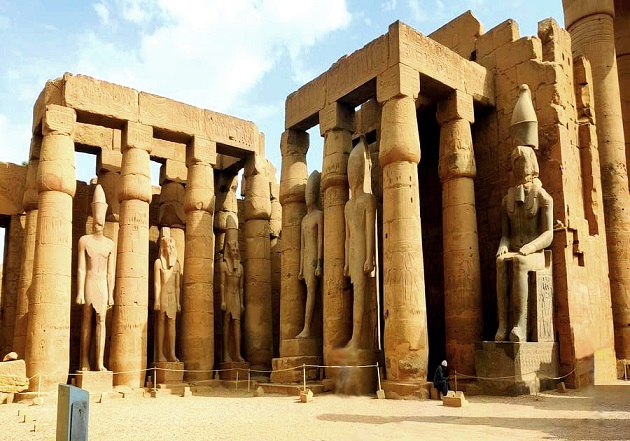
.~Egypt – Land of the Pharaohs
Egypt, an ancient civilization deeply rooted in immortality through its connection with the afterlife in the cosmos. It’s cultural development is reflected in its grand architecture that expresses its earthly strength and captivates our imaginations through its awe-inspiring pyramids and monumental sculptures: the Great Pyramids of Giza and the temples of Karnak and Luxor.
From the unification of the Upper and Lower Egypt Nile River Valleys, the rise and fall of the pharaohs, to the reign of Cleopatra, this civilization’s journey through time is marked by political, social, and religious developments that shaped its history and from the pantheon of gods and goddesses to their elaborate burial practices ignites out imaginations in new and mysterious ways.
.
.
Egypt Ancient Periods
- Predynastic Period: c. 6000 – 3100BC.
Naqada I & II: Early developments in pottery, agriculture along the Nile, and the beginnings of social stratification.
Naqada III (Protodynastic Period): Emergence of unified symbols like the Narmer Palette,,indicating the start of royal power centralization. - Early Dynastic Period: c. 3100 – 2686BC.
First and Second Dynasties: Establishment of Memphis as the capital, the construction of the first mastabas, and the beginning of dynastic rule with King Narmer (Menes). Hieroglyphic writing starts to evolve. - Old Kingdom: c. 2686 – 2181BC.
Third to Sixth Dynasties: Known as the “Age of Pyramids”, including the Step Pyramid of Djoser, the Great Pyramids of Giza, and the Sphinx. This period sees significant advancements in architecture, art, and administration. - First Intermediate Period: c. 2181 – 2055BC
A time of political instability, decentralization, but also cultural richness with local rulers (nomarchs) gaining power. Literature like “The Admonitions of Ipuwer” reflects social upheaval. - Middle Kingdom: c. 2055 – 1650BC
Eleventh to Twelfth Dynasties: Reunification under Mentuhotep II, the construction of the mortuary temple at Deir el-Bahri, and increased control over Nubia. This period is known for literature, like “The Tale of Sinuhe”, and the establishment of a more centralized bureaucracy. - Second Intermediate Period: c. 1650 – 1550BC
Dominated by the Hyksos, who introduced new technologies like the horse-drawn chariot, leading to significant cultural exchanges but also conflict. - New Kingdom: c. 1550 – 1077BC
Eighteenth to Twentieth Dynasties: Egypt’s imperial phase with the expansion into Nubia and the Levant, monumental constructions like the Karnak Temple, and the reigns of famous pharaohs like Hatshepsut, Thutmose III, Akhenaten, and Ramesses II. - Third Intermediate Period: c. 1077 – 664BC
A period of division with the rise of the High Priests of Amun in Thebes, the Libyan and Nubian dynasties, and the eventual Assyrian invasion. - Late Period: c. 664 – 332BC
Characterized by Persian rule, the Saite Renaissance under Psamtik I, and the final pharaonic dynasties before the conquest by Alexander the Great. - Ptolemaic Period: c. 332 – 30BC
Greek influence with the establishment of the Ptolemaic dynasty, leading to the Hellenistic culture blending with Egyptian traditions, culminating with Cleopatra VII. - Roman Period: 30BC – AD 395
Egypt becomes a province of Rome, with significant changes in administration, culture, and religion.
“O King, you are this great star, the companion of Orion, who traverses the sky with Orion, who navigates the Duat with Osiris.” =Unas Pyramid, Utterance 267
.
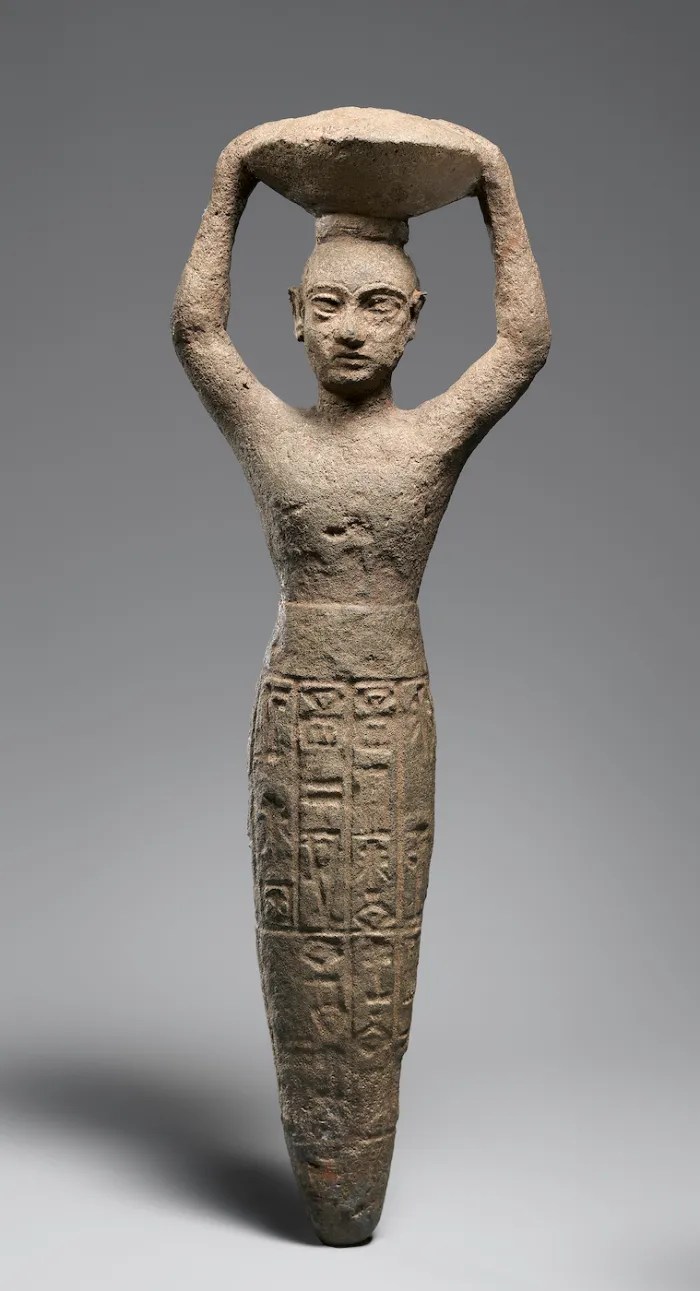
.
Egypt Historical Markers
Development of Hieroglyphics and Writing Systems
Period: Predynastic to Early Dynastic.
Significance: Hieroglyphics not only served as a means of communication but also played a crucial role in religious, administrative, and historical documentation. The evolution from hieroglyphics to hieratic and later demotic scripts shows a sophisticated understanding of language and its utility in governance and culture.
Construction of the Pyramids
Period: Old Kingdom.
Significance: The pyramids, especially those at Giza, are monumental achievements in architecture and engineering. They represent the pharaoh’s divine status and the belief in the afterlife, encapsulating the peak of pyramid-building technology and organization
The Amarna Period and Akhenaten’s Religious Reforms
Period: New Kingdom.
Significance: Pharaoh Akhenaten’s attempt to establish Aten as the sole deity, moving the capital to Amarna, represents one of the earliest known instances of monotheism or at least henotheism in history. This period, although brief, influenced art, religion, and politics, showing the potential for radical change in deeply entrenched religious practices.
The Reign of Hatshepsut and Her Expedition to Punt
Period: New Kingdom.
Significance: Hatshepsut, one of the few female pharaohs, is notable for her successful reign marked by peace, prosperity, and monumental building projects. Her expedition to Punt brought back exotic goods and is one of the best-documented trade missions in ancient history, highlighting Egypt’s maritime capabilities and international relation.
The Rosetta Stone
Period: Ptolemaic Period.
Significance: While not an event from the height of Egyptian power, the Rosetta Stone’s discovery in 1799 was pivotal for modern understanding of ancient Egypt. Inscribed with a decree in three scripts (Hieroglyphic, Demotic, and Greek), it provided the key to deciphering hieroglyphics, thereby unlocking thousands of years of Egyptian history and culture to contemporary scholars...These selections highlight Egypt’s contributions to human civilization in areas like writing, architecture, governance, religion, and cultural exchange, influencing not only its own history but also the broader narrative of human progress.
“I am he who knows, I am one with the sun, I am the crocodile who dwells in the terror of the night.” –Book of the Dead (The Book of Coming Forth by Day):
Spell 17
.
.
Ancient Egyptian Texts
The Pyramid Texts
Content: These are the oldest religious texts in the world, dating back to the Old Kingdom (c. 2400-2300BC). Inscribed in the pyramids of pharaohs like Unas, they contain spells, hymns, and rituals meant to aid the deceased king in his journey to the afterlife.
Relevance: They mention Ra extensively, with spells to ensure the king’s transition to join Ra in the sky, and references to Horus as the protector of the king who is likened to Osiris.
The Coffin Texts
Content: Developed during the First Intermediate Period and Middle Kingdom (c. 2134-1782BC), these texts were inscribed on the coffins and burial chambers of non-royals, democratizing access to afterlife literature.
Relevance: They expand on the themes from the Pyramid Texts, including more detailed narratives about the gods. You’ll find spells involving Isis’s magic, Set’s challenges, and Horus’s role in protecting the dead.
The Book of the Dead
Content: Also known as the “Spells of Coming Forth by Day,” this collection of spells, prayers, and illustrations from the New Kingdom (c. 1550-1077BC) through the Late Period, was meant to help the deceased navigate the afterlife.
Relevance: It includes numerous references to all these deities. For instance, Chapter 175 deals with the myth of Isis and Osiris, while the “Hymn to Ra” (Chapter 15) celebrates Ra. Horus and Set are often invoked for protection or in relation to judgment in the afterlife.
The Contendings of Horus and Seth
Content: A New Kingdom mythographic text found in the Chester Beatty Papyrus I, it recounts the legalistic battle between Horus and Set for the throne of Egypt after Osiris’s death.
Relevance: This text is crucial for understanding the complex relationship between Horus and Set, showing a more nuanced view of Set, and the themes of order vs. chaos, justice, and divine kingship.
The Papyrus Jumilhac
Content: From the Ptolemaic period, this document discusses various myths, including those of Osiris, Isis, and their sons, with a particular focus on Set’s portrayal in Upper Egypt.
Relevance: It provides insights into regional variations in the worship of Set and the ongoing narrative of the Osiris myth, including lesser-known aspects of these gods’ interactions.
The Memphite Theology (Shabaka Stone)
Content: A late 8th-centuryBC text inscribed on a stone by Pharaoh Shabaka, it deals with creation myths and the roles of various deities, including Ra, in the cosmological order.
Relevance: Although not exclusively about these four deities, it provides context on Ra’s primacy and his role in the creation myth, which is foundational to understanding Egyptian theology.
“I have not done evil to mankind. I have not oppressed the members of my family.” –Book of the Dead –(A declaration of identity and power in the afterlife) Spell 125:
.
.
.
.
.
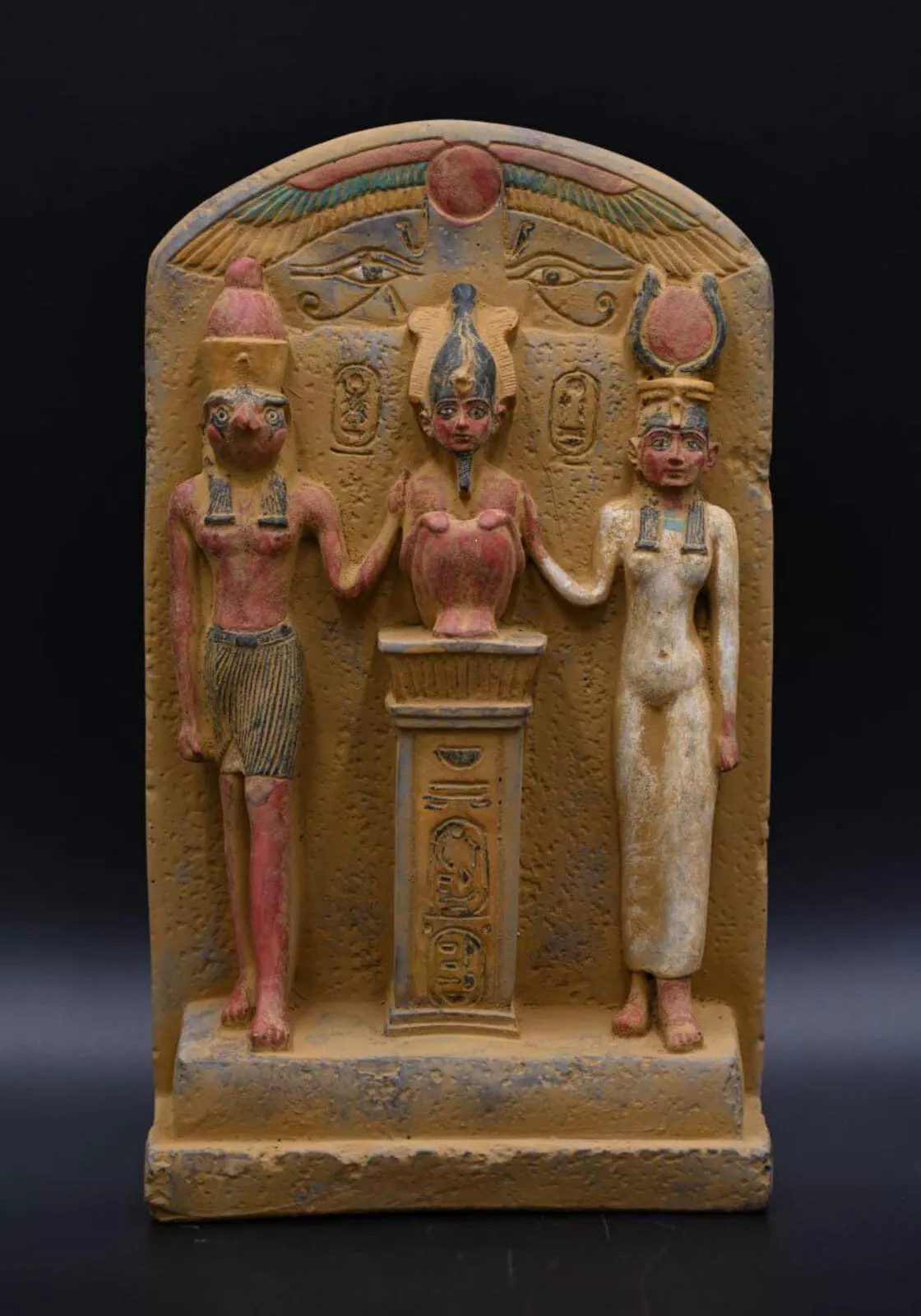
The Eternal Cycle of Life and Divinity
In the beginning, before time itself, there was only Nun, the primordial waters of chaos. From this formless void, the sun god Ra emerged, creating light and bringing order to the chaos by rising from the waters on the sacred mound of creation. Ra, in his many forms, became the creator god, fashioning the world and its inhabitants with his will, setting the sun, moon, and stars in their paths.
From Ra’s union with the sky goddess Nut or through his own self-begetting, came forth the first divine family. Among them was Osiris, who became the first king of Egypt, ruling with wisdom and justice, teaching men agriculture and civilization. His sister-wife, Isis, was the embodiment of magic and healing, protector of the pharaoh, and the ultimate symbol of motherhood and devotion.
But darkness came when Set, the god of chaos, storms, and the desert, driven by jealousy, murdered Osiris. He dismembered his brother’s body, scattering the pieces across Egypt to prevent his return. Here, Isis’s love and magic shone; she searched for Osiris’s remains, piecing him back together with the help of her sister Nephthys and Anubis, the god of mummification. Through her magic, she conceived their son, Horus, even after Osiris’s death.
Horus grew under the protection of Isis, embodying the falcon and the sky, destined to avenge his father and claim his rightful throne. The epic struggle between Horus and Set for the kingship of Egypt became legendary, representing the eternal battle between order and chaos, good and evil. Eventually, through trials and divine intervention, Horus was declared the rightful ruler, symbolizing the triumph of order and the restoration of ma’at (cosmic harmony).
Osiris, now in the afterlife, ruled the underworld, becoming the judge of the dead, ensuring the cycle of life, death, and rebirth. His resurrection was a promise of eternal life for all who followed the path of righteousness, and his myth became central to Egyptian spirituality, symbolizing hope and transformation.
Ra, meanwhile, continued his daily journey across the sky, dying each night to battle chaos in the underworld, only to be reborn at dawn, ensuring the continuation of life. This daily cycle mirrored the larger theme of death and rebirth seen in Osiris’s story.
Isis, revered for her wisdom, magic, and devotion, became one of the most worshipped deities, not just in Egypt but across the ancient world, symbolizing the ideal of the protective, nurturing mother.
.
.
Major Egyptian Deities
Amun – Creator god, later merged with Ra to become Amun-Ra.
Anubis – God of mummification and the afterlife.
Bastet – Goddess of home, fertility, and cats.
Hathor – Goddess of love, beauty, music, dance, and motherhood.
Horus – Sky god, god of kingship and protection, often depicted as a falcon or falcon-headed man.
Isis – Goddess of magic, motherhood, and healing.
Nephthys – Sister of Isis, protector of the dead, and goddess of mourning.
Osiris – God of the afterlife, resurrection, and fertility.
Ptah – Creator god, patron of craftsmen, particularly from Memphis.
Ra (Re) – Sun god, central to the Egyptian pantheon.
Sekhmet – Goddess of war, healing, and protection, often depicted as a lioness.
Set – God of chaos, storms, and foreigners, known for his conflict with Horus.
Thoth – God of wisdom, writing, science, and magic, often with the head of an ibis.
“Your soul flies to the sky; your body lies in the earth; your body is Osiris, your soul is Ra.” – Unas Pyramid, Utterance 217
.
.
.
.
- Ankh: A symbol resembling a cross with a loop at the top, the ankh represents life and immortality in ancient Egyptian culture. It is often depicted in the hands of gods and pharaohs.
- Duat: The Duat is the ancient Egyptian underworld, a realm that the dead would journey through after death. It was believed to be a place filled with various challenges and tests before a soul could achieve immortality.
- Heka: Heka refers to the ancient Egyptian concept of magic or the magical powers that could be harnessed by the gods and humans alike. It is also associated with the god of magic, Heka, who was believed to protect the pharaohs.
- Ka: In ancient Egyptian belief, the ka is one of the components of the human soul, representing the life force or spiritual essence of a person. It is thought to live on after death and requires sustenance in the afterlife, often provided by offerings made by the living.
- Ma’at: Ma’at is the ancient Egyptian concept of truth, balance, order, and justice. It is personified by the goddess Ma’at, who was often depicted with an ostrich feather. Living in accordance with Ma’at was essential for maintaining cosmic order and harmony.
- Nome: A nome was a geographic and administrative division in ancient Egypt. Each nome had its own capital city, local deities, and governance, and they played an important role in the organization of society.
- Nun: Nun is the primordial waters in ancient Egyptian mythology, representing chaos and the abyss from which the world was created. It is often depicted as a watery expanse and is considered the source of life.
- Obelisk: An obelisk is a tall, four-sided, narrow tapering monument with a pyramidion on top, often erected as a commemorative monument. Obelisks were usually inscribed with hieroglyphs and symbolized the sun god Ra.
- Papyrus: Papyrus is a plant-based material used in ancient Egypt for writing and making scrolls. The plant grows in marshy areas and was vital for documenting everything from administrative records to literature.
- Scarab: The scarab beetle (Scarabaeus sacer) was a symbol of regeneration, rebirth, and protection in ancient Egyptian culture. It was often associated with the sun god Ra and the cycle of life, and scarab amulets were commonly used for protection in burial practices.
“The doors of the sky are open for you; the doors of the firmament are thrown open for you.” -Unas Pyramid, Utterance 302
.
.
.
The Great Nile River
The people celebrate the clear waters that fills their pots, it quenches thirsty seeds, while it glistens in the sun, traveling long and far, connecting each to the other. The flood turns fields green, fig ripen sweet, cattle fatten, the waters swell over its banks, filling the baskets for feast and plenty. The children bask in its cool waters, it heals, gives relief and breaks all hunger.
“You are the one who makes barley and brings emmer into being, you are the lord of fish, who makes the birds take wing to the marshes.”
“When you come, O Nile, the earth is in jubilation; men, gods, and all creatures rejoice.”
“Hail to you, O Nile, who manifests himself over this land, and comes to give life to Egypt!” -=Hymn to the Nile, c. 2100BC.
.
.
..
The Sphinx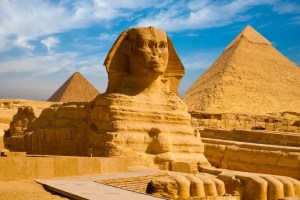
The Great Sphinx of Giza
The Sphinx, located on the Giza Plateau in Egypt near the Pyramids of Giza, is approximately 73 meters (239 feet) long and 20 meters (66 feet) high, making it one of the largest statues in the world. The Sphinx has the body of a lion and the head of a human, traditionally believed to represent Pharaoh Khafre. Carved from limestone, its features have eroded over time, giving it a damaged appearance.
Historically, the Sphinx is believed to have been built during the reign of Pharaoh Khafre, around 2500BC, although some scholars suggest it could date back even earlier. The statue is associated with the sun deity Ra and is thought to have served as a guardian of the Giza Plateau, protecting the tombs of the pharaohs.
Culturally, the Sphinx is often linked to various myths and legends, including those involving the riddle of the Sphinx in Greek mythology, though this is not directly related to the Egyptian Sphinx. It has been a symbol of strength and wisdom throughout history and remains an iconic representation of ancient Egypt.
To preserve the Sphinx, various restoration efforts have been undertaken due to erosion and damage from environmental factors and human activity. Archaeological studies continue to be conducted to learn more about its construction and history. Many mysteries and theories have been the subject of speculation regarding its purpose, the identity of its face, and the meaning of its construction. Some theories suggest the Sphinx may align with astronomical events or may have served a more complex religious or ceremonial role. The Great Sphinx of Giza has captured the imagination of various thinkers, mystics, and scholars over the centuries.
.
The Riddle of the Sphinx in Greek Mythology
In classical Greek mythology, the Sphinx is depicted as a creature that poses a riddle to travelers, famously exemplified in the story of Oedipus. The riddle goes: ‘What walks on four legs in the morning, two legs at noon, and three legs in the evening?’ The answer is ‘a human’—referring to the stages of life: as a baby (crawling on four legs), as an adult (walking on two legs), and in old age (using a cane as a third leg). This riddle symbolizes the journey of life and the quest for knowledge. While this riddle is a Greek interpretation, the essence of riddles and mysteries connected to the Sphinx signifies a challenge to human understanding and the search for deeper truths.”
.
Mystical and Esoteric Interpretations of the Sphinx
The Sphinx as a symbol of humanity’s spiritual evolution and the synthesis of opposites. The lion (representing strength) and the human head (representing intellect) are seen as the dual nature of humanity that needs to be harmonized. Some believe the Sphinx hold deep esoteric knowledge about the human soul’s journey and the connections between the physical and spiritual worlds.
It is thought that ancient Egyptian civilization possessed profound spiritual insights that have largely been lost. Mystical and Esoteric Interpretations such as the mystery Initiation, a deeper quest for self-knowledge and understanding of one’s place in the cosmos. Further esoteric studies in symbolism see the Sphinx as representing the guardian of ancient wisdom and knowledge, that the Sphinx symbolizes the mysteries of life and the spiritual journey of humanity.
These interpretations propose that the Sphinx signifies the need for humanity to seek out hidden truths and to interpret the symbols of the past, suggesting that ancient cultures, including Egyptian civilization, understood the interconnectedness of the physical and spiritual worlds, and the Sphinx served as a key to unlocking these truths—a connection to ancient wisdom.
The Great Sphinx of Giza serves as a potent symbol of the quest for knowledge and the mysteries of existence. Its significance goes beyond physicality – it as a representation of spiritual truths and human evolution. It invite us to consider the riddle of existence itself—a reflection on the journey through life and the pursuit of deeper understanding..
.
.
Lecture
On Friday, 24 January at 7 PM and Saturday, 18 January in the afternoon at 4PM, Professor Burke will give two lecture on Ancient Egypt. He will cover the ancient periods, profound innovations and the deeper meaning of the ancient Egyptians mysteries including: Ra, Osiris, Isis [Aset], Set and Horus. He will go over the Pyramids of Giza, Great Pyramid of Khufu, Pyramids of Khafre and Menkaure, along with the great mystery of the Sphinx.
At the end of the presentation, there will be time for questions, answers, and a discussion from members of the audience and those who continue to study and practice a number of the religions and their history. Each lectures will run about 2 to 2.5 hours.
Professor Burke will also have his books available for purchase in the lobby, and he is always happy to sign copies for those who wish a remembered greeting. His lectures are free, but donations to the History and Philosophy Club are always welcomed.
“May my soul come forth to walk wherever it pleases.” –The Papyrus of Ani, Chapter 15
.
.
.
TBC (move to July save Mysteries)
.~The Greeks
“As above, so below, and I in the middle, the perfect balance. These are the Greeks.”
Prepare for a change in consciousness
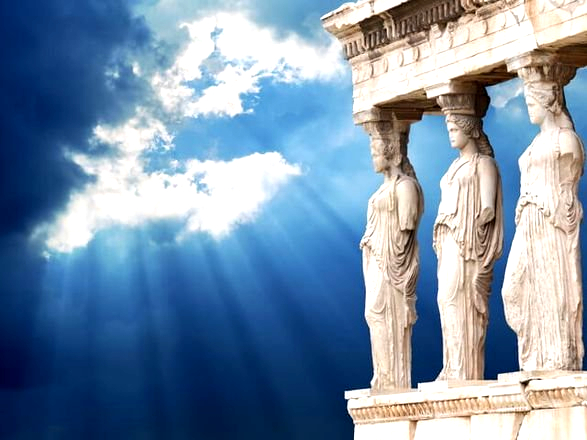
.
.
.
.
ROME
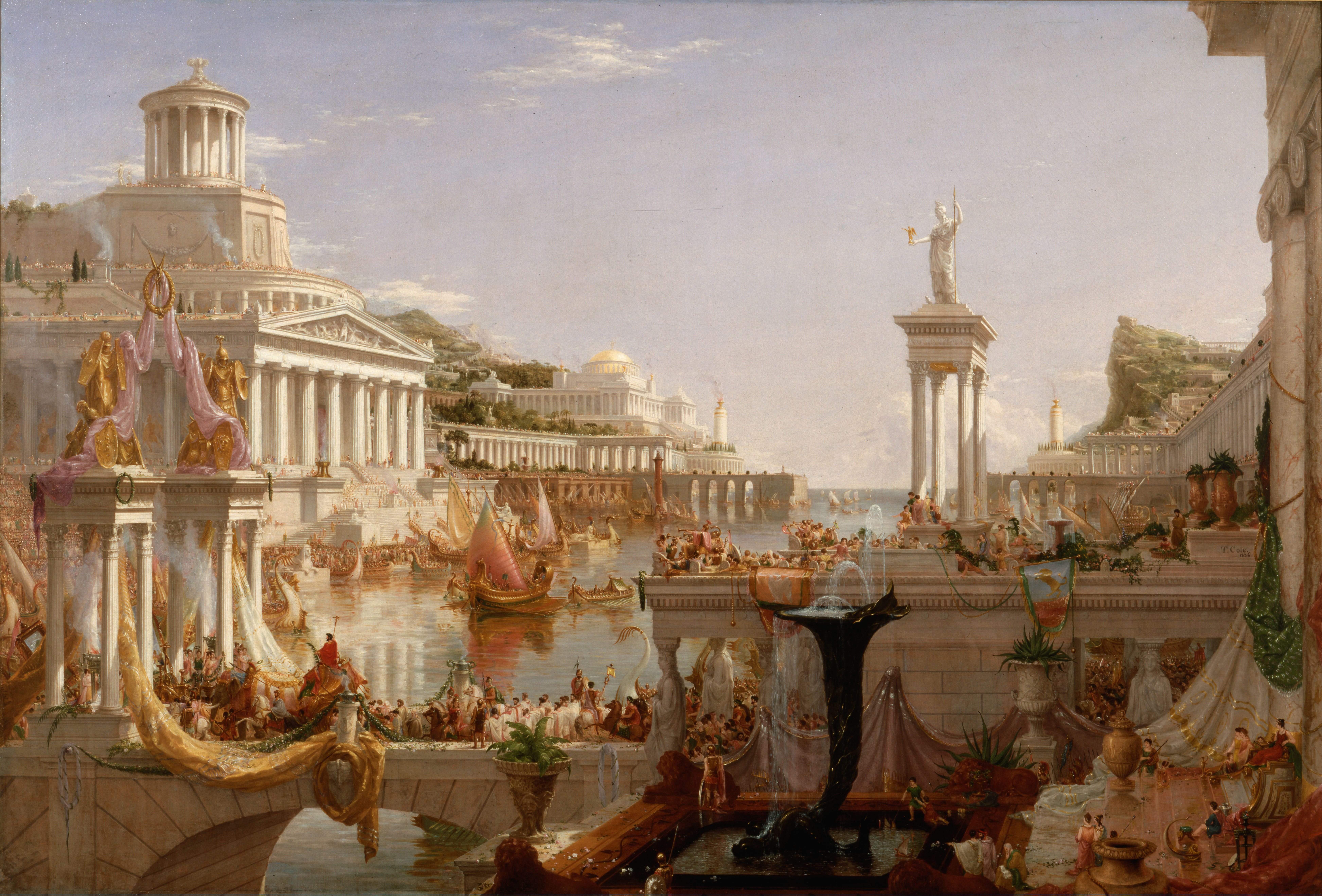
move to august
.
~Rome: Rise and Fall of an Empire
~Rome – 500BC
Rome: The Empire of Innovation chronicles the rise and fall of the ancient Roman Empire, from its humble beginnings as a small city-state to its transformation into a vast and powerful empire. This text explores the political, social, and technological developments that shaped Roman history, examining the establishment of the Roman Republic, the rise of Julius Caesar, and the Pax Romana under the emperors Augustus and Marcus Aurelius. The book delves into the remarkable engineering feats of the Romans, from the construction of aqueducts and roads to the creation of monumental architecture like the Colosseum and the Pantheon. Rome: The Empire of Innovation is a testament to the enduring legacy of Roman civilization and its impact on the world.
Ancient Rome:
Cleopatra VII in 30
.
.
.
.
.
.
From Darkness to Light
The days grew dark and on the solstice the darkness reached its depth and the sun stood still. Yet, the spark collected during Martinmas becomes a bright flame on Christmas Eve and though the darkness holds for ten days, the light within shines ever brighter, leading the way during the holy nights. Then, on the 1st of January, we see the movement of the sun once again as it starts to rise, the slow gesture towards the Spring Equinox. Ever so slight, the plants and trees begin their reluctant awakening. Meanwhile, man is ever clear in his thinking and wide away.
The Great Mysteries Destroyed by Materialism
According to St Augustine, Christianity existed before Christ arrived. He states a sect originated out of the Second Temple, a new form of Judaism. These were also the people who recognized The Christ Jesus [Lamb of God] when he began his ministry.
St Augustine wrote that Christianity existed before the coming of Christ. Jesus said that the wise people of old had been Christians though they were not yet called such.
It is tremendously significant that Christ Jesus openly revealed a Christianity that had already existed in the ancient Mysteries at a time when the Mysteries no longer survived. Further, that Christianity had been part of ancient paganism and that this too had also been lost to materialism, simply destroyed.
Therefore, an event needed to happen, uniting the entire world once and for all, for the whole earth needed a unified awareness.
Many things which Humanity had already discovered, the wise initiate of old saw in his own destiny reflected in the image that every spring represented the resurrection of the human God who had died.
He would say, “What I must become, I must develop wisdom within me. A wisdom that allows me to say, death only has significance for the part of me that has come into being through the forces of nature, and not the part of me that arose on a later occasion, something of which I have gained through my own human powers.’
Self-actualization. Purpose.
During early Christianity, people said to themselves, “To be a mortal human being, one must awaken the soul in themselves, then they will truly be immortal.’
A false view cannot go against this, but there was a false view that did fight against it. In the early centuries, the people who spread Christianity would say, ‘We must nurture the human soul so that it does not die.” Later the church preached as different view, a materialistic view, the church wanted to do this for them. They diminished the spirit in order to care for their eternal soul. This eventually caused a split in the church and many wars. Even today, this issues has not been resolved.
.
.
.
.
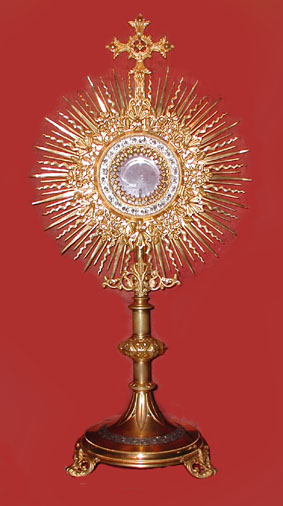
Monstrans – [LT: To show] A monstrance is a ciborium that inspires a sense of awe due to its extraordinary size. The vessel is used to display the consecrated Host allowing the —body of Christ— to be seen. There is a window, a central glass section that holds the Host, this allows the Host to be viewed during the Eucharistic adoration. The designs can vary, with some being made from precious metals with intricate details.
The purpose of a monstrance is to facilitate adoration by the faithful, enabling them to engage in prayer and contemplation in the presence of the Eucharist. It serves as a focal point for devotion and reverence. During adoration, the monstrance is placed on the altar, hymns, prayers, and periods of silence foster a deep spiritual experience for the faithful.
This practice emphasizes the real presence of Christ in the sacrament.
.
.
.
.The Sun’s Victory Over the Moon
Universal – the Sun embodies spiritual illumination, knowledge, while the Moon symbolizes the material world, illusion, Maya, and the astral plane. The Sun symbolizes spiritual enlightenment, clarity, knowledge and the divine spirit. The Moon represents the soul, intuition, and emotional life. The Sun’s victory over the Moon signifies the triumph of higher consciousness and spiritual awareness over the Moon’s forces of instinctual and emotional aspects of human life.
The Cosmic Forces push forward human spiritual evolution. In the path of the Sun, man’s spiritual development transcends his lower desires and seeks enlightenment and a greater purpose. The Sun represents a higher force, it brings forward the power of creation, while the Moon reflects, and obscures, that light. Thus, victory embraces the spirit, morality, the divine essence, and osmic knowledge, over emotionality, instinct, temporal material existence, and the illusion of the physical world.
Inner Transformation – The pursuit of higher consciousness encapsulates the journey of the soul as it ascends from the lower realms of existence, captured by the Moon, to the spiritual awakening of the Sun. In other words, overcoming the Moon Forces of sciolism, through knowledge and the wisdom of the Sun Forces. The victory of the Sun over the Moon is a universal principle and truth. This is where light, understanding, and divinity prevail over darkness, ignorance, and emotional turmoil.
The Principle of the Father, Son, Spirt
In Christian doctrine refereed to as the Holy Trinity, one God existing in three persons: God the Father, God the Son, and God the Holy Spirit.
Rome – Protestants
Nature renewed in the spring , it is also true of the soul and spirit.
Once Born – born to the powers of the Moon.
Twice Born – born to the powers of the Sun.
Rituals developed, recapitulating the birth, life, and death of the man and the Godhead.
‘The Savior has risen for us again.’ “Christ is risen” is “Χριστός ἀνέστη!” (Khristós anésti!) and “truly he is risen” is “Ἀληθῶς ἀνέστη!” (Alethós anésti!).
.
.
.
.
.
.
To understand the Gnostics one must have a background in Greek Philosophy, especially the works of Plato. The concept of dualism, the ideal realm beyond the physical world, and the pursuit of spiritual knowledge, “gnosis,” are central tenets in Platonic and Gnostic thought. The author and organizer of the original Catholic Bible, both OT and NT, was the Church Father, St Augustine, Bishops of Hippo, who was himself a Neoplatonists, blessed with the vision of Christ Jesus and the holy Spirit.
.
willing, thinking and feeling
 The Gnostic
Gnosticism
Gnosis – hidden knowledge
Hylic (from Greek ύλη (hylē) “matter”) material – also called Somatics (from Gk σώμα (sōma) “body”), completely bound to matter. Somatics were deemed doomed, incapable of understanding. They were the lowest order of the three types of human. Falling into corruption.
Psychic and hylics from Greek ψυχή (psychē) “soul”) bound to matter/animal. However, through the Sophia Divine the Spark lingers within the soul. Animal souls of necessity rest forever with the Demiurge in the intermediate place, elemental being are higher, yet, still inferior to the pneumatic.
Pneumatics (from Gk πνεύμα (pneuma) “spirit, breath” spiritual open to secret knowledge. The highest order of humans, escaping the doom transcendent knowledge. Some are by nature good, and others by nature evil. The good are those who become capable of receiving the [spiritual] seed [and becoming pneumatic]. The evil by nature are those who are never able to receive that seed [and become hylic].
Achamoth, being disciplined, and nourished here from that time until now in righteous souls, perfection, shall be given as brides to the angels of the Savior.
firmitas, utilitas, venustas
strength, utility, and beauty.
initiation is the augmentation of thing feeling willing
.the 4th element is a gift = human being – a harmony of all 3 above = wisdom
thinking = sage/magi
feeling = health/healing
willing = wizard-magus/phenomenon
European mystery centers had a group of 12 with the 13th being in harmony/wisdom
==
wasp divine artistry – wisdom / paper
.
Plato’s Four Virtues
These virtues are also connection to the body and one’s disposition.
1. wisdom/ethics – the brain – opposes egotism and materialism or if consumed by both this equates to thoughtlessness, ignorance/
2. courage – heart – a weak heart means cowardice. You have to have Christ in your heart to be courageous.
3. temperance – organs, moderation – weak in moderation means quick to anger, generally violent, will cause organ maladies problems later in life, via any excess.
4. justice – to stand upright – justice is fleeting, it comes in only at one moment when a child stands up right, watch your posture, be weary of people who are bent over. When you speak stand upright and justice will flow through you words. Anyone who uses these for ill-gotten gains will pay a heavy price. What made me think of the virtues was Elonis words, he is a coward.
-wisdom/ethics – brain – opposes egotism and materialism
-courage – heart, stays with you through all incarnations
-temperance – organs, moderation
-justice – upright – childhood
.
.
the blood & the heart
the brain
then limbs
.
.
[TBC]
.
.p;
Mithraic Mysteries – 1st CenturyBC – 4th Century AD.
Monad, Spiritual Creator – Philosophical concepts that date back to ancient philosophies. A term often used in Neoplatonism from the 3rd Century AD.
Demiurge, Material World Creator – In Plato’s dialogues, “Timaeus,” the “Demiurge” refers to a divine craftsman shaping and creating the physical world, essentially, the “material world creator,” by utilizing pre-existing matter and drawing inspiration from perfect Forms in the realm of Ideas; the word “Demiurge” translates from Greek as “craftsman.”
Ennoia – Rebellious angels as a trap for the spiritual – Gnostic texts from the 2nd Century AD.

Archontics, Ophites, Sethians – Gnostic sects emerging in the 2nd Century AD.
Gospel of Thomas – circa 50–100 AD. Found in Nag Hammadi in 1945.
Nag Hammadi – Discovered in 1945, but the texts date back to the 2nd century AD
Manichaeism – Mani, “Apostle of Light” or “Supreme Illuminator” Dualism
Neoplatonism – 3rd Century AD.
Arianism v Homousian – Debated primarily in the 4th Century AD.
Montanism – 2nd Century AD. Also called Cataphrygian heresy, or New Prophecy, a heretical movement founded by the prophet Montanus that arose in the Christian church in Phrygia, Asia Minor, in the 2nd century. Subsequently, it flourished in the West, principally in Carthage under the leadership of Tertullian in the 3rd century.
Constantinople – First Council of Constantinople in 381 AD. In 381 the First Council of Constantinople added an article to the Nicene Creed that described the Holy Spirit as proceeding from the Father. This article address what was being called heresies since the Council of Nicaea in 325. This article makes the spirit non-existent, that man is only made up of body and soul. This article contributed greatly to the split between the Western and Eastern Churches.
Rejected the OT ???
Archontics, Ophites, Sethians –
Apocrypha of John –
.
.
Revitalizing Catharism –
.
.
.
.
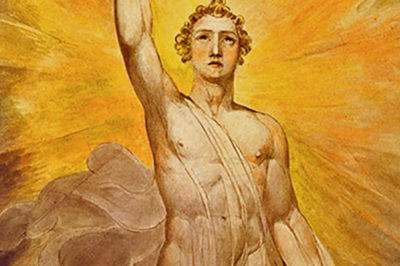
“We are lovers of the beautiful, yet simple in our tastes, and we cultivate the mind without loss of manliness. We employ wealth when there is a real use for it, and we regard poverty as no disgrace. The disgrace is to do nothing to avoid it.” –Pericles
.
A Society of Trust – “When you love your people and your culture, you respect life and life is natur. Every folk spirit develops a culture – language/health, philosophy/religion, arts/skills, work/education, family/community. When you have harmony, trust grows. When you have trust, you have harmony.”
.
.
.
[tbc]
Chaos
Plaris
Hyperborean, earthy/etheric earlier “mineral” as proto-earth forms in Second Race
Lemuria (Third, fire/destruction by volcanoes),
Atlantis (Fourth, water/sunk by floods),
—
Elementals are nature spirits embodying the four classical elements (earth, air, fire, water), Paracelsus 1493 – 1566, was a German-Swiss physician and alchemist, theologian, and philosopher who who established the role of chemistry in medicine during the German Renaissance. He brought forward these invisible beings in order to bridge the physical and spiritual realms. Paracelsus ancient roots were found in Empedocles. Through alchemy he was led spirituality occult traditions. Through science the study of classical elements to chemistry, and learned mythology as creatures and spirits. The elementals, are Scientifically stem from pre-chemistry element theories, via Aristotle and Empedocles, 4th c. BC. Spiritually, they’re guardians in paganism and alchemy, as marked in the Rosicrucian texts. As creatures, they are depicted in folklore and fantasy as sentient entities with personalities, influencing weather, health, and magic.
Earth – Gnomes: According to Paracelsus they are stoic miners and guardians of treasures. In Science, they represent the stability though geology and minerals. Spiritually, the druids saw them a grounding energy. Astrologically, as personalities they are seen as practical, stubborn, wise, often depicted as dwarflike hermits hoarding gems, but in German folklore, they often aid farmers, and punish the greedy.
Air – Sylphs: Paracelsus proclaimed the sylphs were Ethereal flyers inspired by the Greek winds. Scientifically they are atmospheric and dynamics meteorologist. Spiritually, they are intellectuals that inspirer esotericism. As Personality they are playful, elusive, intellectual—whimsical sprites dancing in storms, whispering ideas, but fickle (Pope’s “Rape of the Lock”).
Fire – Salamanders: Flame-dwellers, Paracelsus linked to lizards. Science: Combustion/energy (thermodynamics). Spiritual: Transformation/passion in alchemy. Personality: Fiery, passionate, destructive—bold alchemists forging metals, embodying volcanoes, quick-tempered but creative (medieval bestiaries).
Water Undines: Aquatic nymphs, from Paracelsus/Greek lore. Science: Hydrology/fluids. Spiritual: Emotions/healing in mysticism. Personality: Fluid, empathetic, seductive—mermaid-like beings in rivers, nurturing life but vengeful if betrayed (Andersen’s “Little Mermaid” influences).
.
.
The Masons
John Yarker 1833
Saint Germain 1784
Theosophical founded 1785
Western Esotericism
Minna Mabel Collins book, Flita- 1851 – 1927
Countess Datamart 1789
Rosicrucian
The Golden Dawn
Secret Chiefs
the permission given by the adepts
Philosopher’s Stone
The overcoming of death in Atlantean times is naturally preserved in the memories of the individuals concerned without their being aware of it. There are many people reincarnated today who passed through that period in their former lives and who are led to such revelations through their own memories. That will first of all lead to a kind of overrating of certain medical discoveries. People will imagine that medical science was the discoverer of such things. In reality people will have been led to them through their own memories of Atlantean times.
dryads
.
.
.
.
.
.
..
..
..
.
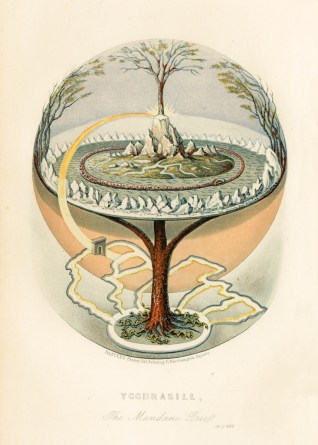
Norse Mythology
The Ancient Culture of the Nord, consisting of nine worlds or realms, with 14 Æsir Gods and 28 Asynjur Goddesses.
Ginnungagap
The gaping abyss, the yawning void.
Völuspá
Icelandic Codex Regius manuscript (c. 1270) and Haukr Erlendsson’s Hauksbók Codex (c. 1334) manuscripts. This is one of the most important sources for the study of the Norse. It is the best known poem of the Poetic Edda. The Völva addresses the Prophecy of the God Odin. It tells the story of the creation of the world, its coming end, and rebirth.
The Prophecy of the Völva (Seeress)
“I remember the Giants born of yore, who bred me up long ago. I remember nine Worlds, nine Sibyls, a glorious Judge beneath the earth. In the beginning, when naught was, there was neither sand nor sea nor the cold waves, nor was earth to be seen nor heaven above.”
Yimir und Auðumbla
Auðumbla is a primeval cow. The primordial frost jötunn Ymir fed from her milk, and over the course of three days she licked away the salty rime rocks and revealed Búri, grandfather of the Gods. Yimir gave birth to all the line of Giants. Auðumbla gave birth to the first God Búri. He then gave birth to Borr who married the giantess Bestla. They had three children: Odin, Ville, and Ve.
Yimir continued to give birth to an endless creation of Giants, causing fear in God, this would upset the balance. So they killed Yimir and created the earth with his dismembered body. From his giant body three brothers used the bones as boulders, crags, and rocks, his skull became the sky, his brains the clouds, his hair the trees and forests, his eyelashes were used to create enclosures to keep future giants contained. Finally, Ymir’s blood formed the seas and oceans and drowned all the frost giants except one, Bergelmir. He sailed far away to safety and from whom future frost giants would be descended.
In retaliation three female Jotnar Giants went to war with the Gods. The God, in response, created many creatures to help fight this battle.
 Stones, Runestone
Runestones are raised stones, boulders, carved bedrock with runic symbols. Most are located in Scandinavia, however, where the Vikings landed you are bound to find a Runestone. Usually these were placed next to a grave.
“For men of consequence, a mound should be raised to their memory, and for all other warriors who had been distinguished for manhood a standing stone, a custom that remained long after Odin’s time.” —The Ynglinga Saga
The Norse Gods & Goddesses
Odin, Borr, Frigg, Baldeu, Bragi, Hermod, Loki, Höðr, Thor, Freya, Freyr, Tyr, Heimdall, Hel, Njord, Vidar, Vale, Forseti, Mimir, Ullr, Iðunn.
Creatures Created By The Gods
Elves, Dwarves, Valkyries, Jörmungandr, Fenrir, Sleipnir, Huginn & Muninn, Níðhöggr, Auðumbla, Hafgufa, Humans.
Humans – Ask [ash] & Embla [elm]
Three Gods, powerful and passionate, left Asgard for Midgard. They found Ask and Embla, weak, fateless in that land. They had no breath, no soul, no hair, no voice, they looked inhuman. Odin gave them breath, Honir gave them souls, Loth gave them hair and human faces. – Völuspá </em
Norns
Norns are deities responsible for shaping the course of human destiny. There are many types of Norns: Elf, Dwarf, Vanir, Giant, Good and Bad. There are three in particular that draw water from their sacred well to nourish the tree, Yggdrasill. This tree resides at the center of the cosmos and the three prevent it from rot. They are described as powerful maiden giantesses from Jötunheimr and Mögþrasir. They are said to have ended the golden age of the Gods. Their neums: Urðr, Verðandi, and Skuld. Norns are also known to visit a newborn child in order to determine the child’s future. They could be malevolent, causing tragic events, or benevolent, be kind and protective.
Nine Worlds
Asgard – Realm of the Aesir
Alfheim – Realm of the Bright Elves
Jotunheim – Realm of the Giants
Midgard – Realm of the Humans
Muspelheim/Muspell – A fire-giant or the forces of chaos or their realm
Nidavellir – Realm of the Dwarves
Niflheim – Realm of Ice and Mist possibly with lower realm of Niflhel
Svartalfheim – Realm of the Black Elves
Vanaheim – Realm of the Vanir
Jörmungandr
Jörmungandr is a snake that encircles the realm of Midgard. He is the son of Loki and the giantess Angrboða. He is the brother of the great wolf, Fenrir, and the Queen of the Dead, Hel. At Ragnarök, Jörmungandr will release his tail and rise from the seas to join the forces of chaos against the Gods. He will slay and is slain by Thor.
.
.

The Death of Baldur
The Death of Baldur Loki and Baldur were two Norse Gods. Loki was known as a trickster, a mischievous figure who often caused trouble for the other Gods. Baldur was the son of Odin. He was thought of as a heroic figure, known for his bravery and strength.
Baldur was the son of Odin and Frigg, the Supreme Gods of Asgard. Baldur was beautiful, kind and charming. He was loved by all. Baldur spread happiness wherever he went. Whoever was with him would enjoy the perfections of the world.
One night, as Baldur fell asleep, he began to have disturbing dreams, his happiness started to dissipate. His beloved wife Nana noticed the change in his mood. She tried to comfort him. Nothing seemed to work. The dreams turned into nightmares and the nightmares grew worse with every passing day. So bad were they that Baldur would wake up in the middle of the night frightened and shaking. None of the Gods knew what to do. None knew the meaning of these dreams.
This came to the attention of the wise All Father Odin. There were many things he knew because of the depth of knowledge he received at the well. He consulted the runes, and then the Ancient Oracle. The Oracle told Odin that he must travel to Helheim in order to see Baldur’s fate. This upset Odin greatly. For you see, only those who are brave, those who die with honor in battle, will enter Valhalla. The souls who do not die in honor enter the realm of Hela. They are the lost souls of the damned.
 Odin disguised himself as a Wanderer. The Oracle led him to the place where he saw daemons and goblins making strange arrangements, singing haunting songs, speaking and writing in a language he did not know. However, the Ancient Oracle deciphered what they were saying. He told All Father Odin that the daemons and goblins were preparing for the arrival of Baldur, who would live with them forever. He then said, “Sorrow will ravage Asgard here in the realm of Hela, and here there will only be joy with the arrival of the spirit of the kindly.”
Odin returned to Asgard and shared the sad news with his wife Frigg. He told her of Baldur’s fate. Immediately, Frigg was determined to prevent this from happening to her beloved son. She knew he was loved by all. The Goddess then demanded all must take an oath and swear never to harm Baldur. Nothing, and no one could ever hurt the God. Every object, plant, disease and weapon pledged not to ever harm Baldur. Frigg went forth and spoke to all as she collected the oaths to protect her son.
Meanwhile, Loki the God of trickery, became envious and jealous of Baldur, but even he was compelled to take the oath, and so Baldur was invulnerable to everything. The God was safe, and his invincibility became cause for jokes and merriment among the Gods. They threw objects at Baldur, but everything harmful that approached him was deflected, for all had taken the oath. Thor hit him with his powerful Hammer, but Baldur felt nothing and everyone in Asgard was happy to know that the Beloved God was protected. Everyone, except Loki, who was determined to find a vulnerability in Baldur.
One day while slithering around, hiding in corners like a shadow, Loki overheard a conversation from the Goddess Frigg, who told a friend that she had managed to get everyone to take the oath. Everyone, except the mistletoe, a totally harmless plant, but in Loki’s evil mind, the mistletoe was not so harmless.
Loki, God of Deceit, had a great amount of wickedness inside him, and he seemed unable to contain such malevolence. Therefore, he planned to kill Baldur, the most beloved of the Gods. After collecting some mistletoe, he addressed the Gods who were still having fun trying to attack Baldur. Only the blind God Höðr felt sad that he was excluded from the fun. How could he throw something at Baldur when he didn’t even know where he was?
The cunning Loki created a dart made of mistletoe and addressed Höðr telling him that he shouldn’t let his blindness stop him from playing and having fun. Loki turned invisible and then guided Höðr to where the other Gods were throwing things at Baldur. Baldur, seeing Höðr approach, was happy to know that his twin brother would also participate in the fun and games.
Still invisible, Loki using all his might, helped Höðr throw the dart made of mistletoe at Baldur. Höðr expecting to hear the laughter of the Gods, experienced nothing, but a great silence. Baldur had been mortally wounded. As the God’s body fell to the ground, all those around him gasped and turned towards desperation. The prophesied death had come to pass. The world of the living mourned his passing. All were disturbed and saddened upon his departure. No longer would they see the beautiful and beloved Baldur.
Hermóðr, another son of Odin, brother of Baldur, was the messenger of the Gods. He rode his steed Sleipnir to the realm of Hell. Hermóðr’s mission was to rescue Baldur from the World of the Dead, and bring him back to Asgard.
When Hermóðr arrived, he immediately received some very good news. The Goddess Hela would return Baldur on one condition: ‘All beings must mourn Baldur’s death and wish him to return.’ Hermóðr brought this news directly to the Gods. All were pleased with the condition of Baldur’s return, for he was loved by all beings.
All the beings were summoned to confirm their desire to have the Beloved God Baldur return. All confirmed their devotion and love for Baldur, save one, a Giantess living in the mountains. She made it clear that she did not want the God to return, and because of her dislike and selfishness, Baldur could not return. This made everyone’s heart fill with sadness and sorrow.
The Gods went searching for the Giantess. When she was found, several of the God’s begged her to reconsider, but she refused. She said in her shrill and decrypted old voice, “Why should I care for his well-being, when I have my own to look after?” Some of the Gods fell to their knees, they begged her to reconsider, to at least try. The sight of the Gods on their knees begging made the Giantess laugh.
However, this laugh was strange and very revealing, for it was the laughter of the God Loki not an old woman. It didn’t take long before the Gods discovered that the heartless Giantess was indeed Loki in disguise.
By this time, Loki had committed every possible kind of mischief, but this act had exceeded the limits of the God’s patience. The Asgardians then came to a consensus: ‘Loki must be punished!’ Loki then fled from the wrath of the Gods. He hid deep in the mountains near a well where the salmon swam. He jumped into the well, took the form of a salmon and mixed with the other fish so not to be found by the Gods, but All Father Odin, was able to see the whole world from his throne. He saw exactly where Loki was hiding.
Still, the trickster God was smart and clever. He knew the Gods would eventually find his hiding place, so he thought about how they would try to capture him. He did not wish to underestimate their inelegance, he knew they were smart, and he knew they would use more than just a bate hook to capture him.
Loki pondered a moment and thought that if he put together a combination of strings and formed a tightly bound mesh, it could be capable of catching fish. He actually created this tool and called it the Net. It was the very first ever Fishing Net. After putting these strings together in different ways, he began to understand how the Net worked, then he designed strategies to escape from all these different combinations of Nets.
As he was designing a new method, he heard the Gods approaching. He threw the net into the fire and jumped into the river, turning back into a Loki Fish. The Gods saw Loki jump, but they didn’t know how to capture him. The God Kvasir looked around the camp fire and noticed what seemed to be traces of string, string that did not burn in the fire.
Kvasir immediately understood what Loki was up to and the purpose of the tightly wound strings. The God went straight to work. He created more of these Nets with the intent of using them to capture the trickster. The Gods then threw these Nets at Loki Fish, but he was well practiced at escaping. He knew when to wiggle, when to turn, when to flip and when to jump up high into the air, then when he landed on the shore he would turn back into himself and tear through the mesh. They could all see Loki was well-prepared.
Thor began to think of a different way to capture Loki. He thought if a bear could catch a salmon on the fly, perhaps so could he. He planned it out. When Loki was in the form of a fish, and when he jumped high in the air, Thor would be ready to grab Loki Fish and hold him before he landed, meanwhile the others would wrap him up in the Net.
Thor was all set and ready to go. The Net was tossed, and Loki Fish jumped high into the air, and before he landed, Thor snatched him like a bear and by the time Loki Fish touched the ground, becoming himself, the Gods had wrapped him up with the Net. From there, Thor dragged Loki to the cave where the Gods would hand down his well deserved punishment.
In the cave, the Gods summoned Loki’s two sons. They turned one into a wolf, who promptly killed his brother, strewing his entrails across the floor of the cave. Loki was then fastened to three rocks with the viscera, entrails, and sinews of his slain son. The Gods then turned his son’s guts into iron chains.
Many wished to kill Loki because of what he had done to Baldur, but Loki had a blood pact with Odin. Despite their different origins, they were like brothers. Odin could not allow the extermination of Loki, he could only imprison him, but this was too mild a punishment for such a traitor.
The Giantess Goddess Skadi [harm] placed a poisonous snake on a stalactite above Loki’s head, where it dripped poisonous venom onto his face, causing enormous pain. Sigyn, Loki’s faithful wife, sat by his side with a bowl that she held up to the snake’s mouth to catch the poison. However, every so often, the bowl became full, and Sigyn would have to leave her husband’s side to dispose of its contents, at which point the drops that fell onto the unrepentant God’s face would cause him to shake violently, which brought about earthquakes in Midgard, the world of humanity. Each Drop of Poison that fell on Loki only increased his desire for revenge.
Loki vowed to repay the Gods of Asgard for all the suffering imposed upon him. This was the lot of Loki and Sigyn until, as fated, Loki will break free from his chains at Ragnarök to assist the giants in destroying the cosmos.
.

Ragnarök
Twilight of the Gods
Another green Earth will rise from the sea. I see eagles over fells, sporting for fish. At Idavoll, the Gods meet, and talk of the serpent, their former strength, and the Wise One’s runes. On the grass, roundabout, are the tables of gold at which they played so long ago. Crops will grow unseeded; ills healed, Baldr returns to live at Valhalla, the shrine to the slaughter-Gods. Vili will cast the blooded runes and the sons of brothers, Baldr and Höðr, will live with the Wind. I see a sun-bright hall, gold-thatched at Gimle, where the Gods will pass their days in pleasure. The black dragon flies over dark-of-moon hills, bearing corpses to Hel. Where I must go too.
Prophecy of the Seeress Völva.
Sitting on a rock, her back to Odin. The room is so silent you can hear the stillness of the air. She looks down and away, then asks the God if he wishes her to recite the ancient lore. There is a muttering from those who have gathered. Turning her head towards Odin, she reads his stare. She faces the crowd requesting silence from the sons of Heimdallr (human beings) and falls into a trance.
She remembers and speaks of the time of giants born in antiquity, the ones who reared her. She speaks of the creation myth Ymir; ‘…the world was nothing but the magical void, Ginnungagap, until the sons of Burr lifted the earth out of the sea, creating the world. The Æsir commands order in the cosmos, the sun, the moon and the stars, and the beginning of day and night. A golden age ensued. The Æsir, having plenty of gold, constructed beautiful temples and made great tools. All was happy, peaceful and calm. Until three mighty giant maidens came from Jötunheimr and that golden age came to a quick end.’
She speaks how The Æsir created the dwarves, of whom Mótsognir and Durinn were mightiest. She recounts the “Dvergatal”, then the formation of Yggdrasil, the world-tree, and the creation of the first man and woman.The seer recalls the burning of Gullveig that led to the first “folk” war, and what occurred in the struggle between the Æsir and Vanir. She recalls how in Gylfaginning Freyja was given to the giant builder and the creation of Fafner the dragon.
The seeress reveals to Odin that she knows many of his secrets, and his great sacrificed, what he gas given up. She tells him she knows where his eye is hidden and how he gave it up in exchange for knowledge. She then askes him several times if he understands. She stops, the air is again still, she turns to look at the God asking if he wishes to hear more. Odin stares at the seeress, shen then turns to face the audience.
The seeress reveals to Odin that she knows many of his secrets, and his great sacrifice; what he has given up. She tells him she knows where his eye is hidden and how he gave it up in exchange for knowledge. She then asks him several times if he understands. She stops, the air is again still, she turns to look at the God, asking if he wishes to hear more. Odin stares at the seeress, she then turns to face the audience.
She goes on to describe the slaying of Odin’s son Baldr, best and fairest of the Gods, and the enmity of Loki, and of others. At the end of her words, a tear falls from Odin’s eye. She closes her eyes, bows her head, and pauses, the room is silent, the tear falls to the floor.
Breathing deeply, she prophesies the destruction of the Gods. She speaks about how fire and flood overwhelm heaven and earth as the Gods fight their final battles with their enemies. “This is the fate of the Gods! Ragnarök.”
She described the summons to battle, the deaths of many of the Gods and how Odin, himself, is slain by Fenrir, the great wolf. Thor, the God of thunder and sworn protector of the earth, faces Jörmungandr, the world serpent, and wins, but Thor is only able to take nine steps afterward before collapsing due to the serpent’s venom. Víðarr faces Fenrir and kicks his jaw open before stabbing the wolf in the heart with his spear. The God Freyr fights the giant Surtr, who wields a fiery sword that shines brighter than the sun, and Freyr falls.
After Ragnarök – The New World
Her voice begins to change. It was ever-growing dark and rough, but now it is light, and her words flow like a song. She looks to be getting younger as she speaks, “A beautiful world is reborn. It rises from the ashes of death and destruction. Baldr and Höðr will live again. The earth sprouts in abundance without sowing any seed. The surviving Æsir reunites with Hœnir, and they meet together at the field of Iðavöllr. She hears them speaking, they are talking, discussing Jörmungandr, all the great events of the past, and the runic alphabet. Suddenly, a dark shadow falls on her face. She sees the appearance of Nidhogg the dragon. In his wings he holds many corpses. Her eyes open wide, she jumps back and emerges from her trance.
.

Asatru – Nine Noble Virtues: Courage, Truth, Honor, Fidelity, Discipline, Hospitality, Industriousness, Self-Reliance, Perseverance. Through the month of January every Monday a member from the Astru will present a lecture on the Norse Myths and Religion. From Ginnungagap through Ragnarök and beyond. The meaning of the Gods, the wars, and battle, the creatures created, the Runes through the twilight of the Gods, including Wagner’s, Ring of the Nibelungen. Sign up for the Lecture Series and the Opera weekend.
.
.
.</s
.

.
.
.
.
The Greek Gods
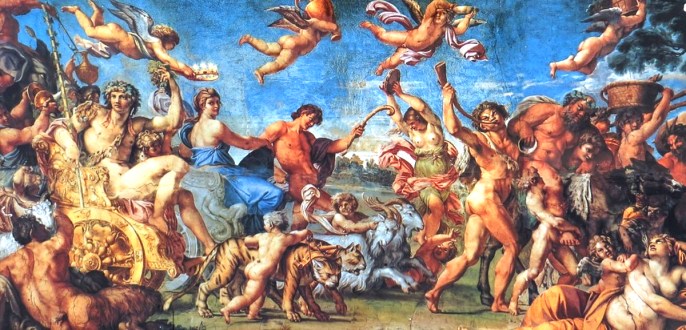
Primatial Greek Gods
Achlys – Goddess of the eternal night, before Chaos, the demon of death.
Chaos – God of the void, the beginning of all life, Chaos pre-existed all, but Achlys.
Tartarus- God of the darkest underworld.
Αether – God of light, spark of life for every creature, the highest and purest layer of air.
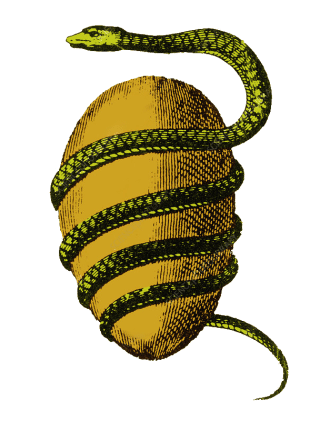
Αion – God of eternity, time, portrayed with a snake body and three heads: human, bull, lion.
Ananke – the Goddess of inevitability, compulsion, and necessity.
Aion and Ananke are often depicted as wrapping themselves around the cosmic egg. Squeezing it tight they break the egg releasing the earth, skies, and sees.
Chronos – God of time, father of Erebus and Nyx.
Erebus – God of darkness and shadow.
Nyx – Goddess of night, mother of the night.
Hemera – Goddess of day.
Hypnos – God of sleep.
Eros – God of love and procreation.
Gaia – Goddess of the earth, the primeval mother.
Nesoi – Goddesses of islands.
Ourea – Gods of mountains.
Pontus – God of the sea and father of the sea creatures.
Nemesis – Goddess of retribution.
Thanatos – God of death.
Uranus – God of the heavens, the skis, ruler of the world, father of the Titans, Uranus was cruel, an unjust leader and a philanderer. Pillar Sons: Hyperion, Iapetos (Iapetus), Krios (Crius), Koios (Coeus).
.
 Titan Gods
The Children of Uranus and Gaea, six males and six females. three gigantic beasts called, Cyclopes & three 100 hand beasts called, Hecatoncheires,
Oceanus – Titan God of the oceans. Eldest son.
Crius – the Titan God of constellations. The ram, Aries. South Pillar
Tethys – Titan Goddess and mother of all the rivers, fresh water, clouds, nymphs and undines.
Hyperion – Titan God of light, West Pillar.
Cronus – Titan God of the harvest. East Pillar. Married his sister Rhea. Youngest child of Uranus, Castrated his father with a sickle, seized power.
Rhea – Titan Goddess of fertility and generation.
Theia – Titan Goddess of the æther. Gave birth to Helios, the sun.
Eos – Titan God of the dawn.
Selene – Titan God of the moon.
Mnemosyne – Titan Goddess of memory and remembrance.
Iapetus – Titan god of mortality stands at the eastern pillar of the world, embodying the boundary between divine eternity and mortal existence. He is the father of four notable sons: Menoetius, who holds violent anger and commits rash actions, he was struck with a thunderbolt and sent into Erebos (the Underworld), by Zeus for his hubris. Atlas, who bears the weight of the heavens upon his shoulders, symbolizing endurance and the burden of divine authority. Prometheus, the foresighted Titan, who gifted fire to humanity—an act of rebellion and enlightenment that would forever alter the relationship between gods and mortals. Epimetheus, the twin brother of Prometheus, whose name means “hindsight.” He married Pandora, the first mortal woman, whose curiosity unleashed suffering upon all of mankind.
.
Prometheus -Lord Byron
 Titan! to whose immortal eyes
The sufferings of mortality,
Seen in their sad reality,
Were not as things that Gods despise;
What was thy pity’s recompense?
A silent suffering, and intense;
The rock, the vulture, and the chain,
All that the proud can feel of pain,
The agony they do not show,
The suffocating sense of woe,
Which speaks but in its loneliness,
And then is jealous lest the sky
Should have a listener, nor will sigh
Until its voice is echoless.
Titan! to thee the strife was given
Between the suffering and the will, Which torture where they cannot kill; And the inexorable Heaven,
And the deaf tyranny of Fate,
The ruling principle of Hate,
Which for its pleasure doth create
The things it may annihilate,
Refus’d thee even the boon to die:
The wretched gift Eternity
Was thine—and thou hast borne it well.
All that the Thunderer wrung from thee
Was but the menace which flung back
On him the torments of thy rack;
The fate thou didst so well foresee,
But would not to appease him tell;
And in thy Silence was his Sentence,
And in his Soul a vain repentance,
And evil dread so ill dissembled,
That in his hand the lightnings trembled.
 Thy Godlike crime was to be kind,
To render with thy precepts less
The sum of human wretchedness,
And strengthen Man with his own mind;
But baffled as thou wert from high,
Still in thy patient energy,
In the endurance, and repulse
Of thine impenetrable Spirit,
Which Earth and Heaven could not convulse,
A mighty lesson we inherit:
Thou art a symbol and a sign
To Mortals of their fate and force;
Like thee, Man is in part divine,
A troubled stream from a pure source;
And Man in portions can foresee
His own funereal destiny;
His wretchedness, and his resistance,
And his sad unallied existence:
To which his Spirit may oppose
Itself—and equal to all woes,
And a firm will, and a deep sense,
Which even in torture can descry
Its own concenter’d recompense,
Triumphant where it dares defy,
And making Death a Victory.
.
.
.
.The Beginning and The End
Four Pillars – Four corners of the earth. Brothers who hold the heavens and the earth apart. Iapetus, Pillar of the West. Crius, Pillar of the South. Cronus, Pillar of the North. Hyperion, Pillar of the East.
The Hecatoncheires & the Cyclopes – The youngest, evil and most troublesome children of Uranus. Hated by their father. He had them all imprisoned in Tartarus, a dark place, deep in the bowels of the earth, inside their mother Gaea. This caused Gaea great pain, and suffering. To ease her pain Gaea fashioned a blade, a stone sickle, out of adamant [lodestone and diamond]. She then begged her youngest son to castrate Uranus so that he would have no more power over them. In the end, the brothers, Iapetus, Crius, Hyperion, held Uranus firmly in place whiles Cronus castrated him with the sickle casting the sex of their father into the sea leaving Uranus powerless. This marked a permanent separation of the earth and sky from the universe, creating a new order.
A New King – Usurping his father Uranus, Cronos, the new leader, king of the Gods brought order and justice to the universe after Uranus. This was known as the Golden Age of the Gods. With his sister-wife Rhea he had 6 children: Hestia, Demeter, Hera, Hades, Poseidon, and Zeus. What later became known as, The Olympians. However, over time Cronus proved to be no better than his father, a tyrant. Like his father he too locked the Hecatoncheires and the Cyclopes in Tartarus. However, before that could be fulfilled, Cronus was told by his mother Gaea and his father Uranus of the prophecy that had come into being, that like his father Uranus one of his children was fated to dethrone him, as he had dethroned his father. So Cronus ate each of his children as soon as they were born, thus forestalling his fate by devouring the infants, trapping them forever, inside himself.
Zeus – Zeus was the youngest son of Cronus. When he was born, his mother Rhea hid him in a cave on the island of Crete. Instead of feeding Cronos the child, as he expected, she swaddling a large stone in blankets telling Cronus it was the child. He ate the stone child quickly and felt at rest. Meanwhile, Zeus was kept well hidden on Crete. There he was raised by a nymph named Amalthea. As Zeus grew up, he dreamt about ruling over Mount Olympus. Years passed, Zeus now a man, standing over 40 feet tall, met with Metis, the Titan Goddess of wisdom, she gave him a poisonous magic elixir to give to Cronus. This potion would force Cronus to throw up his children trapped in his stomach.
Zeus transformed into a cup bearer and disguised the poison as red wine. He presented the wine to Cronus, who drank it up quick. All at once the sons and daughters of Cronus were expelled immediately. The children declared themselves to be the rulers of heaven. The Titans seemed fine with the children, but they would not accept Zeus as the leader. The children refused and so began a violent and brutal war called the Titanomoky. For ten years they battled and all looked lost for Zeus and his brothers and sisters, but Zeus released the Hecatoncheires and the Cyclopes from Tartarus and the Titans were defeated. Zeus became the God of all the heavens, as prophesized he deposed Cronus and the Titans, and as in his dream, his brothers and sisters ruled over as the Olympic Gods.
Unfortunately, like his father, Zeus became cruel and unjust. He made Atlas hold the world up forever on his shoulders, and sent his father Cronus to Tartarus for eternity. This outraged his mother who sent all manner of earthly evil to attack Zeus. He defeated all the challenges sent. Regrettably, regardless, of being brave in battled, Zeus was often petty tyrant, passing serve punishment on the Olympians for the slightest of offences. He was hypocritical, prone to temptation, and silly arguments.
Over time he declared the Gods stay out of the machinations of man, and those who didn’t he punished both the God and man. One punishment was sending the woman Pandora. She became wife of Epimetheus, brother of Prometheus. For her wedding, Zeus gave her a special gift, a beautiful jar, but she was told never to open it. Yet. her curiosity got the best of her. Zeus, of course, knew this would happen, and when she opened the jar she released all the ills and evils into the world. When she covered the jar up, nothing remained, but hope.
.Seven Wives of Zeus
When Zeus became King of the Gods he took as his First Wife, the Titan Goddess of fertility, thoughtfulness, prudence, and wisdom, Metis, the Oceanid nymph. She was one of 3000 daughters of Oceanus and Tethys. Metis was also the Goddess who gave Zeus the poison that released his brothers and sisters from the belly of Cronus. Metis gave birth to only one child, Athena. In the pecking order of children Athena was the first child of Zeus, but her birth came about in the most unusual way, you see, the father of Zeus, Cronus, and his mother, Rhea told Zeus of the agonizing prophesy he would suffer as his father and grandfather, Urines, had faced. That the God of the heavens would be overpowered and unseated by his own child. It was then prophesized that Metis would give birth to the child who would overthrow the father. To escape the prophecy, Zeus swallowed Metis while pregnant with Athena.
Second Wife, Themis, the Titan Goddess of divine law and order, traditional rules of conduct established by the Primal Gods. She is the divine voice (themistes) who instructed mankind in the primal laws of justice, the nómos (body and spirit of the law), morality, precepts of piety, rules of hospitality, good governance, conduct of assembly, and pious offerings to the Gods. She is one of the twelve Titan children of Gaia and Uranus. As the second wife of Zeus, Themis was his first counsellor. She was seated beside her husband advising him on the precepts of divine law and the rules of fate.
She was also a prophetic Goddess who presided over the most ancient oracles, including Delphoi (Delphi). She bore the Seasons and Fates with her six children: The ruling Horae, divinities of the seasons, Eunomia (Εὐνομία), Eirene/Irene (Εἰρήνη) and Dike (Δίκη). The bringer of death, Moirai (Moirae, Fates), Themis was also identified with Gaia in the role of the oracular voice of earth.
 Third Wife, Eurynome, Titan-Goddess of water-meadows and pasturelands. “She of Broad-Pastures” urys “wide” or “broad” and nomia “pasture.” Daughter of Titans Oceanus and Tethys. Oceanid, Ocean, elder Okeanides, Water Nymphic one of the three thousand nymph Goddess of enticing beauty. Sister to Metis, she wore a crown of clover, protector and lover of cows, horses, dolphin, strength, power and speed.
Zeus transformed himself into a tame white bull and mixed in with her father’s herds. While Europa and her helpers were gathering flowers, she saw the bull, caressed his flanks, and eventually got onto his back. Zeus took that opportunity and ran to the sea and swam, with her on his back, to the island of Crete. She was one of his divine lovers.
She bore the Kharites – Charites, known as the Graces. Goddesses of mercy, these three fair-cheeked beauties were named: Aglaea “Radiance,” Euphrosyne “Joy,” and Thalia “Flowering.” It is said from whose eyes they glanced flowed love that unnerves the limbs, and such beautiful is their glance that beneath their brows. They represented and personified beauty, happiness, and abundance.
Eurynome, the daughter of Ocean, beautiful in form, bore [Zeus] three fair-cheeked Charites (Graces), Aglaea, and Euphrosyne, and lovely [Thalia], from whose eyes as they glanced flowed love that unnerves the limbs: and beautiful is their glance beneath their brows.
Forth wife – Demeter is the Olympian Goddess of the harvest. She presides over agriculture, crops, grains, essentially, all foods from the earth, and the fertility of the earth. She was an extremely important Goddess to the Ancient Greek people, known as the Grain-Mother, for she control all of their food.
Demeter had Chthonic power Any spirit who lives inside Earth is technically a chthonic spirit. In the older chthonic cults the earth goddess was related to the Underworld and in the secret rites, the mysteries Demeter served the double function of death and fertility. Chthon means “Earth” is used to indicate subterranean beings, those spirits who dwell inside Earth as opposed to in the Heavens, within trees, caves, burrows, and other placed in the Earth. Chthonic force consists in nature, lifeforce, nurturance and growth; evoking mystery, danger, chaos, and is equated with the subjective, the intuitive, the irrational, and the personal. As a chthonian underworld deity was often accompanied by a snake.
Like her siblings Demeter was consumed at birth by he father Cronus. She lived in his belly until the youngest son,, her brother Zeus rescued all his brothers and sisters from their father’s captivity. Zeus and his sibling overthrew their father as the prophesy determined.
Demeter never married, but at one point she became the sister wife of Zeus. S he had two children with him. A daughter, Persephone, and a son, Iacchus.
Being Chthonic Demeter and Zeus merged in the form of intertwining serpents. From this union the beautiful Goddess Persephone was born.
Demeter was very proud of her daughter, she was beautiful, and sweet. Demeter loved her very much, and like her mother, Persephone, loved nature, and like her mother, she also shares the double function of death and fertility.

One day Zeus enraged Demeter, he had permitted their brother Hades, the god of the underworld, to kidnap their daughter. In fact, it was all his idea. How it all began, Zeus gave his consent for Hades to marry his daughter, but because he believed that Demeter would not approve of the match, he told Hades to abduct Persephone and take her to his realm in the Underworld. With the aid of Gaia, Hades did just that, He abducted the beautiful daughter of Zeus and Demeter, and carried her to the Underworld.
Now, the Sirens were the companions of young Persephone. When she realized her daughter was missing Demeter gave them wings to search for her beloved girl. When she found out that the Sirens did nothing to save her daughter, Demeter cursed them for failing to intervene in the abduction.
Demeter then carried a pair of flaming torches in her search for Persephone. Even today she is depicted in art holding one or two torches as her attribute.
Demeter was also called Khrysaoros (Lady of the Golden Blade) after the golden sword or sickle which she wielded in her search. Demeter looked everywhere in the world for her, but was unsuccessful. Devastated by Persephone’s kidnapping Demeter fell into a great sorrow and grief. She withdrew from her responsibilities and refused to permit any crops to grow on Earth. This led to a massive famine and put the survival of humanity in danger.
Zeus pleaded with Demeter to save humanity, but she refused, and so Zeus confessed to his part in the plan to abduct Persephone and allow their brother Hades of the Underworld to marry her.
Persephone was in the meadow picking flowers when Hades emerged from a crack on the earth, he grabbed the child, and carried her off to the Underworld. She struggled to get free, but he overpowered her. Hecate and Helios witnessed the abduction. Hecate ran to fetch torches, and Helios ran to tell Demeter.
Now that she knew the truth Zeus needed to go to the Underworld to speak to Hades, otherwise Humanity would die.
Now, according to the myth, anyone who consumes food or drink in the underworld was bound to it and could never leave. As long as Persephone did not eat in the Underworld she could return to the land of the living, and to that point Persephone had eaten nothing while kidnapped by Hades.
Hades then tempted the girl with a Pomegranate. He pealed back the leathery skin and inside the snug white flesh of the fruit were red juicy seeds that looked like gems. He said if she ate just one, she would live forever, and so she did. Without realizing what she had done she had eaten food in the Underworld. The simple temptation of the luscious Pomegranate made Persephone Hade’s eternal queen.
Needless to say, Hades was not happy when Zeus arrived wanting to bring Persephone back to the living, but Zeus explained that there was no choice in the matter, humans needed to eat and without food they could not worship the Gods, and they would all parish. In the end he forced Demeter and Hades to make a compromise regarding their claims to Persephone.
For eating the seed Persephone was bound to the Underworld and Hades. She is always watched by hos Owl. She spent 4 moths of sorrow with her husband, and 8 months with her mother, happy among the living. Her journey from the Underworld to the Land of the Living is symbolized in the change of the seasons. When she leaves her mother, Demeter grows sad and alone, she is at rest, the gardens grow dark and cold, the world is in a state of winter until her darling daughter returns in the Spring.
Persephone has two children with Hades one daughter, Melinoë, and one son, Zagreus. Melinoë became the Goddess of nightmares and madness. Zagreus the God of intoxication. However, there has always been rumors that Zeus is the biological father of both children.
.
.
.
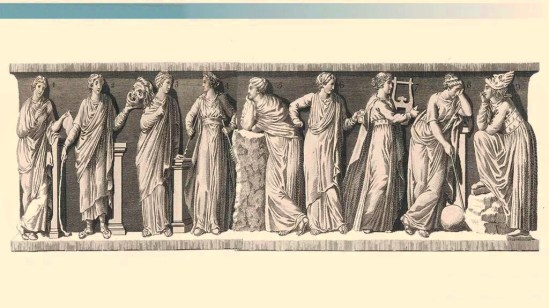
Fifth Wife– Mnemosyne, Goddess of memory, mother of the Muse, all born through a relationship with her nephew Zeus.
Birth of The Muses – When Zeus became the Father of Gods, he slept with the Goddess of memory and remembrance, Mnemosyne. He stayed with her for nine consecutive days. This led to the birth of the nine Muses. In *Hesiod’s Theogony, the kings and poets were inspired by Mnemosyne and the Muses, thus getting their extraordinary abilities in speech and using powerful words. All ancient writers appeal to the Muses at the beginning of their work. Apollo was the best known patron of the Muses. Homer asks the Muses both in the Iliad and Odyssey to help him tell the story in the most proper way, and even until today the Muses are symbols of inspiration and artistic creation. The Muses had many incarnations, but eventually settled on nine.
.
The Nine Muses
Clio – Muse of history
Calliope – Muse of heroic or epic poetry
Erato – Muse of lyric and love poetry
Euterpe – Muse of music or flutes
Melpomeni – Muse of tragedy
Polymnia – Muse of sacred poetry or of the mimic art
Terpsichore – Muse of dancing and choral song
Thalia – Muse of comedy
Urania – Muse of astronomy
.
Homer’s Call to the Muses
Sing, Goddess, sing of the rage of Achilles, son of Peleus—
that murderous anger which condemned Achaeans
to countless agonies and threw many warrior souls
deep into Hades, leaving their dead bodies
carrion food for dogs and birds—
all in fulfilment of the will of Zeus.
.
.
.
.
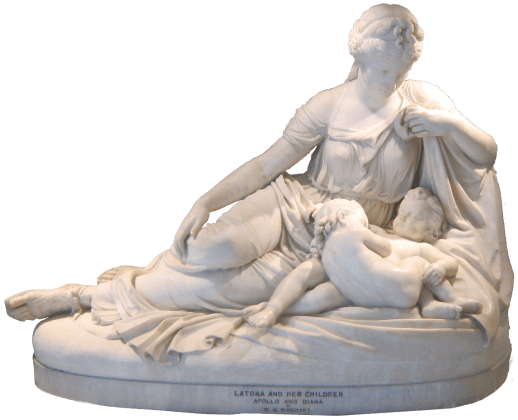 Sixth Wife – Leto, Goddess of motherhood. Titan, daughter of Cronus and Phoebe. Sister wife of Zeus. As the Goddess of motherhood she is the protectress of the young. She is also portrayed as the Goddess of modesty and womanly demure, some connect her name with the word lethô, modesty. In a number of Greek vase paintings she is depicted as a young woman lifting her veil to Zeus, a gesture of modesty.
She is more often depicted as a mother, accompanied by her two children. The origin of her name is thought to mean “unseen” this makes a connection to her modesty, though some believe her name derives from “lada,” which is the Lycian word for woman. The cult of Leto was wide-spread all over Greece and Asia Minor for being the mother of two Gods. She is also connected to the island of Delos and later, the town and Oracle of Delphi.
Leto, pregnant by Zeus, sought a place of refuge to deliver her children. This was difficult for she was now cursed by Zeus’ seventh wife, Hera. Enraged and full of jealousy Hera pursued Leto relentlessly. She vowed to curse any piece of land that allowed Leto to rest and give birth. Hera sent her serpent-dragon Python in pursuit to destroy her and the children she carried. Hera’s curses drove Leto from land to land preventing her from finding a place to rest and give birth.
Eventually, the day came and Leto fell into the throes of labor, Python went in for the kill extending his clutches to grab her she was almost magickly swooped up by the North Wind, this was of course sent by Zeus. The wind lifter Leto higher allowing her to escape Python, and it carried her clear to the Aegean Sea. The wind then blew her onto a wandering barren rock, borne about by the waves, adrift in the sea, attached to nothing. Here is where Leto found refuge and rest.
Her labor could not be held back and as she gave birth on that rock it fixed itself to the sea floor, becoming the isle of Delos [Cyclades archipelago of Greece]. It’s name means to manifest, to reveal. There she gave birth to a set of twins, a male and a female. Their names, the God Apollo and the Goddess Artemis.
The Island of Delos now became a sacred place. Upon their birth Hyperborean Swans circled the island seven times. This was a symbol, a sign, and a blessing of good health, harmony, divination, and grace. The Titaness, Earth Goddesses, would also grant and bear Apollo and Artemis Olympian Gods.
.
.
Gifts from Zeus To Leto’s Twins
Zeus gifted Apollo the city of Delphi, a golden tripod, a golden bow and quiver of arrows that could never be emptied, and a silver chariot pulled by swans
Zeus promised Artemis all the mountains as her domain, he presented her with 30 cities, and guardian of the world’s roads and harbors. Zeus granted Artemis a silver bow and arrows made by the Cyclops, granted her eternal virginity, and a group of nymphs to serve her forever.
.
.
Wandering The World
The twins grew rapidly, into fierce protectors of their mother. At only four days old Apollo was ready to slay the beast that chased his mother, and put upon him vengeance for the horrors she suffered for simply bringing the twins into the world (more on this later).
The Island of Delos was small and though safe, threats were always looming. Now that the children were born, this wasn’t the end of Leto’s woes. Hera did not cease in her pursuit of Leto. Her jealousy and anger only increased. This forced Leto and the children to wander the world, they were constantly pursued by all manner of creatures, sent by Hera of course.
Travelling to Delphi, Leto was accosted by the giant Tityus he was attempting to abduct and rape her on the orders of Hera. Tityus, was an earth-born giant, A child of Zeus. Zeus hid his mistress Elara from his wife, Hera, by placing her deep beneath the earth. Tityus grew so large that he split his mother’s womb, and he was carried to term by Gaia, the Earth Mother.
There are two stories sounding Tityus death. One by the twins, where his death came hard and fast. Tityus tried to accost Leto, but his advances were repelled by Apollo, and Airtimes through the power and skill of Apollos silver arrows. The others claim it was Zeus who intervened with a bolt of lightening and thunder. When Zeus heard of the attempt to abduct Leto he poured a thunderbolt upon his head, and as punishment, Tityus was stretched out in Tartarus and tortured by two vultures who fed on his liver, which grew back every night. This punishment is comparable to the story of the Titan Prometheus.
.
.

One day while Leto and the children were passing through Lycia, she felt thirsty and tried to drink from a well. The peasants however, stirred up the mud at the bottom of the well, and made the water undrinkable for her and the children. In anger for the unfairness towards her children, Leto turned them all into frogs.
.
.
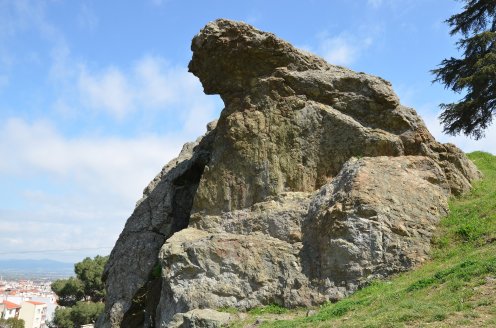
After many yeas and adventures of wandering had passed, Leto decided to settle in Thebes, this is where she wished to spend the rest of her life. Her children would then follow their father and rule in Olympus.
In the city of Thebes, there was an arrogant and hubris queen named Niobe, she was the daughter of Tantalus. She once said that she was superior to Leto, because Niobe had given birth to fourteen children, seven male, and seven female, instead of only two. Leto and her divine children were so insulted when they found out about this reproach, both Apollo and Artemis took revenge, killing all fourteen of Niobe’s children. When Niobe discovered what had happened, she burst into great tears and sorrowful grief. There was no consoling her. She then asked Zeus to show mercy on her by turning her into stone, so that she would no longer feel the pain and suffering of this loss. Zeus granted her request, and turned her into a pillar of stone. To this day people say that when they pass the pillar, they see it weeping.
.
.
[tbc]
.Seventh Wife – Hera
Zeus made Hera his lush and fertile wife. She gave birth to youthful Hebê, Ares, and Eileithyia, joining in love with the king of gods and men, but Hera raged in strife with her husband, and joining in intercourse with no one, gave birth to renowned Hephaestus, who surpassed all the descendants of Ouranos in skill of his hands.
Hera reigns as the majestic queen of the Olympian gods, embodying the ideals of marriage, fidelity, and the sanctity of the family. As the sister and wife of Zeus, she holds a position of supreme authority among the gods, often depicted as regal and commanding, adorned with symbols of royalty such as the peacock’s shimmering feathers and the sacred cow. Her presence exudes dignity and strength, yet beneath her regal exterior lies a fierce protector of her domain—marriage and the women who uphold its vows.
Hera’s character is a tapestry woven with threads of majesty, devotion, jealousy, and vengeance. She exemplifies the virtues of a devoted wife and protector of the sanctity of marriage, often acting as a guardian for women in childbirth and those married under her auspices. However, her personality is also marked by intense jealousy—particularly toward Zeus’s lovers and illegitimate offspring. This is vividly illustrated in her relentless pursuit of Hera’s rivals; for instance, she persecuted the mortal woman Io, whom Zeus transformed into a cow to hide her from Hera’s wrath, and she was known to torment the hero Heracles, who was the son of Zeus and a mortal woman, Alcmene.
Children . The birth and significance of her children:
1. Hebê – goddess of youth and adolescence
2. Ares – god of war, representing conflict
3. Eileithyia – goddess of childbirth
4. Hephaestus – god of fire and craftsmanship
A. Queen of the Olympian gods
B. Wife and sister of Zeus
C. Goddess of marriage, women, and family
D. Symbolism: peacock, cow, pomegranate, lotus
Attributes and Domains
A. Protector of marriage and marital fidelity
B. Patroness of women in childbirth
C. Regulator of family and household
D. Associated symbols:
1. Peacocks – representing beauty and pride
2. Cows – symbols of nurturing and fertility
3. Pomegranates – symbolizing fertility and marriage
Mythological Role and Personality
A. Embodying matrimony and fidelity
B. Fiercely loyal to her marriage with Zeus
C. Often depicted as jealous and vengeful, especially towards Zeus’s lovers and offspring
D. Protector of married women and the sanctity of marriage
Hera’s vindictiveness is also evident in her treatment of her own children when she perceives betrayal or disrespect. She is known to have plotted against the lovers of Zeus, such as Ares’s consorts, and even interfered in the fates of her children, sometimes favoring some while casting others into suffering. Yet, she remains fiercely loyal to her marriage vows, embodying both the ideal and the challenges of maintaining fidelity and authority within her divine household.
Her protective nature extends to her role as a nurturer of the sacred bond of marriage. She was honored in many rituals and festivals that celebrated the union of husband and wife, and her image often appeared in wedding ceremonies as a symbol of fidelity and divine blessing. Despite her sometimes vengeful actions, Hera’s complexity lies in her duality—both a loving protector and a formidable goddess of retribution, embodying the complicated realities faced by women and queens in myth and culture alike.
Hera as a multifaceted goddess: regal, protective, jealous, and fiercely devoted to her role as queen and goddess of marriage.
Her mythic stories reflect her complex personality, balancing her dignified status with her passionate responses to infidelity and betrayal.
.
.

.
Apollo and Delphi
When Leto was saved by the North Wind from the serpent-dragon Python she landed on a rock floating in the Aegean. This was the only way to avoid the curse set by Hera. When Leto started to give birth to the divine twins, the children of Zeus, the rock began to take root and became the island of Delos.
Her twins grew rapidly, becoming her fierce protectors of their mother. At only four days old Apollo was ready to slay the creatures known as Python. Python was described as a terrifying monster and a “bloody plague.” She was also the nurse of the giant Typhon, one of the deadliest creatures in the cosmos. It is said Hera had created the monster to overthrow Zeus.
It did not take long for Apollo to search for the serpent-dragon. He was ready to put an end to the beast that raped his mother while pregnant, then chased and tried to kill her. Python’s lair was on Delphi, and Apollo would strike vengeance upon the beast for the horrors his mother suffered.
He found Python’s lair on Mt. Parnassus and killed Python with a single arrow shot from his golden bow. He then let the corpse rot under the sun and declared himself the oracle deity of Delphi. As the corps rotted in the sun it produced a sticky substance, and a strange, but sweet smell. Apollo then claimed the ground sacred and as his own. A sanctuary was vested by Gaia, the earth Goddess. This is where Apollo secured his worship and temple. Apollo’s domain was now established, he was the light and the sun, truth and prophecy, healing, music, and poetry. Apollo built his temple, and inscribed on the entrance are the words:
“Know Thyself”
(Γνῶθι σαυτόν)
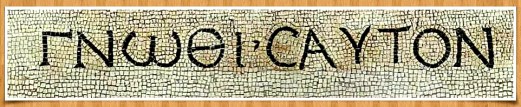
.
Apollo’s Gifts To Mortals
It was out of the Hyperborean land, from the North, that Apollo came to the Oracle at Delphi. Through the Pythia, in summer, he spoke the most important things that the Greeks wished to hear.
Apollo spoke through the unconscious soul-life of the Pythia, his will worked through the Pythia. The other gods worked with forces which are always connected with subconscious realms of the soul. It was incumbent upon the person to prepare himself for a meeting with the Pythia, that is the only way for him to understand the wishes of the Gods.
Apollo spoke through the unconscious soul-life of the Pythia. He was capable of seeing into the future, Apollo gave some mortals the gift of prophecy, the ability to see into the future. However, often times this “gift” came with severe consequences. In contrast with unconscious soul-life we have the Jahve-god uttering his commandments, making a covenant with his people, speaking directly to the Ego in the soul. We can see the contacts in cultures even this far back.
.
.
..
Oracle of Delphi
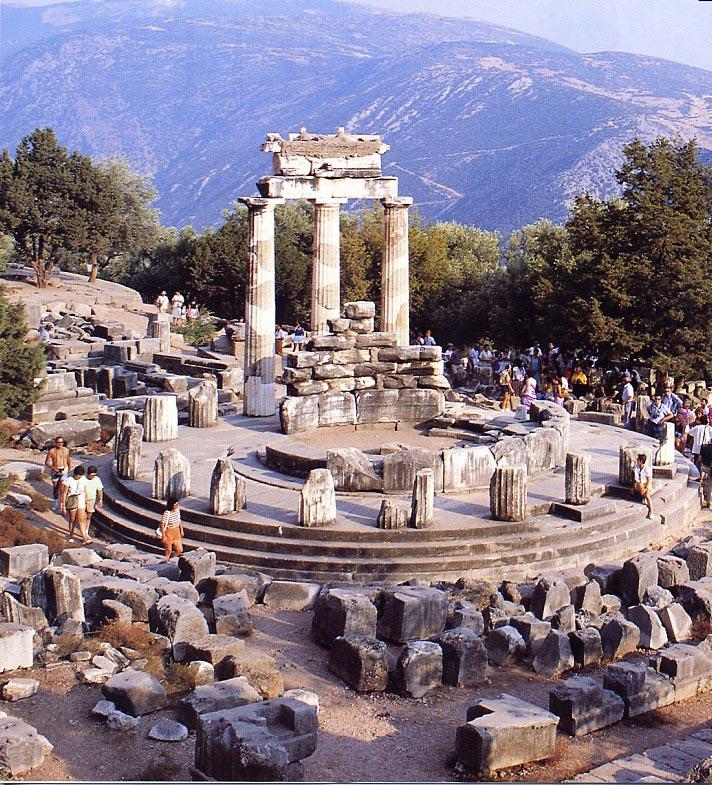 When Apollo had overcome the dragon Python, a temple was built. From the corps of the creature vapors emerged and out of the dragon we saw how the vapors entered into the soul of a priestess, known as the Pythia, she is the Oracle of Delphi.
The Greeks imagined that Apollo lived in these swirling dragon-vapors and prophesied to them through the Oracle Pythia. Through the mouth of the Pythia, what was passed on to the Greeks was Apollo’s wisdom. Those who sought advice addressed themselves to the Pythian Oracle and received from her mouth the words of Apollo. In Greece, Apollo was a living Being. It was everything that led them forward. Again and again people went to Apollo to ask for guidance on important occasions, and at difficult moments in their lives, ready to abide by his decisions. With their souls well prepared, they would receive prophetic guidance from the Pythia, who was stimulated by the vapors in which Apollo lived.
People traveled from far away places to have an audience with the Oracle. It was required to bring an animal to slaughter and check its insides for a favorable reading. The guest must also bathe in the waters of the cave to be clean in order to sit before the Pythia.
At this place, in the abode of Python, is where these curling, snake-like vapors issued from the gorge. This is where the Greeks erected the Pythian Oracle Sanctuary this was the center of the world, the Omphalos, Delphi (womb).
Sitting on her tripod, she would fall into a trance, then be transported by the rising vapors into a state of visionary consciousness, and her utterances were conceived to be the spiritual language Apollo.
The priests who tended and cared for her would then interpret the words spoken. Often, the priests answered the questions in the dactylic hexameter
.
.
.
Prophecies & Procedures
The Pythia derived her prophecies in a small, enclosed chamber below the temple. She went to this chamber every month, as tradition required. On the seventh day of the month the oracle would undergo purification rites, the number seven is sacred and associated with the god Apollo. She would also fast in order to prepare for communication with the divine. Her face covered in a violet veil, she was escorted by two priests to the temple One of the priests would then proclaim:
Servant of the Delphine Apollo
Go to the Castilian Spring
Wash in its silvery eddies,
And return cleansed to the temple.
Guard your lips from offence
To those who ask for oracles.
Let the God’s answer come
Pure from all private fault.
The Pythia would then bathe naked in the Castilian Spring, she would drink the holy water of the Cassotis, where a nymph possessing magical powers lived.
Euripides described the ritual in this wise, “Purification ceremony with the priest’s Ion dancing on the highest point of Mount Parnassus, home of the Muse. he would sprinkling the temple floor with holy water. The Hosioi, an aristocratic council of five, with a crowd of oracular servants, would arrive at the temple Consultants carrying the sacred laurel branches would approached the temple along the winding upward course of the Sacred Way. They would bring a young goat, a kid, for sacrifice in the forecourt of the temple, and a monetary fee.”
.
.
History of The Oracles
The name Pythia is derived from Pytho, which was the original name of Delphi. Her full background is unknown, but often controversial. Was she the sister of Asteria, the Titan Goddess of falling stars and nocturnal divination, is Phythia then the Goddess of day or night? Is her true title Pythoness? or was Asteria the sister of Leto who turned herself into a floating rock, which Leto then landed on to give birth to the twin God and Goddess?
Regardless of her true origin, Pythia sits in the temple on a golden tripod, in her left hand are sprigs of laurel and lavender, and in the other a wooden bowl full of holy water. One is to calm the other to cleanse. Apollo speaks through her. He speaks the sacred speech applying the dactylic hexameter. Seekers came to the temple from all over the world for guidance in all major decisions. Apollo would speak through this priestess and answer their questions.
The Delphi Oracles were a guild of virgin priestesses, all dedicated to the God Apollo. All were natives of Delphi. They were required to have had a sober life, and be of good character. Most were raised among the local farmers. The Pythia lived in her own home tended by two priests who also oversaw the guests. The Pythia made prediction 9 days a year, but the challenge was so great few of the priestesses lived beyond middle age. The guild were all considered priestesses, when one died another was chosen by the others to be the high priestess, the Oracle.
In our modern age there are those who have explored Delphi and discovered that the caves produce a certain gas that could have been the cause of hallucinations, or could put one into a trance like state. Two geological faults were discovered that intersect directly below the temple. The Delphi Earthquakes would release the hydrocarbon gas ethylene. Ethylene is a sweet smelling gas, it produces a narcotic effect often described as floating or a sense of disembodied euphoria. It is thought by modern science that the Priestesses could have been exposed to concentrations of the narcotic gas that were strong enough to induce a trance-like state. Of course, not so much when there were no earthquakes or tremors.
.
.
.

.
.
.
.
The End of the Oracle
Overtime things changed for many reasons. In later years some of the Oracles were married, However, upon assuming their role as the Pythia, the priestess would cease all family responsibilities, marital relations, and her individual identity.
In more prosperous times of the Oracle, the Pythia may have been a woman chosen from an influential family, well educated in geography, politics, history, philosophy, and the arts. During later periods, however, uneducated peasant women were chosen for the role, which may explain why the poetic pentameter or hexameter prophecies of the early period were later made only in prose.
The temple began to fall into ruin under the Roman Caesar Nero. He ended the practice of the Oracle, while he looted the temple. Julian the Apostate, the last pagan emperor, posed the last question to the Oracle, but the temple was already fallen into into pieces. Julian sent an emissary to pose the Oracle the question, in turn, the priests of the temple sent him the following reply, “Tell the Emperor that the glorious temple fell into ruins. Apollo does not have a roof over his head anymore. The leaves of the laurels are silent, the sources and prophetic streams are dead.” It was the Christian Emperor Theodosius I who finally closed the temple.
.
.
.
Knights of Pythias
While it is understood that most Secret Societies went underground due to the dominant beliefs of the age taking precedent, as well as, forbidding their practice by the ruling leaders. The Oracle of Delphi, and the Pythia all fell into ruins and vanished as the Byzantium Empire grew, and dominated what was once the Roman Empire.
Strange and Interesting the Knights of Pythia appeared at the end of the Civil War in the US, 1884. This lodge grew strong and spread world wide.
As most lodges of the time they had several object, part of their ritual, like most lodges they has a sword for the Knights of Pythia, imbedded in the handle of the blade was inscribed the initials FCB meaning, Friendship, Charity, Benevolence. On their mandilion we see the image of a knight’s helmet and a lion on the crest, a sprig of myrtle; the Pythian symbol of love. A falcon; the Pythian symbol of vigilance. We hope to learn more about this particular Lodge and any connection to Delphi. today and of the past.
.
.
.
.
.The Sibyls
The English word sibyl, is from Middle English, via the Old French sibile and the Latin sibylla from the ancient Greek Σίβυλλα. It was a Roman polymath and author, a man regarded as Rome’s greatest scholar, Marcus Terentius Varro, 116BC – 27AD. He derived the name sibyl from the Aeolic Greek also known as Aeolian Lesbian, Libya from an Aeolic sioboulla, the equivalent of Attic, theobule “divine counsel.” This ancient language dates back to 1200BC.
The first known Greek writer to mention a sibyl is Heraclitus, testimony of Plutarch, 500BC. “The Sibyl, with frenzied-mouths, uttering things not to be laughed at, unadorned and unperfumed, yet reaches to a thousand years with her voice by aid of the God.”
Greek philosophy is a significant sign of the birth of the Ego, but side by side with Greek philosophy we find the Sibylline soothsayers. Unlike the Pythia, under the influence of Apollo, the Sibyls were women whose life of soul lacked order and harmony, who allowed the revelations they received to work chaotically in their thinking, feeling, and willing.
So, who are they.
.
.The Five Oracles
 Delphi – The sacred site of Apollo’s priestess, the Pythia, she would deliver Apollo’s prophecies. The Oracle of Delphi is a key part of ancient Greek History. The Oracle influenced events, such as,
conflicts between Persia, Athens, and Sparta, among others. All were influenced by the riddled words of the Pythia. Her greatest influences were the Persian Wars, and Alexander the Great’s expansion of the empire.
The Oracle of Delphi, which found the sum of human wisdom in the expression “Know Thyself,” also said that there was no man wiser than Socrates, from which one might conclude that no man knew himself better than Socrates.
Delphi, is located in Phocis, a region in Greece, near the Gulf of Corinth. It was originally called Pytho, home of the Dragon-Python. If you remember the story the Dragon-Python under the spell of Hera, the jealous wife of Zeus. Hera using the Dragon-Python, tried to murder Apollo’s mother, Leto, while pregnant, with twins, in labor, looking for a safe place to land that wasn’t compromised by Hera’s spells. Eventually, she landed on a floating rock that grew roots into the ocean floor as she gave birth to the God Apollo and Goddess Artemis.
After Apollo was born he sought vengeance upon the monster who stalked his mother, which he did. He arrived at his destination on a Dolphin and killed the beast. From the vapors of the rotting beast, The island of Pytho was then given to him by Gaia, and he named it after the creature he arrived on, a dolphin, a Delphi. He was also given the temple by his father Zeus as an Oracle. Perhaps the best and most important Oracle in existence.
Delphi was originally guided by Gaia who was known as the ‘Grandmother of the Earth’. The city was guarded by a dragon, Python on the instructions of Gaia. This was the monster Apollo killed.
Phoebe was the third goddess to become a priestess of Delphi. She also happens to be the mother of Leto, and grandmother of Apollo.
.
.
Center Of The World
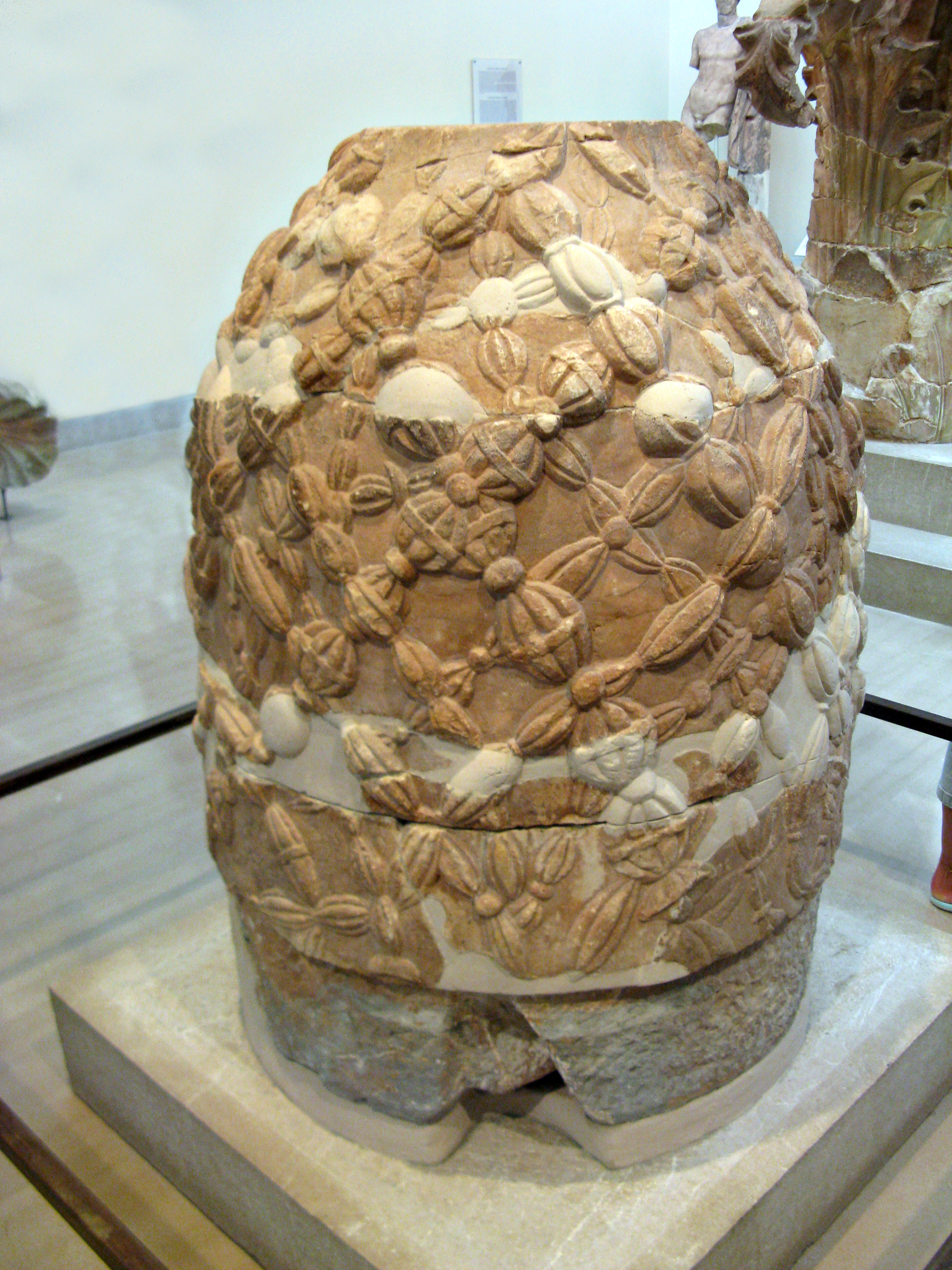 Delphi is considered the center of the world. This came about when Zeus released four eagles from the four corners of the Earth, which was believed to be flat, and they met at Delphi, which was henceforth known as the navel of the world, or the omphalos.
Delphi like other religious regions in Greece held Games to honor Greek deities. The Pythian Games commenced in 591BC and were held every eight years. The main event that took place at the Pythian Games was a musical competition. During the competitions, solo musicians sang hymnals to Apollo.
.
.
.
.
.
.
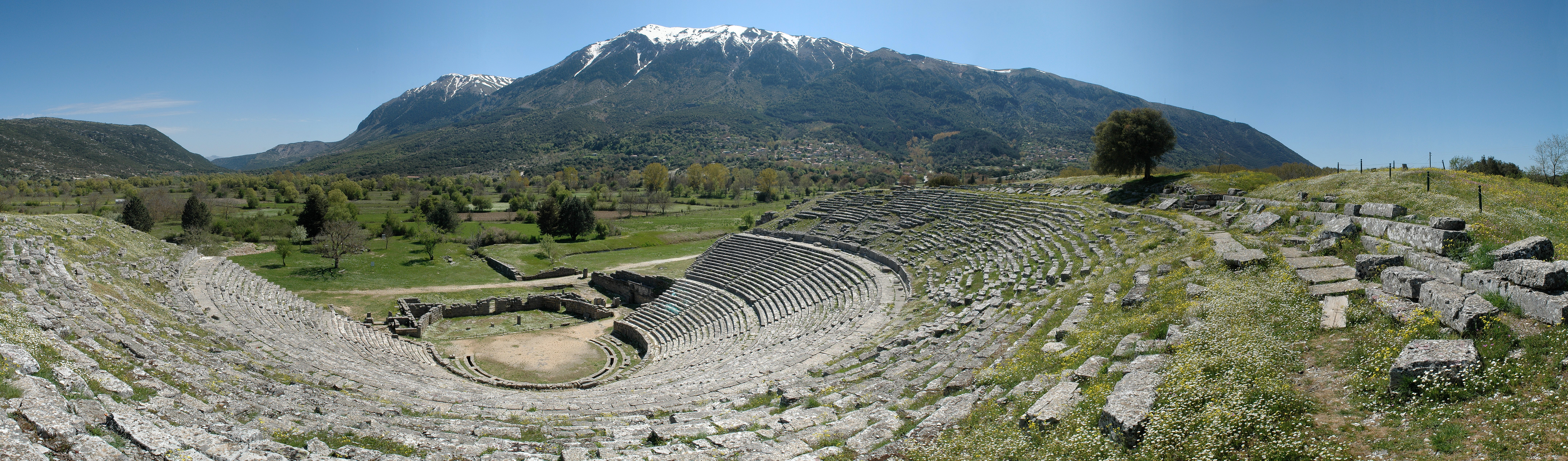
Dodona
Doric Greek: Δωδώνα, romanized: Dōdṓnā, in northwestern Greece was the oldest Hellenic oracle, possibly dating to the 2nd millennium BC according to Herodotus. The earliest accounts in Homer describe Dodona as an oracle of Zeus. Situated in a remote region away from the main Greek poleis, it was considered second only to the Oracle of Delphi in prestige.
Aristotle considered the region around Dodona to have been part of Hellas and the region where the Hellenes originated. The oracle was first under the control of the Thesprotians before it passed into the hands of the Molossians. It remained an important religious sanctuary until the rise of Christianity during the Late Roman era.
Trophonius.
.
.
Oracle at Abae
The oracle of Abae was one of the most important oracles. It was almost completely destroyed by the Persians during the Second Persian invasion of Greece.[13]
.
.
.
.
Erythaea
Create the page “The Oracle of Erythaea is one of the four oracles which are associated with Apollo. The oracle was known for giving prophecies out in the forms of acrostics (word puzzles).
The Dark Prophecy.
Apollo mentions the Erythaean Sybil liked to give acrostics (word puzzles) for her prophecies. Based on the lines of the prophecy from the Oracle of Trophonius, Apollo was able to determine that the Oracle and Sybil of Erythaea would be in the Southwest because that is where the third emperor would be. The Erytraean Sybil was referred to as the crossword speaker.
The Burning Maze
The Erythaean Sybil in the form of Herophile first appeared in a dream of Apollo’s, they were on a stone platform above a pool of lava and her hands were cuffed with molten chains attached to glowing red iron cuff anchoring her to the platform. When she speaks a crossword puzzle, she chokes as if glass was in her throat.
Apollo, along with Meg and Grover, find the Oracle in the heart of the Burning Maze and, after a brief fight with Medea, liberate her.
Prophecy
A prophecy was made by Apollo when he solved the puzzles while walking though the Burning Maze using Caligula’s caligae, the sibyl was trying to guide them to her. There were a series of chambers with glowing golden inscriptions on the wall, some not in English. Apollo, Meg and Grover had to choose the path with the square tiles that match the amount of the letters in the correct answer. Each answer forms a word in the prophecy. Clues:
.
.
Oracle at Didyma
The ruins of the Temple of Apollo at Didyma
Didyma near Ionia in Asia Minor in the domain of the famous city of Miletus.
Sibyl at Cumae
Cumae was the first Greek colony on the mainland of Italy, near Naples, dating back to the 8th century BC. The sibylla or prophetess at Cumae became famous because of her proximity to Rome and the Sibylline Books acquired and consulted in emergencies by Rome wherein her prophecies were transcribed. The Cumaean Sibyl was called “Herophile” by Pausanias and Lactantius, “Deiphobe, daughter of Glaucus” by Virgil, as well as “Amaltheia”, “Demophile”, or “Taraxandra” by others. Sibyl’s prophecies became popular with Christians as they were thought to predict the birth of Jesus Christ.
.
Asklepios, the Healer, is for the Greeks the son of Apollo, the healing god.
It is known for its many riddle by the Muse. In particular, the Riddle of the Sphinx.
“What has one voice but goes on four legs in the morning, two in the afternoon, and three in the evening?”
The wise Sphinx posed this riddle, and it was clever Oedipus who guessed the answer.
“It’s a human being, who crawls as a baby, stands on two legs as an adult, and walks with a stick in old age.”
==================================================
.
.
.
.
.
.Seventh Wife – Hera
Zeus made Hera his lush and fertile wife. She gave birth to youthful Hebê, Ares, and Eileithyia, joining in love with the king of gods and men, but Hera raged in strife with her husband, and joining in intercourse with no one, gave birth to renowned Hephaestus, who surpassed all the descendants of Ouranos in skill of his hands.
.
.
———————————————————————————
Lecture on the Muse
Clash of the Titans
Metis creator of Demeter, Hestia, and Hera.
Apollo was the patron of the muse
.
.
.
.
.
.
12 Olympian Gods
Children of Cronus
Zeus – Youngest Son. Overthrew his father becoming the God of all the heavens. God of thunder. Lord of justice.
Hera- Goddess of lawful marriage and family. Protector of women during childbirth. Faithful wife to Zeus.
Demeter – Goddess of agriculture and the harvest, presided over the fertility of the earth the natural cycle of life and death.
Hestia – Eldest of the Olympians, Virgin Goddess of the hearth, home, and hospitality.
Hades –
Poseidon –
.
.
.
.
Children of Zeus
Athena, endowed with courage and prudent counsel, equal to her father.
Athena, according to Greek mythology, was the goddess of wisdom and strategic warfare. Athena was the beloved daughter of Zeus. Her mother was the Titaness Metis, the first wife of Zeus. Zeus received a prophecy informing him that Metis would give birth to the child who would overthrow his father. To escape the prophecy, Zeus swallowed Metis while she was pregnant in Athena. Later, Zeus began to suffer from headaches and called on Hephaestus to help him. Hephaestus hit the head of Zeus with his hammer and Athena sprang out in full armor. She is always pictured to be armed, never as a child, always a virgin. She won the battle for the patronage of Athens over Poseidon. The Parthenon in Athens is the most famous temple dedicated to her. Protector of heroes and wisest among the Gods, Athena was considered one of the most powerful and important Olympian Gods.
Athena, endowed with courage and prudent counsel, equal to her father.
, Zeus placed her down into his belly,
so the goddess might advise him on good and evil.
Zeus himself gave birth from his head to owl-eyed Athena, fearsome rouser of battles, leader of armies, never wearying queen who rejoices at the clash of arms, wars, and battles.
In order to forestall these consequences, Zeus tricked Metis into turning herself into a fly and promptly swallowed her. However, she was already pregnant with their first and only child, Athena. Metis crafted armor, a spear, and a shield for her daughter, whom she raised in Zeus’ mind.
Athena, according to Greek mythology, was the goddess of wisdom and strategic warfare. Athena was the beloved daughter of Zeus. Later, Zeus began to suffer from headaches and called on Hephaestus to help him. Hephaestus hit the head of Zeus with his hammer and Athena sprang out in full armor. She is always pictured to be armed, never as a child, always a virgin. She won the battle for the patronage of Athens over Poseidon. The Parthenon in Athens is the most famous temple dedicated to her. Protector of heroes and wisest among the Gods, Athena was considered one of the most powerful and important Olympian Gods.
Apollo – God of the the sun, music, archery, prophecy and healing. His symbols sun, a bow and arrow, a lyre, and a swan.
Apollo The twin brother of Artemis – or Diana – children of Zeus and Leto.
On hearing of Leto’s pregnancy, Hera – Zeus’ wife – banned Leto from giving birth on land. Leto found the island of Delos (in the Cyclades archipelago of Greece), which was a ‘floating’ island and wasn’t anchored to the mainland, and gave birth to Apollo and Artemis safely there. When the twins were born, swans are said to have circled the island seven times – island was sacred to him . Zeus also gave his son a golden chariot pulled by swans as a gift. Apollo he is the only god in the classical pantheon to share the same name in both Greek and Roman traditions.
Artemis or Diana – twin sister to Apollo – – goddess of the hunt, wild animals, chastity and childbirth.
In the story of the hunter Actaeon. Actaeon stumbled into Diana’s grove as she bathed, catching a glimpse of the goddess naked. In retribution, she splashed him with water, cursing him and transforming him into a deer, and he was killed by his own hunting dogs.
Artemis from Ephesus
Ares –
Hermes –
Hercules –
Perseus –
Dionysus –
.
.
More Children of Zeus
Zeus had over 100 children a few we are familiar Gods.
Hephaistos – son of Zeus
Aphrodite –
The beginning and the end
.
.
*The Theogony, by Hesiod is a poem describing the origins and genealogies of the Greek gods, composed c. 730–700BC. It is written in the Epic dialect of Ancient Greek .
.
GREEK MYTHS GLOSSARY
Alpha & Omega –
Delphi –
Delphic Oracle – Ritual
Dionysian Rite – ecstasy and rebirth
Eleusinian Rites – Secret initiations near Athens honoring Demeter and Persephone, promising initiates afterlife bliss. Involved processions, fasting, and hidden revelations; open to all free people, emphasizing themes of death, rebirth, and agriculture.
Gigantomachy – battle with giants post-Titanomachy.
Homer – Blind story teller.
Hubris – Excessive pride leading to downfall, a key theme in myths.
Iliad and the Odyssey –
Labyrinth – Minos’s maze, symbolizing trials and intuition.
Moirae – The Fates who control destiny.
Muse –
Olympians – The principal gods residing on Mount Olympus, led by Zeus.
Oracles
Orphic Hymns – soul journeys and immortality
Prometheus – fire theft, human creation, punishment by Zeus
Theogony – creation and genealogy of gods.
Titans – Elder deities overthrown in the Titanomachy.
Titanomachy – In Greek myth, this 10-year cosmic war saw Zeus and the Olympians battle the Titans, led by Cronus. Aided by Cyclopes’ weapons (thunderbolts), the Olympians triumphed, banishing Titans to Tartarus—symbolizing the victory of order over primordial chaos.
– – – –
.
.Greco-Roman
From the Greek Gods to the Roman Gods
.
 Greek and Roman God of the sun, medicine, music, poetry, and sciences. Apollo’s epithet is Phoebus, “bright”.
The only God who kept his original name from the Greeks ot ht eSOmans
.
.
.
.
.
.
.
.
.
.
.
.
.
.
.
.
.
Roman Gods and their relationship to the Greek Gods.
Jupiter/Zeus
Juno/Hera
Neptune/Poseidon
Minerva/Athena
Mars/Ares
Venus/Aphrodite
Apollo
Diana/Artemis
Vulcan/Hephaestus
Mercury/Hermes
Ceres/Demeter
Vesta/Hestia
.
.
The beginning and the end
.
.
.
Atlantis Fell
When Atlantis fell it was from the misty sky, and as all the world solidified there was one final piece of heaven left surrounded by the brume and miasma. Yet, it remained for thousands of years above gazing at the remnant of all that was before, never forgetting all that took place, and witnessed all that came into being, and then that too fell. Today we call that last piece of heaven, Éireann. – Knowledge Of Ancient Worlds

People often believe Atlantis was met by flood, rising tides enveloped by heaps of rain. This is partially correct. The part that is often missed, or, perhaps, misunderstood is that Atlantis actually fell from the sky into the melting ice below. We then, to a certain extent, live on top of what was once inside this misty place, save one piece of what we call land today. One remnant that held on to this mist and haze, the fog and heavy vapor until it began to solidify, grew heavy and could hold on to the sky no longer. As it fell from the sky, it became known as the last piece of heaven. It is still there today, full of the memories of that place, its being, phantoms that even 23 and me can not figure out where they came from. Now, I won’t tell you the name of this place. I won’t tell you because you already know. See if you can draw it up from inside yourself. Can you remember? When you do, don’t forget to catch your breath and hold it for a moment or two.
Then, wait until you hear the tales of the dinosaurs, rock plants that squeak, and the Sphinx.
Goethe & Plato
There will be a public lecture as part of the Goethean Science Class on Goethe’s Relationship to Plato, the Platonic Year, and The 7 Platonic Solids.
Date and Location: 2nd Friday, 7PM-9PM, Lecture I.
.
.
.
.
.
.
The World Of Dreams – Myths And Legends 
Secret Wisdom Of The Fairytale
The Myth –
The Actions –
The Legacy –
von Goethe – The Green Snake and The Beautiful Lily.
Magical Idealism
Novalis – The Story of Hyacinth and Roseblossom
Ludwig Tieck. Tales from the Phantasus
Norse Mysteries
Snorri Sturluson, 1179 – 1241, Icelandic historian, poet, politician.
Odin – Twilight Of The Gods
Baldr – Phoebus – Christ
Greco-Roman Myths- Apollo and the Number 7
Delphic Maxims
The Golden Bough – Written by Virgil, 70–19BC. Roman poet. The narrative adventures of the Trojan hero Aeneas after the Trojan War.
Celtic Mysteries – I see/hear your thoughts vs the Semitic Materialism. “I am my father’s thoughts.”
T Sages
sagacity
W Magicians
F Healers
4
creators of all three in a harmonious balance, but unable to reach the heights.
almost a simpleton, naive but wwith great natural gifts yet divine heavenly wisdom
saturated in divine wisdome, not earth widom
Mystery Schools
—
European schools carried 12 and relied on the 13th to instruct
The Mysteries, by Goethe
Ancient History
Oriental – India Hindu cosmology: A world of endless cycles. Each cycle lasts for 4,320,000 years, 12,000 which are divine year. There are four Yugas, world ages. that repeat.
-Yuga Cycles:
Krita Yuga, Four legged cow.
Vishnu Incarnation
Fish
Tortes
Boer
Lion
Treta Yuga, three legged cow.
Rama
Dvapara Yuga, two legged cow.
Krishna
Kali Yuga, one legged cow.
Buddha
Kalki Yuga is the end of time, Vishnu Returns.
-Bodhisattva
Varna Man – Bronze
Persia
Zarathustra
Persepolis – 1st Empire
-Cyrus
-writing
-messengers
-first gardens
-textiles
-feasting
-Alexander
-Mesopotamia
-Babylon
-Egypt – Creators of the autobiography and [reservation of memory and reality. Persevering the dead created strong ties to the underworld. Where as, cremation cuts the ties from the material world to the spiritual world.
-Minoan
-Brief: Greece Rome Gnostics
-The Sibylline Oracles
– Eleusinian Mysteries
History Topics
History of Materialism
Money – banks, trust, labor, inspiration
Communication – media, truth/lies, art/creativity, imagination
Laws – politics, organization, social, intuition
Clocks & Calendars
Fibonacci
Magna Carta
The Black Death
Magic – From Ancient Greece through the Middle Ages.
Galileo –

Philosophy
Modern Mystics and Schools of Philosophy—William Blake
Theosophy – clairvoyant – adept – initiate
Rosicrucian –
Anthroposophy –
Modern Gnostic –
Mason –
H. P. Blavatsky to Manly P Hall
Philosophy Of Freedom, Rudolf Steiner
Study Of Goethean Science: Observation of the Senses, Understanding Quality.
Literature
CS Lewis — Narnia
JRR Tolkien – Rings Cycle
G.K. Chesterton – The Everlasting Man
Poetry
Edda – Snorri Sturluson [1220] (trans.) Pros — Codex Regius [written 1200]- Poetry — Skaldic Poetry
Milton—Paradise Lost
Novalus – 1794
Esoterica
Emerald Tablet
Song Of Life, Bodhisattva
Theophrastus von Hohenheim, Paracelsus – 1493-1541
13 Days – Christmas Eve through the Epiphany
Death – Is birth into the spiritual world. The 1st breath, the awakening of the soul, is the end if the life body and the experience of the will of the astral body, the connection with the anguloi, hierarchy.
The time of isolation, healing, justice, organization, skill 850—1190.
Raphael—Late Dark Age through Middle Ages. Out of the darkness, something new began to stir. The age of death and material enlightenment, humanism, a Greek Revival 1190—1510.
Samuel—High Middle Ages, Gothic through the Italian and English Renaissance.
1840–1879 Materialism from collective instinct to individualism.
Michael 1879
The Humors
The Etheric
The Astriak
The I
adepts
.
.
.
Prehistoric Orkney –
Hallstatt Culture –
First of the Celts – Varna Man
[tbc]
 .
.
.
.
.
.
.
.
.
.
.
.
.
.
.
.
.
.
.
.
.
.
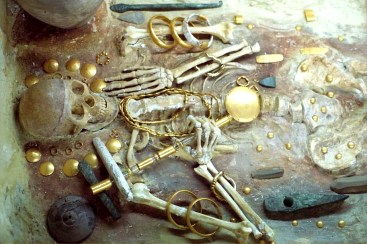 [tbc]
[tbc]
.
.
.
.
.
.
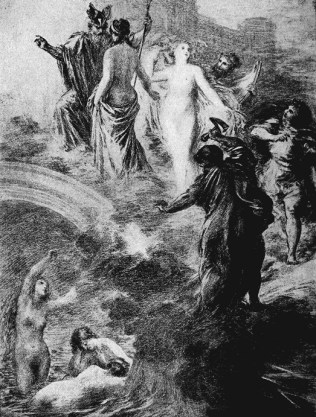
Opera Weekend
3rd Weekend of January
Weekend of Operatic Films. Every year there is an Operatic Theme, Verdi, Puccini, Mozart, Bizet, Strauss, Rossini, Wagner. The Film Club and Cooking Club produces this weekend. Each Opera is preceded by a Lecture on the Artist and the Opera in the Salon. On Saturday evening, a special room and Meal is prepared in the Café.
This year’s Opera is, Wagner, Der Ring des Nibelungen.
Friday: Lecture: 7PM – Film Opera: Das Rheingold
Saturday: Dinner: 5PM – Lecture: 7PM – Film Opera: Das Valkyrie.
Sunday: Lecture: 1PM – Film Opera: Siegfried.
Lecture: 6PM – Film Opera: Götterdämmerung.
.
[tbc]
.
.
.
.
.

Mozart’s Masked Ball
The celebration of Wolfgang Amadeus Mozart’s birth, 27th of January. No doubt this will be an enjoyable time for all. The lengths members go to creating these beautiful masks and head dresses is something to behold. Added to the fun is keeping these beautiful and interesting creations a secret all year until the day of the Ball. Not only are the masks admired, no one is really certain who is behind them. Whether dressed entirely for the period or draped in feathers, glitter, silks, velvet, or streams of cray-paper, the creations are always unique and remarkable. Half the fun is making and wearing the costume.
Once people arrive and have settled in, everyone is welcomed and the dance begins. Our dance instructors lead the dances for this period. The dances are simple period movements. However, if you are interested, they also offered instruction a week before. Our chamber orchestra performs the music.
The mask contest follows the dances. The contest is for the best and most captivating creations, cast by secret ballot. The contestant will walk the promenade in the style of their creation. They will then remove the masks and headdresses revealing the person behind them, they are placed on a stand at the front of the room.
This leads to a performance of one of Mozart’s songs by a few of our residents and performed by our chamber orchestra.
A birthday cake is then brought out and everyone will sing, Bei Männern welche Liebe fühlen, from Die Zauberflöte. Music and words, in English, will be handed out. Two of our residents sing the song, first in German, and then everyone joins in for a second time through in English. It is a simple song, but feel free to hum along if you wish. Cake and Champaign will then be served and ballots collected. There is more dancing followed by the announcement of the winners. Each winner will be crowned, receive a bottle of Champaign, and a Gift Certificate to the Tè Chay Tea Room. The winning head dresses will then be encased in a glass box for the year in the Tea Room as works of art.
F – History lecture Masonic weekend of fun!
S – The Magic Flute, film by Ingmar Bergman, 2pm
Then home to change into costume.
S Dinner – 7pm followed by games, music, candy, secrets, surprises, dance, Mozart’s – birthday cake
One of the most delightful events at the Masked Ball is the performance by the dance classe participants in the areas of traditional dances, but especially the Montagues and Capulets also known as, Dance of the Knight from Sergei Prokofiev’s Romeo and Juliet. This particular dance was choreographed by Sir Kenneth MacMillan. His version was first staged in 1965 for The Royal Ballet in London, it is used in almost every performance of the ballet. For new comers we invite you to step into the drama. MacMillan’s interpretation is legendary for its power, theatricality, and bold presence. The choreography is sculptural and commanding—a majestic processions, emphatic steps, and sweeping gestures that let every dancer feel poised, confident, and utterly unforgettable. Even those who say they “can’t dance” find their stride in its regal swagger. Dynamic, dramatic, and iconic, Dance of the Knights is not just a piece to perform—it’s an experience to embody. Note: Entrance, posture, and presence will be guided in class so every dancer can claim their place in this timeless story. Lessons begin in early December, every Saturday at 1PM until 4PM, in the Ballroom (Top Floor of the Swan Factory).
(think about treasures hunt this day or another time – weather maybe in June with Bloomsday OR tied to midsummer’s play with dinner and treasure hunt)
[TBC]
.
.
.
.
.
.WINTER FESTIVAL
.

PEACH Community – Annual Winter Olympics
Brought to you by the Cooking Club, Festivals and Celebrations Club, The Film Club, Bicycle, Ski & Skate Shop.
Event: A Weekend Long Winter Olympics (2nd weekend in January).
Registration Date: Halloween
Date and Time Of Event: Friday 4PM through Sunday 4PM.
 Friday: Opening 4PM Check-in – Rules of the Snow, Map of Course, Safety Outlines, Sleeping Accommodations.
Evening Activities; Songs, Games, Pot-luck Stew, Movie at 9PM.
Indoor Activities
Friday 6PM through Noon Sunday
Practical Arts
Knitting: socks, hat, scarf, or mittens.
Basket weaving and Bird House Building.
Book-Binding.
Outdoor Activities (must have cell phone
charged and turned on at all times).

Saturday 6AM – 8PM
Sun Up Through Sun Down – Cross Country Skiing: .22 calibers and bow and arrow targets.
Snow Walking: Snowshoes, bundle of sticks in a rucksack.
Course = half mile (see map).
1PM – Skating races; sing, double relay.
3PM – Ice Pole Dancing.
4PM – 4PM – Snowball Fight
8AM – 8PM: Ice fishing, Snowman Building, Igloo Building, Mountain Shoveling or Neighborhood Shoveling (weather dependent). Figure Skating and Sledding.
Sunday
All Projects Completed and Submitted by Noon.
Sunday Noon – 2PM: Poetry Reading – break or make time.
Crowing of the Winter King and Queen Song.
Glass Icicle Closing Ceremony.
Meals
Friday: Stew and salad pot luck.
Saturday: 6AM – 11AM Traditional Farmer’s Breakfast.
Saturday: 12PM – 4PM Soup, Sandwich, Salad.
Saturday Evening: Pizza, Popcorn.
Sunday: 6AM – 11:AM Traditional Breakfast.
All Day Treats and Snacks:
Coffee, Tea, Cocoa, Raw Milk. Maple Cookies, Shortbread, Zucchini Bread, Carrot Cake.
Our goal is to expand this Festival into a week-long event with more activities, indoor and outdoor, including; ice sculpture, a dogsled race/ride and ice hockey. If the weather is too nice or too cold, most activities will take place in the gym.
.
.
.
.
.

JANUARY CALENDAR
Festivals Celebrations: New Years Day, Myth’s and Legends, Winter Festival and Olympics, Sunday Afternoon Wind Ensembles Performances, Opera Festival, Mozart’s Masked Ball, Reading of the Edda, Open House.
Lectures – Great Mysteries: The Mystery Schools. Mystery of the Arts. The Evolution of The Cosmos. The Creation and the Fall. Modern Mystics and Schools of Philosophy. ( Friday Evenings 7PM).
Goethean Science, Individual Topics (Saturday Afternoons 2PM).
The Greeks:
Lecture on the Muse, Wives of Zeus. Clash of the Titans.
Topics in Ancient History & Cultural: Topics In Ancient History: Hallstatt Culture – Varna Man India, Persia, Mesopotamia, Egypt. Review: Greece, Rome Early Christians through the end of Rome – 800, 1066, 1190 (Saturday Evenings 7PM)
History of the Mystic: The Expansion and Contraction of Civilizations: Lemuria, Atlantis, Norse, Buddha, Zoroastrian. Reading of the Poetic Edda. (Sunday Evenings 7PM)
Arts: Pottery, Painting, Woodworking, Music, Dance, Theatre, Photography, Printmaking.
Clubs: Lecture and History Clubs, Book Club, Sports Club, Dance Clubs,
Writer’s Club: Intuition – 1k to 3k Essay: A mystical trip. Mundane, Magical, Shock!
Businesses: Ski and Skates, Swan Factory.
Open House: Description of the Calendar, Celebration and Festivals, Businesses, Sports, Clubs, Lectures, History, Educational Classes, Administration, All Skills, Fine Arts and Folk Arts.
.
.
.
.
.
.

.
.
.
.
.
.
.
.
.
.
.
Living Pan-European and American Cultural and Heritage Community Center

.
EMAIL: peachcommunity yahoo.com
.
.
.
.
.
.
.
.
.
.
.
.
.
quicklink
.
.
.
.
.
.
.
.
.
.
.
.
.
.
.
.
.
.
.
.
.
.
.
.
 PEACH COMMUNITY