.
.
[ 7th–8th Centuries – Church and monasteries preserve literacy, law, classical knowledge.
~Silk Road
700 AD – The Father of Western Europe, Charlemagne, Charles the Great, King of the Franks, King of the Lombards, Emperor of the Romans, Ruler of the Carolingian Empire, Pater Europe, Beatified.
Viking Raids ~790–1100 AD Norse plunder redraws Europe’s borders.
850 AD – Rollo The Viking Chieftain Ruler of Normandy.
Pepin the Short – 714-768, Latin: Pipinus. French: Pépin le Bref. German: Pippin der Kurze. King of the Franks, 751 – 768. First Carolingian to become king.
The Germanic Tribes
Text by Rudolf Steiner
The Germanic tribes came to rest in different places, you will think of the way these races brought their ancient institutions, their manners and customs, with them into their new homes, and developed them there. And we see that they preserved their own peculiar character, a kind of social order, consisting in the distribution of private and common property.
There were little social assemblies, which formed their original organization: village communities, then, later, hundreds and cantons; and in all these, what could be common property was so: forest, meadow, water, etc. And only what a single individual could cultivate was assigned to the private family and became hereditary; all the rest remained common property.
Now we have seen that the leaders of such tribes received much larger territories at the conquest, and that on this account certain positions of mastery sprang up, especially in Gaul, where much land was still to be reclaimed.
For the working of these domains, it was partly members of the former population, partly the Roman colonists or prisoners of war, who were taken. In this way, certain legal conditions grew up. The large landowner was not responsible to others for what he did on his own property; he could not be brought to book for any orders that he gave. Hence he could rescind for his own estate, any legal prescription or police regulation. So, in the Frankish Empire, we meet with no united monarchy; what was called the Empire of the Merovingians was nothing more than such a large landed estate.
The Merovingians were one of the families which possessed much land; according to civil law — through the struggle for existence — their rule extended farther and farther. New territories were constantly added to it. The large landowner was not such a king as we have been accustomed to in the 13th, 14th, yes, even in the 16th century; but private government gradually became legal rule.
He transferred certain parts of his domain, and with them his rights; to others with less land; that was called being “under exemption”; this judicial authority had grown out of the irresponsible position in such circumstances. In return, this type of landowner must pay tribute, and do military service for the king in time of war. In the expansion of such proprietary relationships, the Merovingian stock as conquerors took precedence of all others, so that we must retain the formula: the ancient Frankish Empire progressed through purely private legal conditions.
Again the transition from the Merovingian to the Carlovingian stock, from which Charles Martel descended, took place in the same way, out of the same conditions. The Carlovingians were originally stewards of the domains of the Merovingians; but they gradually became so influential that Pepin the Short succeeded in putting the imbecile Childeric into a monastery, and, with the help of the pope, in deposing him. From him was descended his successor, Charlemagne.
In a cursory survey we can only touch upon the external events; for, indeed, they have no further significance. Charlemagne made war on the neighboring German tribes and extended his control in certain directions. Even this empire, however, cannot be called a State. He waged lengthy wars against the Saxons, who clung to the ancient village organization, the old manners and customs, the old Germanic faith, with great tenacity. Victory was won after wearisome wars, fought with extraordinary ferocity on both sides.
Among such tribes as the Saxons, one personality in particular would stand out, and would then become a leader. One of these was Widukind, a duke with great possessions and a strong military retinue, whose courage withstood the most violent opposition. He had to be subdued with the greatest cruelty, and then submitted to the rule of Charlemagne. What did the rule amount to? It amounted to this: if the authority of Charlemagne had been withdrawn, nothing special would have happened. Those tribesmen who in their thousands had been obliged to submit to baptism, would have gone on living in the same way as before.
— It was the form Charlemagne had given the Church which established his powerful position. Through the power of the Church these territories were subdued. Bishoprics and monasteries were founded, the large properties formerly possessed by the Saxons were distributed. The cultivation of these was in the hands of the bishops and abbots; thus the Church undertook what had formerly been done by secular landholders protected by “exemption,” namely, judiciary authority. If the Saxons did not acquiesce, they were coerced by fresh inroads of Charlemagne. Thus the same things went on as in western France: the smaller landowners could not carry on alone, hence they gave what they had to the monasteries and bishoprics, to receive it again under feudal tenure.
The one condition was, then, that the large properties should belong to the Church, as in the newly established bishoprics of Paderborn, Merseburg and Erfurt, which were cultivated for the bishop by the conquered tribes. But even those who still had their own possessions held them as fiefs and had to pay ever-increasing taxes to the bishoprics and abbeys. This was how the rule of Charlemagne was established: with the help of the great influence obtained by the Church whose suzerain he was, his position of authority was achieved. —
Charles extended his authority in other regions, just as he was extending it here. In Bavaria he succeeded in breaking the power of Duke Tassilo and sending him to a monastery, so that he might bring Bavaria under his own dominion. The Bavarians had allied themselves with the Avars, a people who may be called the successors of the Huns. Charles was victorious in this struggle and fortified a strip of land as a boundary against the Avars, the original Avarian limit of the land which to-day is Austria. In the same way he had protected himself also against the Danes.
Like Pepin he fought in Italy against the Longobards, who were harassing the pope; again he was victorious, and established his authority there. He experienced too against the Moors in Spain, and almost everywhere he was the victor. We see Frankish rule established over the whole of the European world of those days; it merely contained the germ of the future State.
In these newly won regions, Counts were inaugurated, who exercised justiciary authority. In the places where Charlemagne alternatively held his court — fortified places called Palatinates — were the Counts Palatine, mostly large landowners, who received certain tribute from the surrounding districts. It was not only tribute from the land and soil, however, which fell to their share; they also received revenues from the administration of justice. If a murder were committed, the public tribunal was convened by the Count Palatine. A relative, or someone who was closely connected with the victim, brought the indictment. At that time certain compensation could be paid for murder, a recognized sum, differing in value for a free man and an unfree, paid partly to the family of the murdered man, partly to the justiciary of the canton, and partly to the king’s central fund. Those who looked after communal concerns — actually only such as concerned taxes and defense — were the land-graves, who travelled from one district to another, ambassadors with no special function.
Under these conditions, the divergence between the new nobility of landowners and the serfs became more and more marked, and also between the landowners and those freemen who were indeed personally still free, but had fallen into a condition of servile dependence, because they had to pay heavy tribute and to render compulsory military service. These conditions grew more and more critical; secular and ecclesiastical property became increasingly extensive; and soon we see the populace in bitter dependence, and already we meet with small conspiracies — revolts — foreshadowing what we know as the Peasant Wars. We can understand that, in the meantime, material culture developed more and more productively. Many Germanic tribes had had no concern with agriculture before the folk migrations, but had earned their living by cattle raising; now they were developing agriculture more and more; especially were they cultivating oats and barley, but also wheat, leeks, etc. These were the essential things which were important in that older civilization. There was, as yet, no actual handicraft; it was only evolving under the surface; weaving, dyeing, etc. were mostly carried on by the women at home. The arts of the goldsmith and the smith were the first crafts to be cultivated. Still less important was trade.
Actual cities were developed from the 10th century onwards, and therewith a historical event began to take shape. But what sprang up with these cities, namely trade, had at that time no importance; at its best it was only a trade in valuables from the East, carried on by Israelite merchants. Trade usages hardly existed, although Charlemagne had already had coins minted. Nearly everything was barter, in which cattle, weapons, and such things were exchanged.
This is how we must picture the material culture of these regions; and now we shall understand why the spiritual culture also was bound to assume a certain definite form. Nothing of what we picture as spiritual culture existed in these regions, either among the freemen or the serfs. Hunting, war, agriculture, were the occupations of the landowners; princes, dukes, kings, even poets, unless they were ecclesiastics, could seldom read and write. Wolfram von Eschenbach had to dictate his poems to a clergyman and let him read them aloud to him; Hartmann von der Aue boasts, as a special attribute, that he can read books. In all that secular culture catered for, there was no question of reading and writing. Only in enclosed monasteries were Art and Science studied. All other students were directed to what was offered them in the teaching and preaching of the clergy. And that brought about their dependence on the clergy and the monks; it gave the Church its authority.
When we read descriptions today of what is called “the dark Middle Ages” — persecution of heretics, trials of witches, and so on — we must be clear that these conditions only began with the 13th century. In the older times nothing of this kind existed. The Church had no more authority than the secular large landowners. Either the Church went hand-in-hand with the secular authority, and was only a branch of it, or it was endeavoring to cultivate theology and the science of Christianity.
Until the current of spiritual influence came from the Arabs, all spiritual concerns were fostered only in the monasteries; the activities of the monks were completely unknown to the world outside. All that was known outside the monasteries was the preaching, and a kind of spiritual instruction given in the primitive schools.
The authority of the Church was enhanced by the fact that it was the clergy themselves who carried out all the arrangements for promoting knowledge. The monks were the architects; it was they who adorned the churches with statues, they who copied the works of classical, too, the emperor’s chancellors, were, for the most part, monks.
One form of culture which was fostered in the monasteries was Scholasticism. A later was Mysticism. This scholasticism, which flourished until the middle of the 14th century, endeavored — at least at one juncture — to inculcate a severely disciplined way of thinking. There were severe examinations to undergo; nobody could make progress in absolutely logical discipline of thinking without hard tests; only those who could really think logically, were able to take part in the spiritual life. Today that is not considered. But actually it was because of this training in consistent logic that when the Moorish-Arabian culture came to Europe, this science found disciplined thinking there already. The forms of thought with which Science works today were already there; there are very few arrangements of ideas, which are not derived from thence.
The concepts with which the Science — still operate today, such as subject and object, were established at that time. A training of thought, such as does not appear elsewhere in world history, was developed. The keen thinker of today owes that which flows in the veins of his intellect to the training fostered between the 5th and 14th centuries. Now some may feel it to be unjust that the masses at that time had nothing of all this; but the course of world history is not directed by justice of injustice, it follows the universal law of cause and effect. Thus we see here two definite currents flowing side by side: 1. Outside, material culture, absolutely without science; 2. A finely chiseled culture, confined to a few within the Church. Yet the culture of the cities was based on this strict scholastic way of thinking. The men who carried through the great revolution were ecclesiastics: Copernicus was a prebendary, Giordano Bruno was a Dominican friar. Their education and that of many others, their formal schooling, was rooted in this spirit of the Church. They were not powerful men, but simple monks, who, indeed, often suffered under the oppression of those in power.
Nor was it bishops and rich abbots, but on the contrary, poor monks, living in obscurity, who propagated the spread of Science. The Church, having allied itself with external powers, was obliged to materialize itself; it had to secularize its teachings and its whole character. Very long ago, up to the 12th century, nothing was held more solemn, more sublime, by the Christians, than the Lord’s Supper. It was regarded as a sacrifice of grateful remembrance, a symbol of the intensifying of Christianity. Then came the secularization, the lack of understanding for such exalted spiritual facts, especially as regards the festivals.
In the 9th century there lived in the land of the Franks, at the court of Charles the Bald, Scotus Erigena, a very distinguished Irish monk, in whose book De Divisioni Naturae we find a rich store of profound intellectual thought — though, indeed, not what the 20th century understands as Science. Erigena had to fight against hostile criticism in the Church. He defended the old doctrine that the Lord’s Supper represented the symbolism of the highest Sacrifice. Another, materialistic, interpretation existed, and was supported in Rome, namely, that the bread and wine was actually transformed into flesh and blood. This dogma of the Lord’s Supper originated under the influence of this continuous materialization, but it only became official in the 13th century.
Scotus Erigena had to take refuge in England, and at the instigation of the pope, was murdered in his own monastery by the fraternity of monks. These struggles took place, not within the Church, but through the interpenetration of secular influence. You see that spiritual life was confined to a few, and was closed to the masses, upon whom lay an ever-increasing pressure, both from the secular and the spiritual side. In this way discontent continued to grow. It could not be otherwise than that dissatisfaction should increase among these people of divided loyalties. In country, on the farms, new causes of discontent kept cropping up. No wonder that the small towns, such as those already established on the Rhine and the Danube, should continually grow larger and form themselves anew from the influx of those who could no longer get on in the country. The fundamental cause of this reorganization of conditions was the people’s thirst for freedom.
It was a purely natural motive which gave rise to the culture of the cities. Spiritual culture remained undisturbed for the time being; many cities developed round the bishoprics and monasteries. From the city-culture rose all that constituted trade and industry in the Middle Ages, and afterwards brought about quite different relationships.
The need to develop the full life of the human personality, was the cause of the founding of the cities. It was a long step on the path of freedom; as, indeed, according to the words of Hegel, history signifies the education of the human race towards freedom.
And if we follow the history of the Middle Ages farther, we shall see that this founding of the city-culture represented, not an insignificant, but a very important step on the path of freedom
The Early Middle Ages, 476 AD through the era of hierarchy, Charlemagne, Viking Hoards, 800 AD. The High Middle Ages, 1000 AD -1300 AD, the Great Schism and the Crusades through the diseased riddled end of the Late Middle Ages, 1400 AD. We discover what is long forgotten, seldom written or read, and yet it is always with us.
How do you sum up the entirety of the Middle Ages? War, famine, disease, religion, power, control, survival? It is indeed a slow bake. 1000 years of pure survival, living surrounded by nature, and your family tribe. Skills to survive were passed down through generations, Your last name designated you as the son of John (Johnson) or of the clan of Smiths (Smithy) a member of a skill.
The Medieval period has more to offer than we realize, and we bring the gifts, the lessons and the skills taught and learned forward. These skills were part of our inheritance, they taught us to think, to innovate and to become masters of the muse. As we descend into the darkness of the year, we draw closer to our people and how much we are like them, and how much they were like us.
The Path of Initiation in the Dark and Middle Ages
Men brought into the mysteries faced three distinct stages through which they had to pass through.
First – simple-mindedness. The meaning of the name, Percival—Persifal—Parzival—“through the vale”—”the middle”—was the name given in medieval times to all such candidates for initiation. The process taking place in nature is the same what takes place in the animal kingdom and human beings. However, only in nature does it take place without desire or passion. It goes forward in perfect purity and chastity. The boundless and chaste innocence that sleeps in the flower buds of the plants was felt. This feeling must enter right into the soul of the pupil.
Second – doubt. The struggle, the trials, and tribulations, suffering, and understanding of one’s limits. The limits of nature pushing back, the learning of laws, loyalty and dedication, and the journey to freedom.
Third – blessedness. Through freedom, a choice made independently to serve. This is true freedom and a blessing.
Early Medieval Feudalism (~1100 AD): Lords, vassals, serfs redefine Europe’s power.
Knights Templar (1119–1312 AD): Pilgrim guardians to bankers, betrayed by greed (lecture Sep 24).
===
Charlemagne (Charles the Great)
TITLE: King of the Franks; Holy Roman Emperor
PRIMARY OCCUPATION: Monarch; Military Leader; Empire Builder
FULL NAME: Carolus Magnus
BIRTH: 742 – Aachen (modern Germany)
DEATH: 814 – Aachen
PARENTS: Pepin the Short (father), Bertrada of Laon (mother)
SIBLINGS: Carloman I (brother)
EDUCATION: Basic education from court scholars; lifelong learner
PHILOSOPHY/RELIGION: Christian (Catholic), supporter of Church reforms
ACCOMPLISHMENTS: United much of Western Europe; crowned Holy Roman Emperor by Pope Leo III in 800; promoted Carolingian Renaissance; reformed administration and education
AFFILIATIONS: Carolingian Dynasty; Holy Roman Empire; Catholic Church
YEARS OF RULE OR VOCATION: King of Franks 768–814; Emperor 800–814
SPOUSES: Hildegard of Vinzgouw (primary wife) and others
CHILDREN IN WEDLOCK: Louis the Pious, Charles the Younger, and others
OUT OF WEDLOCK: Several illegitimate children
NAME OF SUCCESSOR: Louis the Pious
WORKS/BOOKS: None authored, patron of learning and arts
SYMBOL/EMBLEM: Imperial eagle; Carolingian heraldry
CONTEMPORARIES/RIVALS: Byzantine Emperors, Saxon tribes, Lombards
LEGACY/INFLUENCE: Father of Europe; shaped medieval European identity; cultural revival known as Carolingian Renaissance
MEMORABLE QUOTE: “To have another language is to possess a second soul.”
Charlemagne’s Empire (c. 800 AD): Carolingian Renaissance, forced conversions, iron rule.
Through the system of Portable Inheritance; property apportioned amongst heirs, most of which is passed down to the eldest son, the kingdom was passed down through the generations. However, this did not stop the Franks from expanding their lands into other areas, which included the western edges of Germany and Denmark to the borders of the Visigoths. Today Spain.
By the time Charlemagne was born, two centuries had passed since the Franks had conquered, secured, and constantly expanded their lands throughout most of Gaul. Conquering and battling seemed to be in their blood, and part of their culture.
Charlemagne – Charlemagne – Charles the Great, Carolus Magnus – 2 April 747 – 28 January 814. Carolingian Dynasty, King of the Franks, 768. King of the Lombards, 774. First Roman Emperor, 800. Charlemagne united most of Western and Central Europe. He was the first recognized ruler since the fall of the Roman Empire, 376AD. He expanded the Frankish state known as the Carolingian Empire. Furthermore, he was canonized by Antipope Paschal III and is now regarded as beatified in the Catholic Church.
He became king of the Franks in 768AD following his father’s death. Initially he was co-ruler with his brother Carloman I until his death in 771AD. As sole ruler, he continued his father’s policy towards protection of the papacy. He removing the Lombards [ last of roman Rule, now Italy]from power in northern Italy and leading an invasion of Muslim in Spain. He fought the Saxons to his east, and Christianized them upon penalty of death (Massacre of Verden). In 800AD he was crowned Emperor of the Romans, by Pope Leo III, on Christmas Day, at St. Peter’s Basilica, in Rome.
The feats and triumphant marches of Charlemagne occupies an extravagant amount of space in European History. He is known posthumously as the Father of Europe, Pater Europae. He united most of Western Europe, something not done since the Roman Empire, along with parts that had never been under Frankish or Roman rule. Through his leadership and power within the church he sparked the Carolingian Renaissance, a time of expanding and unifying Carlovingian cultural and intellectualism.
On the other side of Christianity, the Eastern Orthodox Church disfavored Charlemagne, this was due to his support of the filioque (son not of baptism) and the role of women in the church (Irene of Athens). These disputes eventually led to the split between the Rome and Byzantium – Romaioi Church, during the Great Schism,1054AD.
Regardless, all what was accomplished under Charlemagne was only an external expression of much deeper events in the Middle Ages. Events leading to many convergence and significant factors in the formation and evolution of Europe and the modern world today.
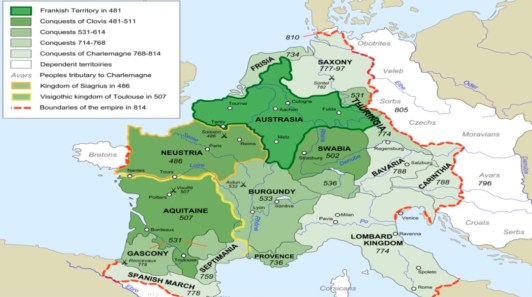
The Middle Ages – European conditions after the folk migrations.
The Evolution of Property, Laws and Societal Structures.
From Tribes to The Church to Kingdoms.
From Villages to City.
List of Popes
List Of Kings & Rulers
======================
etc…
Alcuin of York
TITLE: Scholar; Advisor to Charlemagne; Theologian
PRIMARY OCCUPATION: Educator; Theologian; Advisor
FULL NAME: Alcuinus Eboracensis
BIRTH: c. 735 – Northumbria, England
DEATH: 804 – Tours, Francia
PARENTS: Unknown
SIBLINGS: Unknown
EDUCATION: Trained in the monastery school at York
PHILOSOPHY/RELIGION: Christian (Catholic)
ACCOMPLISHMENTS: Key figure in Carolingian Renaissance; reformed education across empire; advisor to Charlemagne; wrote theological and educational works
AFFILIATIONS: Carolingian court; Monastic schools
YEARS OF RULE OR VOCATION: c. 780–804
SPOUSES: None (clerical celibacy)
CHILDREN IN WEDLOCK: None
OUT OF WEDLOCK: None
NAME OF SUCCESSOR: None
WORKS/BOOKS: Various theological treatises and letters
SYMBOL/EMBLEM: Monastic symbols; educational emblems
CONTEMPORARIES/RIVALS: Charlemagne, Einhard
LEGACY/INFLUENCE: Father of medieval education reform; preserved and spread classical knowledge in early Middle Ages
MEMORABLE QUOTE: “Knowledge is the food of the soul.”
.
.
Pope Leo III
TITLE: Bishop of Rome
PRIMARY OCCUPATION: Religious leader
FULL NAME: Leo
BIRTH: Unknown – Rome, Italy
DEATH: 816 – Rome, Italy
PARENTS: Unknown
SIBLINGS: Unknown
EDUCATION: Clerical training in Rome
PHILOSOPHY/RELIGION: Christianity – Roman Catholic
ACCOMPLISHMENTS: Crowned Charlemagne as Holy Roman Emperor in 800; strengthened papal power
AFFILIATIONS: Catholic Church
YEARS OF RULE OR VOCATION: 795–816 (Papacy)
SPOUSES: None (celibate clergy)
CHILDREN IN WEDLOCK: None
OUT OF WEDLOCK: None
NAME OF SUCCESSOR: Stephen IV
WORKS/BOOKS: Letters and correspondence
SYMBOL/EMBLEM: Papal tiara and keys
CONTEMPORARIES/RIVALS: Charlemagne; Byzantine Emperor Nikephoros I
LEGACY/INFLUENCE: Solidified alliance between Frankish monarchy and papacy; pivotal in founding the Holy Roman Empire
MEMORABLE QUOTE: “It is God who makes emperors.”
.
.
strong>Otto I (the Great)
TITLE: Holy Roman Emperor
PRIMARY OCCUPATION: Monarch, military leader
FULL NAME: Otto I of Germany
BIRTH: 23 November 912 – Wallhausen, East Francia
DEATH: 7 May 973 – Memleben, Holy Roman Empire
PARENTS: Henry I the Fowler (King of East Francia), Matilda of Ringelheim
SIBLINGS: Thankmar, Henry, Bruno, Hedwig, Gerberga
EDUCATION: Courtly and military training under his father
PHILOSOPHY/RELIGION: Christianity – Roman Catholic
ACCOMPLISHMENTS: Defeated Magyars at Lechfeld (955); Crowned Holy Roman Emperor (962); Consolidated imperial power in Italy and Germany
AFFILIATIONS: Ottonian Dynasty; Holy Roman Empire
YEARS OF RULE OR VOCATION: King of Germany (936–973); Holy Roman Emperor (962–973)
SPOUSES: Edith of England, Adelaide of Italy
CHILDREN IN WEDLOCK: Liudolf, Otto II, and others
OUT OF WEDLOCK: William (Archbishop of Mainz)
NAME OF SUCCESSOR: Otto II
WORKS/BOOKS: None authored; chronicled by Widukind of Corvey and Liutprand of Cremona
SYMBOL/EMBLEM: Imperial orb and cross
CONTEMPORARIES/RIVALS: Pope John XII, Berengar II of Italy
LEGACY/INFLUENCE: Founder of the Holy Roman Empire; strengthened imperial-papal relations
MEMORABLE QUOTE: “By the will of God, I have brought peace and empire to Christendom.”
.
.
768 – Charlemagne ascends Frankish throne, campaigns unify Western Europe.
800 – Charlemagne crowned Emperor of the Romans by Pope Leo III.]
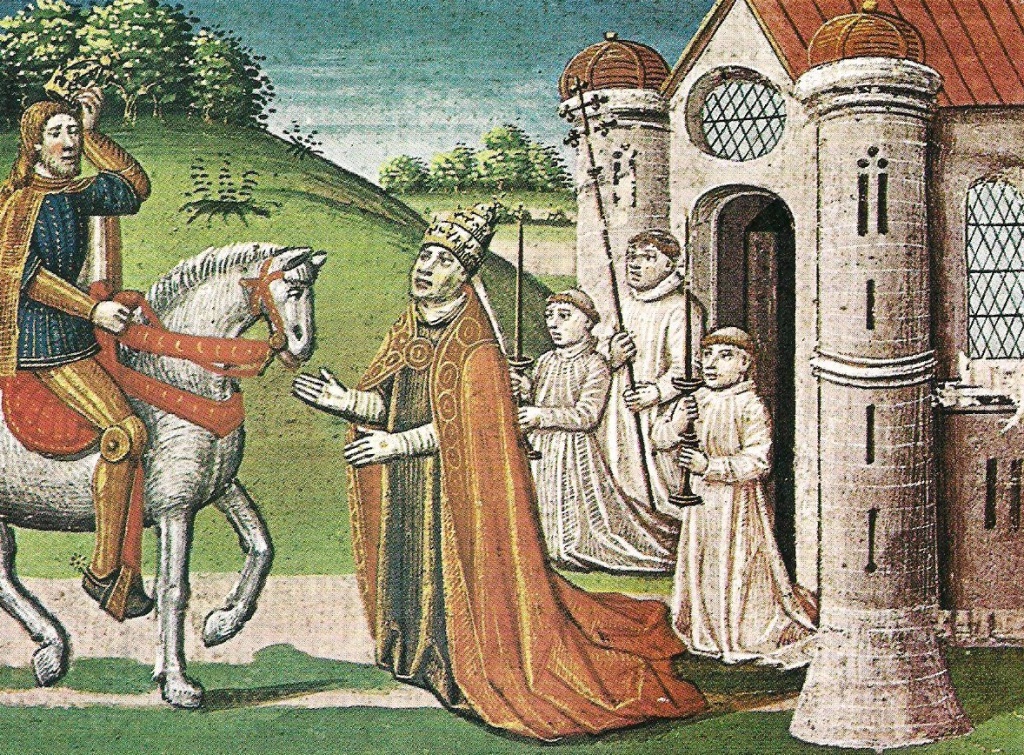
Western People – Peasantry During the Medieval Age
Hygiene & Health
Health throughout history has always been a concern. Many growing towns suffered unsanitary conditions due to the lack of a proper sewage system, or a way to manage the waterways, but people were aware of the importance of water and sanitation.
It took centuries to really bring the topic to a collective consciousness. See the book and documentary Silent Spring, by Rachael Carson. Through the 1960s, many people in the US were still tossing their trash in the streets and parks, dumping chemical waste into the waterways, and up until the late 19th century many people would throw their human waste in the gutter.
Bidet
However, there were flushable toilets, but they were few and far between. Those that had them had a water flush system and that pushed the waste into a cistern where the cistern would be used later as fertilization in fields, thrown into rivers, or simply buried. The toilet, a.k.a., water-closet, was invented in Great Britain during the 1500s. This was mostly enjoyed by those with status and wealth. On a larger scale, and to rid the growing cities of illness, the modern flushable toilet today was invented in the 1860s by a fellow named, Thomas Crapper. By the 1900s, indoor toilets quickly became the standard fare in building. Regardless, crowded areas were often unbearable to live in. Mass sanitation was one of the many hallmark accomplishments in Western Civilization.
Sadly, there still lies a common misconception that Medieval people, mostly the peasantry, were always dirty and paid little attention to personal hygiene. Of course, lice and other parasites, along with plagues, and body odor from hard work helped to create this misconception. They did not have access to the vast surplus of water we have today, but they were well aware of the difference between being clean and not clean. They clearly understood that the importance of cleanliness was next to Godliness. The Germans took this to a new level in the 1700s, (see the Enlightenment). If you pay attention to the geography of a city, you will notice most towns and villages were built near a source of water. In rural areas, wells were always dug first, and cities near large bodies of water used the old Roman system of lead pipes.
To Wash
A topic most often presented in Medieval art and literature was bathing. It was an important and basic part of life. All ages and incomes understood the Basic Hygiene troubles in the Middle Ages. Whether a jug basin, tub or trough was used to soak.
In wealthy homes, they had wooden bath tubs. The peasantry washed their faces and hands every day, upon waking and especially before meals, since most people ate with their hands.
In rural areas, our people would bathe in ponds, springs, or lakes. Due to the laborious sweaty and hands-on dirty work, most people would bathe daily.
In towns there were public bath-houses, both men and women would bathe together – this often led to a number of problems and troubles. Later, during the Victorian Era, bath-houses separated males and females.
Many bathhouses were connected to factories which allowed the water to be heated or pipes used to carry hot running water in the facilities.
In wealthy homes, wooden bathtubs which were filled with hot water in a great iron pot boiling on the iron stove. This is where the Saturday-Night bath began. Great labor was taken in order to be fresh for Sunday, the Lord’s Day.
Soap
At the PEACH we make Medieval soap with recipes that date back to the 9th century. An outline history and process is taught as part of the Practical Arts Club.
There are a number of soap-making recipes used in this class from oak ash, tallow, lime, egg whites, salt, and even flour. The soaps are scented using fresh herbs: rosemary. sage. and thyme.
In the Middle Ages bar soap was also used to wash your hair, liquid shampoo didn’t pop up until the early 1900s
Our people brushed their hair and used a wooden comb, not only for cosmetic reasons, fine-toothed combs were used as a delousing implement, specifically designed to remove lice from the hair.
They brushed their teeth using hazel twigs or linen cloth. They would also mix salt, cloves, and other herbs to clean teeth and freshen their breath.
Underwear
Chamois
Laundry
Herbs as Remedies
Cleaners & Astringents
Soapwort
Water and Alcohol
—
Feudal Nobility
Feudal Nobility Ranks
Knight/Dame → Landed military servant (small fief)
Baron/Baroness → Multiple knights, direct vassal to higher lords
Viscount/Viscountess → Administrative overseer (less common in England)
Count/Earl (Countess) → Ruled a county/shire; major players
Marquess/Marchioness → Border lord (march = frontier); created later in England (e.g., first in 1385)
Duke/Duchess → Controlled multiple earls/counts; highest non-royal rank
Prince/Princess → Often royal family or sovereign ruler of a principality (not always in the strict feudal ladder)
King/Queen → Sovereign of the kingdom
Emperor/Empress → Ruler of multiple kingdoms, Save England
Pope – The Pope is considered the ultimate representative of God on earth holding privileges and duties in the matters of spiritual importance and the official doctrines of the Church. The Pope appointed cardinals who were consulted by kings about the affairs of the state. From the Middle Ages through the nineteenth century, the papacy held direct temporal power in the Papal States, and many titles of papal nobility were derived from fiefs with territorial privileges attached. During this time, the Pope also bestowed ancient civic titles on patrician.
The Holy Trinity – Christian doctrine concerning the nature of God, which defines one God existing in three coeternal, consubstantial divine persons: God the Father, God the Son and God the Holy Spirit, three distinct persons sharing one essence, substance and nature.
English Nobility
England used Earl instead of Count.
Dukes were rare until Edward III started creating them in the 1330s (e.g., his sons: Black Prince as Duke of Cornwall, Lionel of Antwerp as Duke of Clarence, John of Gaunt as Duke of Lancaster).
Marquess title wasn’t introduced in England until Richard II in 1385.
Under Henry VIII 1529 the King is the head of the Church of England by divine right.
Anglo-Saxon Earls
Duchy of Bohemia, 500AD – 1300AD
Charlemagne – King of the Franks, Father Of Europe 700AD
The Normans. 800AD – 1300AD, – From 1 to 3.
Book of Kells, 900AB
Great Schism 800-1000
Medieval Guilds and Taxonomy
The Norman Conquest, 1066 – Godwinson
“Domine Libera Nos!” “Lord Deliver Us!”
This was the cry of those living up, down and throughout the Western European Cost. “Lord Deliver Us!” Indeed, but from whom?
From the Vikings. Who are the Vikings? A marauding group of northern pirates, traveling in hoards upon their ships looting, pillaging, as they made their way terrorizing, the relatively peaceful peasants going about their lives, in the isles of the now European countryside of Christendom?
Viking sleep habits
Then, one day, in the late 800s, it all came to an abrupt end. Landing with his band of maunders in the region of Normandy, France, the most feared renegade Viking, Rollo.
He hailed from the land we now call Norway. Loyal to his men, he had a mission, and wasn’t a man not to be trifled with, but one to fear with great trepidation. Indeed, “Domine Libera Nos!”
However, this last time, Rollo came to Normandy with an idea in mind. In a way he wished to retire, settle down, take-up residence in this particular region.
[tbc]
Who were the Vikings, and where did they come from?
Our Lady of Chartres –
7 Liberal Arts –
Martianus Capella –
Peter Abelard (1079 – 1142) –
Feudalism

.
Wars and Progress
The Byzantine Empire and Islamic Wars. Fought between 700AD and 1000AD. By 1025, under Emperor Basil II, the Byzantine Empire reached as far east as Iran, as far north as Bulgaria, and Southern Italy controlled the entire Mediterranean Sea. Even the Northern Slavic Tribes and Christians lived peaceful, prosperous lives. Including the borders regions with Islamic tribal countries. Peace, for the most part, reigned.
Until the Seljuk Turks arrived, in the latter half of the 10th century. This tribe and other small Islamic tribes slowly chipped away at the borders and eventually the whole of The Byzantium Empire. When they captured Jerusalem, the full nature of the Crusades began.
There were Ten Crusades, including the success of the Reconquista, and the last Crusade in 1571, against a failing Ottoman Empire. Each Crusade has its own characteristics. There was much death and destruction, but there was no doubt this helped shape the European continent and culture.
The European tribes grew and united in different regions. Over time, through discoveries, weapons, and the development of ships, a uniting force was congealing. We see the effects through the greatest victory during the Reconquista.
By this time, thrones and power were established and secured, the need switched from security to resources, creating an increase in commerce. Setting off the Age of Discovery. During this change, new and exotic items and materials poured in, and in exchange trade established with far-away lands, out of the establishment of commerce, arose the Renaissance.
By the middle of the 1600s, an age of craftsmanship had transformed into refinement. Class distinction, self-education, and leisure for the nobles and courtly developed new traditions. New ideas, not always accepted, were being tested, challenges to the church and power structures, ushering in more independent thought. This all led to the Reformation, Neo-Classical and eventually, The Enlightenment.
.
.
.
.
DEC???
1000 AD – The Crusades – From Jerusalem, The fall of Constantinople, the Reconquista.
1050 AD – Great Schism, 1050.
.
.
.
.
.
.
.
.
.
.
.
.
.
.
.
.
Living Pan-European and American Cultural and Heritage Community Center

.
EMAIL: peachcommunity yahoo.com
.
.
.
.
.
.
.
.
.
.
.
.
.
quicklink
 PEACH COMMUNITY