.
.

.
..
.Late Gothic, Early Renaissance, Early Reformation 1250–1500
. .
.
.
.I. Magna Carta, The Great Charter – 1215
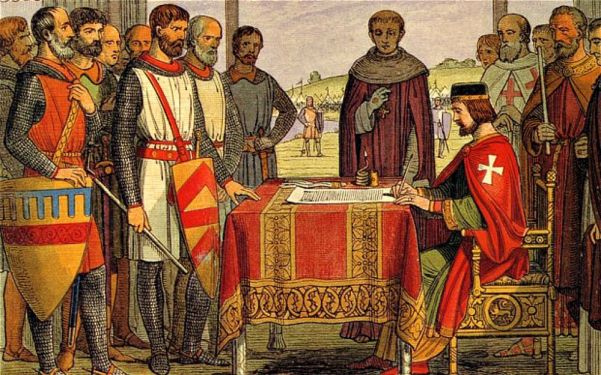
In the year of our Lord 1215, the English sovereign, King John, son of King Henry the Second, did affix his seal to the Magna Carta, also known as the Great Charter. This noble document sought to restore the ancient rights of the English nobility, rights held ere the Norman Conquest of 1066, and to reaffirm the principles first set forth by Henry the First some six decades prior.
The Magna Carta commanded that the King himself was not above the law, and must henceforth seek the counsel of his nobles ere embarking on wars or levying new taxes. Originally, it contained some twenty clauses, which later expanded to sixty-three, forming the bedrock of English liberties.
Moreover, this August assembly of nobles came to be regarded as the first English Parliament. In later ages, the Magna Carta would be esteemed as the very foundation upon which the United States Constitution was built, and the noble assembly therein an inspiration for the House of Representatives. Thus was born the principle of ‘No taxation without representation.
Lastly, it’s worth noting while the original Magna Carta had 63 clauses, only a few of them remain legally binding in England today. These clauses primarily pertain to the freedoms of the Church, the liberties of the City of London, and the right to a fair trial.
.
.
.
.
.
.
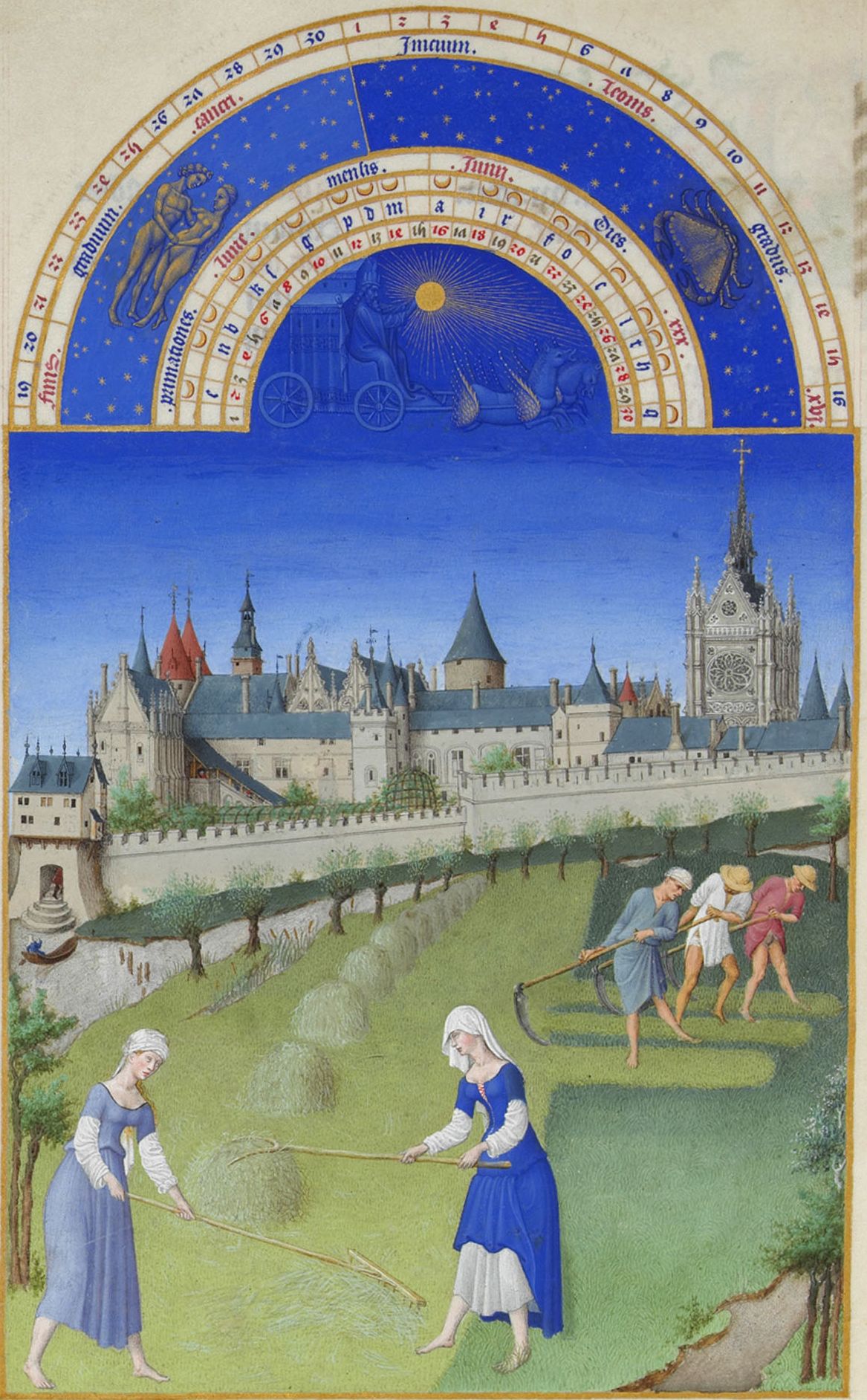 Feudalism
Here is, but a brief on the feudal system in England, from the year 1215 until the dire affliction of the Black Death. The King, in his sovereign majesty, held all lands as supreme lord, granting fiefs (a parcel of land granted by a lord to a vassal in exchange for military service and loyalty), to noble lords (a noble was one who held land and authority) who, in turn, bestowed portions upon vassals (an individuals who pledged allegiance, homage and fealty to a lord who granted him land in exchange, loyalty, martial and military service). Thus, a vassal was responsible for protection, justice, and governance within a given territory. These vassals, oft valiant knights, might further parcel their lands by subinfeudation (a vasal who received land from a lord, who then granted portions to others, creating their own vassals or subtenants. This created a hierarchical chain of land ownership and obligations, thus binding men in a intricate chain of obligation. The lowly peasants and serfs, tied to the earth, laboured to sustain this order. Such was the constitution of society, with ranks firmly fixed, until the grievous plague did rend it asunder. I pray you find favour with this humble account.
.
.
.
.
.
.
.
.
.
.
.
II. The Black Death, 1346–1351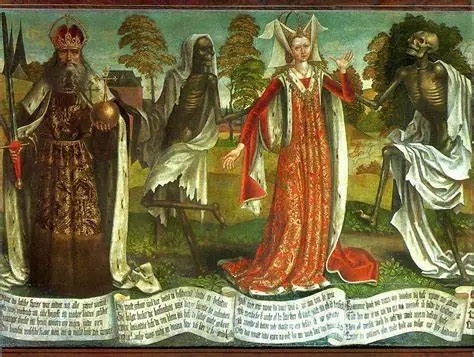
Chronicle of Shadows
Time – The Black Death, 1346
An Interview – The following is recounted by a survivor, in the winter of 1350, within a stone chamber lit only by tallow and memory.
The Black Death journal entry (1346–1351, Florence, Italy):
Do you ask what it was like? 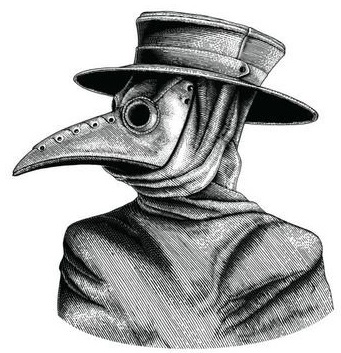
Very well…
Sit you down, I shall speak.
Be warned — for you shall not sleep well, nor, perhaps should you.
It was the Year of Our Lord 1348, The air was leaden and pravus, The heavens turned to ash with dread as though the angels held their breath, even the birds flew skewwhiff. Dogs howled without cause, bells, once faithful heralds of the hour and, full of prayer, fell silent.
A merchant vessel came to Messina. At the first, we understood little. The ship limped into port, its crew sick with trepidation and foreboding. We could see what few souls still walked its deck bore black swellings around the neck, beneath the arms and at the bobos—bloated and burning, their skin was the color of mulberry. They raved and wept and bled from the eyes. Then they died.
The whispers began—plague, from the East. From Caffa, the Mongol hordes who flung their dead over walls like stones. Others spoke of stars misaligned, of the divine wrath for sin. Some swore the Devil himself had come, dragging a tally of souls.
What we saw among our people was neighbor turned from neighbor. Mothers sealed their children away. To keep their children from harm Mothers sequestered them as if in a strong keep, shielding them under their cloaks protected from the world’s ill winds. The sick were bolted within their homes, given neither prayer nor farewell. Priests withered. Monks fell. Even His Holiness the Pope took to sitting between two roaring fires, in hope the flames would purify the air.
From this fear Quarantine was born. Forty days alone, isolated. Ships were burned at harbor. Villages vanished as if drawn into the earth. I entered one hamlet, the door ajar, pottage, a thin, clay-like sludge of turnips and a carrot, barely warm upon the hearth—and not a soul to be had.
A wagon rolls by, it’s laden with bodies, men, women children, corpses all thin and faces hollow. The driver wears a robe fouled with pitch and a mask, a great black beaks, stuffed with lavender, rosemary, thyme, sage, vinegar, garlic. Theas physicians, healer, monks were later called Plague doctors—but they healed no man, they simply counted.
All cures were tried, bleedings, fasting, flagellations. The flagellants went from city to city, they arrived barefoot and wild-eyed, lashing their own backs in hope God would take pity. He did not.
And then came the fires. The cries, “The wells are poisoned!” They turned to the Jews, Jews and lepers were accused in the past for poisonings wells as acts of vengeance when expelled from villages or towns. Here too these groups were blamed, many were hunted and burned, most cast them out, but the dying did not cease. Trust then decency fled, order crumbled, fear unmade the world. There seemed to be no end, the living now envied the dead.
We buried thousands. And when the priests were gone, we said the rites ourselves. And when the words were spent, we said nothing. Graves overflowed. We dug pits. We burned the bodies. And oh—the stench, I will never forget that smell and taste, my eyes still burn when I think of it. I watched my beloved perish. I watched my youngest swell and burst—like overripe fruit. Silence. I watched men lose their minds. Some laughed as death came. Others sang.
Then, strangely—it waned. Not through cure nor prayer, but simply for want of fuel. The fire burned itself to ash. One day the corpses were fewer. Then fewer still. Those of us who remained rose, gazing into a world stripped bare. Gold lay in the gutters. Land lay unclaimed. Bread was cheap. Labor, dear. I had been poor. Now I am rich. Yet, I would give all to forget. For it was not merely death that swept the land—but something darker. A shadow in men’s hearts, unleashed when law and love break. a darkness we carry still. I fear not dying. I fear what we have become.
Take this tale and tell it. Not to sow fear—but to remember. There are things worse than plague. And they are already within us..
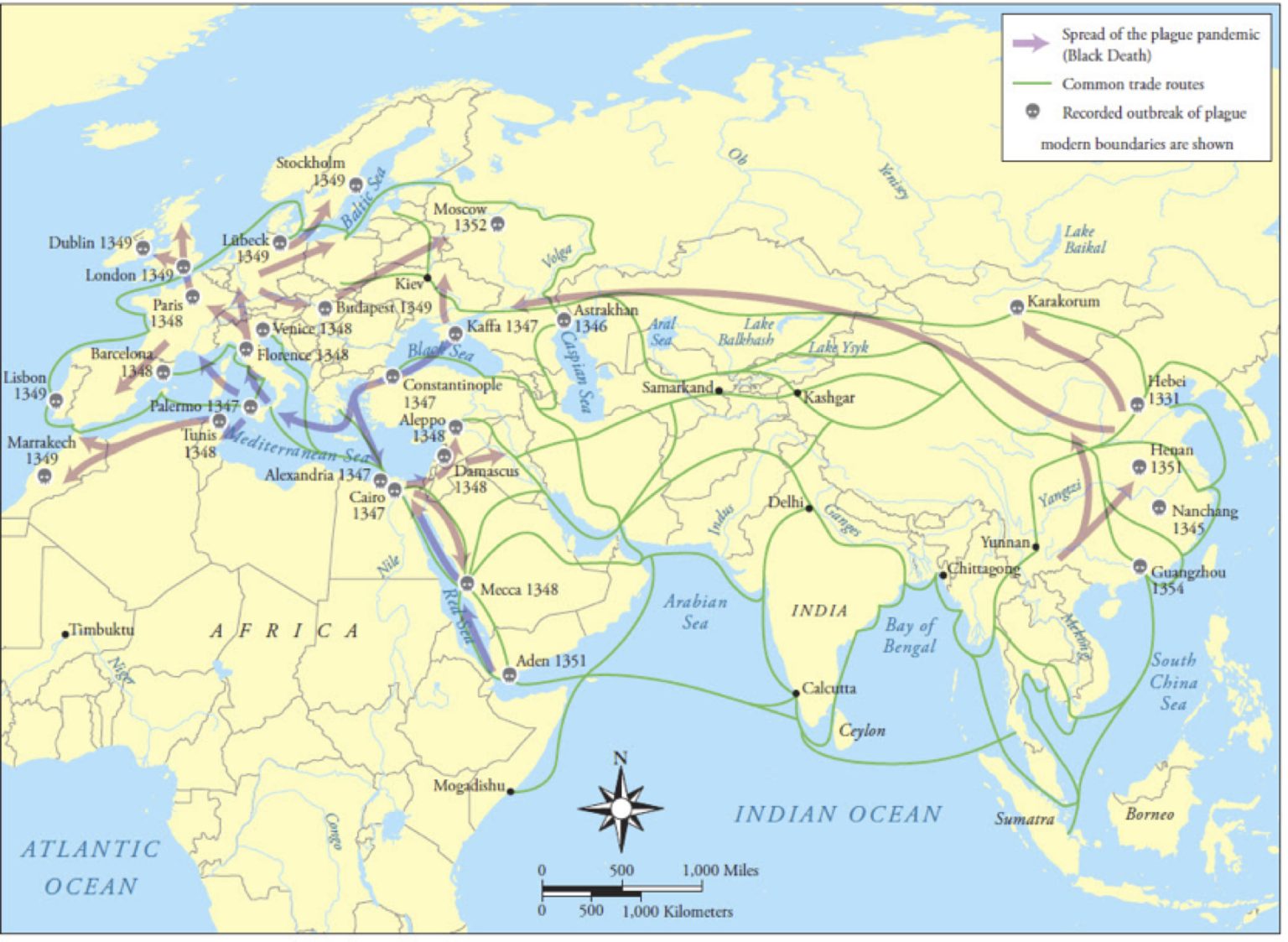
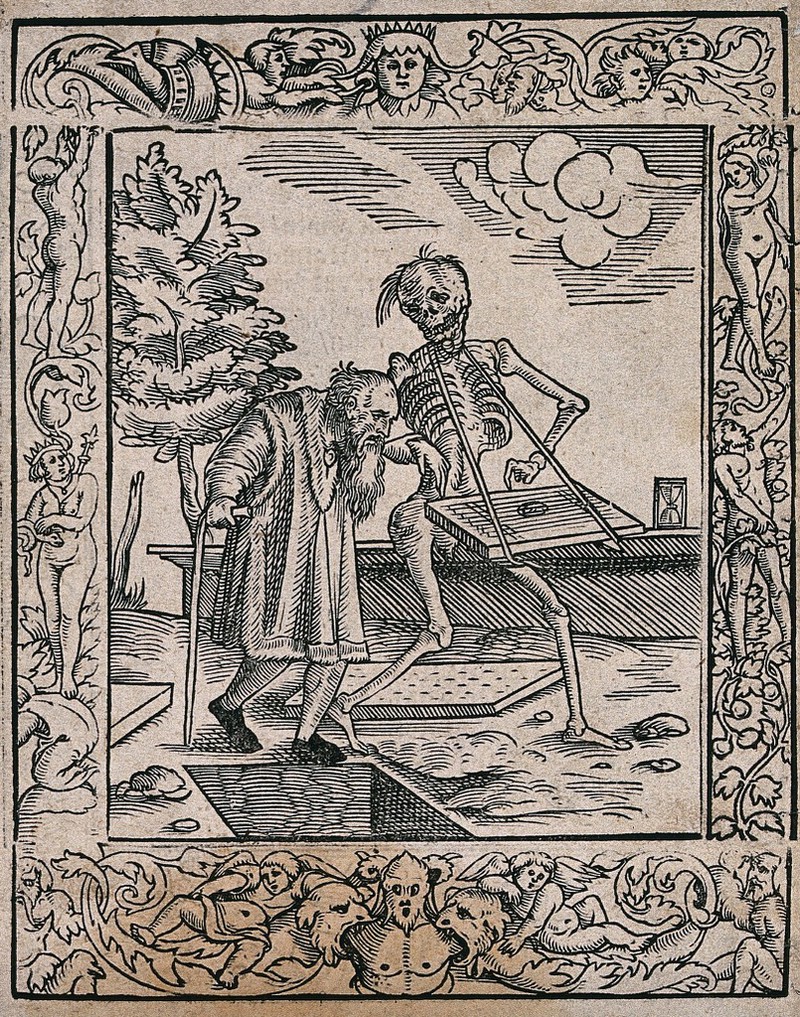 The Black Death was a devastating pandemic of bubonic plague that swept through Europe and Asia in the mid-1300s, killing an estimated 30-60% of Europe’s population. The villain is now known as Bacterium Yersinia Pestis. It is spread by fleas on rats. Symptoms include: high fever, chills, swollen and painful lymph nodes (buboes). There were also signs of Septicemic plague. This led to gangrene and organ failure.
The Black Death spread along trade routes, quickly moving through cities and rural areas. It caused a dramatic decline in the population, labor shortages and changed many social structures. There is no doubt that it significantly impacted the course of history. In a journal written on January 12, 1348 – “The pestilence has devoured Florence, leaving streets silent and bodies piled high. Yet…”
Economically
Wages for artisans and peasants rose due to labor shortages, along with a shift towards less labor-intensive farming practices. The plague killed millions, devastated families, communities, nations, the known world. Yet, in the shadow of the Black Death, gold and land pass to survivors kindling new wealth and dreams. The aftermath shook and freed capital birthing a middle class that fueled trade, and financial growth, as speculation and commerce expanded.
Socially
During the Black Death the Church’s influence began to wane, priests and church leaders died. People began to question religious explanations for the plague, no one was there to tell them what it all meant. They started to turned towards mysticism and other beliefs. A preoccupation with death and the afterlife became prevalent in art and culture. In the aftermath there was a restructuring of social hierarchies and power dynamics. The Church and traditional aristocratic authority weakened, rigid social order became more fluid, and developed a more merit-based society creating social mobility which then had people questioning many of the established norms and values.
Evolutionary
The Black Death may have played a role in the Renaissance by creating conditions for social and economic change. Recent research suggests the Black Death may have influenced the human genome by favoring individuals with certain genetic resistance to the plague. It also sparked the philosophy of Humanism.
.
.
.
.
Key England-specific notes (super useful for Plantagenet era):England used Earl instead of Count until much later.
Dukes were rare until Edward III started creating them in the 1330s (e.g., his sons: Black Prince as Duke of Cornwall, Lionel of Antwerp as Duke of Clarence, John of Gaunt as Duke of Lancaster).
Marquess title wasn’t introduced in England until Richard II in 1385.
Quick Plantagenet Snapshot with Rank Context Just to show how the ranks played out during their rule: Henry II (1154–1189) → King, but also Duke of Normandy, Count of Anjou, etc. (held multiple high titles personally)
Richard I (1189–1199) → King + Duke of Normandy/Aquitaine
John (1199–1216) → Lost most continental holdings → forced Magna Carta by rebellious barons/earls
Henry III (1216–1272) → Long minority → powerful earls/barons dominated (Simon de Montfort)
Edward I (1272–1307) → “Hammer of the Scots”; created earldoms strategically
Edward II (1307–1327) → Deposed by his wife + powerful Marcher lords (border barons/marquesses)
Edward III (1330–1377) → Began creating dukedoms for his sons → planted the seeds for Wars of the Roses rivalries
Richard II (1377–1399) → Deposed by his cousin Henry Bolingbroke (future Henry IV), showing how powerful dukes could challenge kings
.
.
.
III. The Hundred Years’ War, 1337–1453
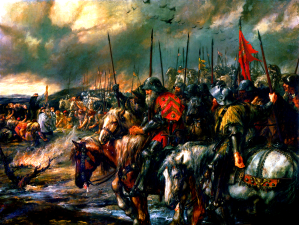
The wars prior to the Hundred Years Wars between conflict of feudal lords in England and France exhausted feudalism. While the conflicts among feudal lords and the Hundred Years’ War played a role, the decline of feudalism was a multifaceted: Economic shifts, Demographic changes; caused by the Black Death, Rise of towns and trade, Centralization of royal power, Technological advancements in warfare, and evolving political structures all contributed to this significant transformation in European society. This created conditions conducive to the emergence of national identities in both England and France. out of this national identities we born.
English King Edward III claimed the French throne, citing his descent from Philip IV of France, challenging the Valois Dynasty. Feudal disputes over English-held territories in France (e.g., Gascony) also fueled tensions. England and Burgundy vs. France and Scotland. This was not a continuous war but a series of campaigns punctuated by temporary truces.
Isabelle de Valois was the eldest daughter of Charles VI of France and Isabeau of Bavaria. Married to Richard II of England in March 1396, at the young age of only 6, her marriage was to symbolize the new peace treaty between England and France after decades of conflict.
In the end who won?: France. By 1453, England lost nearly all its French territories (except Calais), and the French Valois dynasty solidified its rule. The war strengthened French national identity and weakened English claims to the French crown. Key Turning Points: Joan of Arc’s campaigns (1429–30) revitalized France, while advancements in French artillery (e.g., at Formigny and Castillon) sealed their victory.
Broader Context and Sentiments The war was less about continuous fighting and more about sporadic campaigns, with long truces (e.g., Treaty of Brétigny, 1360; Treaty of Troyes, 1420). Both sides suffered economic strain and internal divisions (e.g., France’s Armagnac-Burgundian civil war, England’s Wars of the Roses). Contemporary sentiment varied: early English victories (Crécy, Poitiers) fueled confidence in divine favor, while French resurgence under Joan of Arc and Charles VII fostered a sense of national destiny. By 1453, French chroniclers celebrated the expulsion of the English, while English accounts mourned the loss of their continental empire.
.
.
.
..
IV. The Fall of Constantinople, 1453
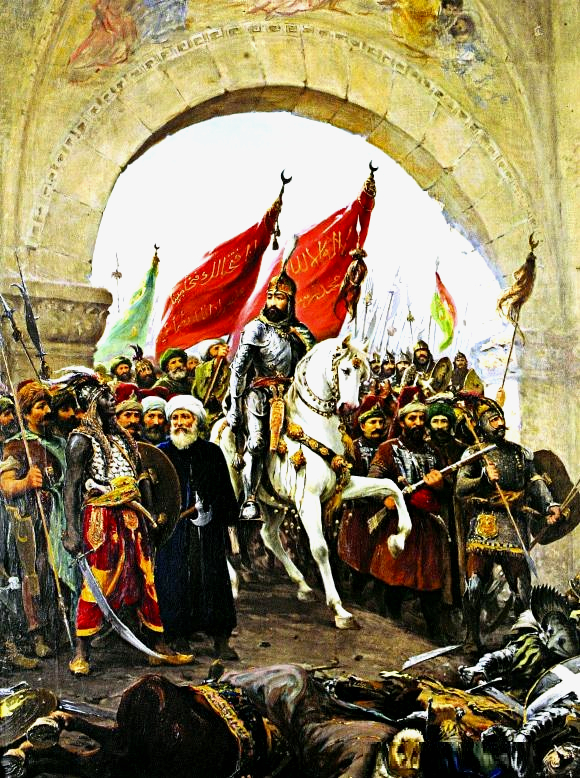
1453, marked the twilight of the Byzantine Empire and the dawn of the Renaissance, as we prepare to segue from the Middle Ages. Five causes wrought this calamity on Constantinople. The city’s dwindled populace and weakened defenses, scarce able to man its ancient walls. The Ottoman’s fearsome cannons, which rent asunder the Theodosian fortifications. Internal strife and religious discord, sundering Byzantine unity. The paucity of aid from Western Europe, lost to its own quarrels, and the cunning stratagems of Sultan Mehmed II, who blockaded by sea and land, even hauling ships o’er hills to breach the Golden Horn.
Yet, from this loss sprang three boons for Europe: a flood of Greek scholars and texts to Italy, kindling the Renaissance’s flame; the spur to seek new sea routes to Asia, birthing the Age of Exploration; and a westward shift in power, as Portugal and Spain rose to prominence. Thus, Constantinople’s fall reshaped the world, heralding a new era of learning and discovery.
..
Lament for the Fall of Constantinople
O city of Constantine, thou crown of the East,
Where saints in marble sleep, where Hagia Sophia sang—
Once girded by angels, now torn by sword and flame,
Thy walls cried out for Rome, yet Rome was deaf.
The Latin keys turned not;
The golden city wept alone.
Brothers in Christ, estranged by pride,
Left thee to the crescent moon.
The cross fell silent, save in blood,
And Peter’s throne looked Westward still.
.
.
.
.
Plantagenet Dynasty History
The House of Plantagenet the royal dynasty that ruled England from 1154 to 1485. They originating from Anjou, France. Founded by Henry II, their reign included 14 kings, including Lancaster and York, four distinct royal houses: the Angevins, who were also counts of Anjou; the main line of the Plantagenets following the loss of Anjou; and the Houses of Lancaster and York, two of the Plantagenets’ cadet branches. The family held the English throne from 1154, with the accession of Henry II, until 1485, when Richard III died in battle. They shaped England through the Magna Carta, the Hundred Years’ War, and the Wars of the Roses, ending with Richard III. The Plantagenet reign lasted 331-year.
Henry II
War of the Roses
The Wars of the Roses were a result of the the Hundred Years’ War (1337–1453) – which bankrupted everyone.
The Wars of the Roses, at the time, was simply thought of as a Civil Wars, and because the leaders, rulers, kings were related it was also know as the Cousins’ War. Between 1455 through 1487 there was a series of armed confrontations and campaigns fought for control of the English throne.
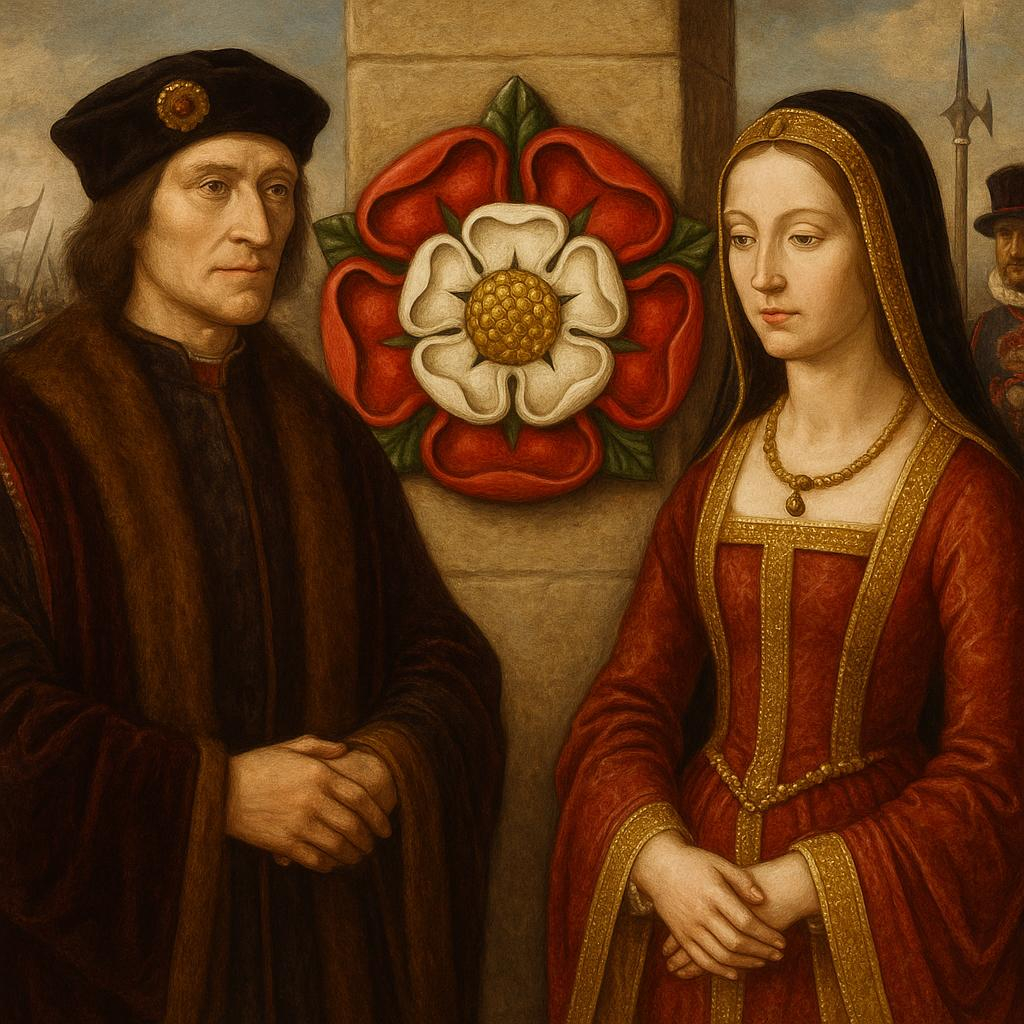
~ADD Note: war of the Roses [red rose] brought forward used by Henry VII to give legitimacy to the Tudor dynasty.
note red roses brought forward by Henry VII
Why was it called the Roses? The conflict was fought between the House of Lancaster, whose emblem was a red rose, and the House of York, whose emblem was a white rose. These conflicts were between two rival cadet [male line] branches of the royal House of Plantagenet.
The conflict resulted in the end of Lancaster’s male line in 1471, leaving the Tudor family to inherit their claim to the throne through the female line. The union of the two houses was created through marriage, creating the Tudor dynasty.
House of Plantagenet
Henry II (1154–1189) – King, but also Duke of Normandy, Count of Anjou, etc. (held multiple high titles personally).
Richard I (1189–1199) – King + Duke of Normandy/Aquitaine.
John (1199–1216) – Lost most continental holdings → forced Magna Carta by rebellious barons/earls.
Henry III (1216–1272) – Long minority → powerful earls/barons dominated (Simon de Montfort).
Edward I (1272–1307) – “Hammer of the Scots”; created earldoms strategically.
Edward II (1307–1327) – Deposed by his wife + powerful Marcher lords (border barons/marquesses).
Edward III (1330–1377) – Began creating dukedoms for his sons → planted the seeds for Wars of the Roses rivalries.
Richard II (1377–1399) – Deposed by his cousin Henry Bolingbroke (future Henry IV), showing how powerful dukes could challenge kings.
Henry V (1413–22) – Agincourt victory.
Henry VI (1422–61/70–71) – Wars of Roses, deposed.
Edward IV (1461–70/71–83) – Yorkist restorer.
Edward V (1483) – Brief rule, Tower mystery.
Richard III (1483–85) – He was the last of everything. Last king of the Plantagenet Dynasty and the House of York. He was the last of the old nobility. The direct descendent of Edward III, further back, Henry II, and through the female line his family dates back to the Normans, William the Conqueror. 331 year rule. He is defeated in battle at Bosworth, thus ending the English Middle Ages.
.
&.
.
.
.
.
.
.
.
.
House of Valois
Philip VI (1328–1350): First Valois king; sparked war by claiming French throne over Edward III of England.
John II (1350–1364): Captured at Poitiers; signed Treaty of Brétigny, ceding lands to England.
Charles V (1364–1380): Regained territories through diplomacy and war; patron of arts.
Charles VI (1380–1422), known as “the Glass King,” suffered from severe mental illness, including delusions that his body was made of glass and could shatter. He wore iron rods in his clothes for “protection” and avoided physical contact. This Mental illness led to civil strif. All the English gains under Henry V, contributed to France’s instability during the Hundred Years’ War, enabling English invasions like Agincourt.
Charles VII (1422–1461): Crowned with Joan of Arc’s aid; reconquered France, ending major war phases.
Louis XI (1461–1483): “Spider King”; centralized power, weakened nobles via intrigue; expanded France.
Charles VIII (1483–1498): “The Affable”; invaded Italy, sparking Italian Wars; died young from hitting his head on a low doorway lintel at the Château d’Amboise while heading to watch a tennis match. He fell into a coma and passed away hours later. Tragic and ironic end.
Louis XII (1498–1515): Valois-Orléans; continued Italian campaigns; married Anne of Brittany to unite with France.
Francis I (1515–1547), of the Valois-Angoulême branch, was Leonardo da Vinci’s patron at his death in 1519. Legend says Francis held him as he died at Clos Lucé,
.
.
.
.
Battle
Charging Cavalry, by Pat Mandziy
PEACH edit
Why were horses and Cavalry such effective Tools? In medieval warfare men on horseback were very good at breaking battle line formations. Moreover, You didn’t want to kill everyone on the other side, well, perhaps you did, but this was not effective. You see, it wasn’t so much the first to die who was the loser, it was the first to break the ranks and run. When a line breaks there are gaps and your forces can rush through and pick off individuals rather than a United unit. It’s much easier to route the other army. Further, you didn’t want enemy Knights dead, you wanted to capture as many as you could alive, wounded perhaps, but alive. This way you could then ransom them back to their families and make a profit.
It’s also to keep in mind that during battle you wouldn’t charge directly into the line, like driving a car into a wall, you damage yourself more than the wall. You want to attack from the sides, the flanks, or the back, the rear, ‘hit them in the flanks break the ranks! Hit them in the rear cause fear!’
There is a psychological element at work here as well. Imagine a horse charging towards you, it’s terrifying. Now imagine 400 horses charging at you, the ground shaking beneath your feet you can hear the horses breath. This is just the horses, now add the riders on top of the horse, men with harsh weapons swinging at you, trying to kill you.
Now, on the other hand, you really didn’t want that many horses in your army, for you see, horses eat through supplies quickly, they need to eat so much and if they eat a lot they also defecate, a lot. Which means you have to have an entire teams to carry away all this waste. You certainly do not want this in the camp, that’s how diseases spread, and a disease will take out an army faster than any battle will. God knows how the Mongols did it, they had thousands of horses, but also they did look mighty cool.
.
In addition:
The destrier — the medieval war horse was a specific breed, enormous and trained to kick and bite in battle. Not your average horse.
The chevauchée — the cavalry tactic of riding through enemy territory burning crops and villages to destroy morale and supply lines. Very medieval, very brutal, very effective.
Agincourt connection — Later, the French cavalry charge against English longbowmen at Agincourt 1415 is the perfect illustration of cavalry going wrong. Mud, stakes, arrows. The flower of French knighthood destroyed. Henry V. Shakespeare. Connects directly to the PEACH theatre programme.
The ransom economy — The ransom system was so formalized that captured knights were essentially currency. Edward III made a fortune ransoming French nobles after Crécy. It was almost gentlemanly — you captured a knight, fed him well, wrote to his family, negotiated a price. More like a business transaction than warfare.
Disease point — you mention disease taking out armies faster than battle. True Statistically — in most medieval campaigns more soldiers died of dysentery than combat. Regarding the Mongol horse sanitation policy — they had very strict rules about camp hygiene precisely because they understood the risk.
Mongols did it because they had small horses that were easy to upkeep. They utilized everything they could from them, from feces as fire fuel, milk to make alcohol, meat for food, hides for leather and so on. There was no part of horse that was going to waste
.
.
.
.
.
.
.
.
.
.
.
.
.
.
=======MOVE DEC
2. High Middle Ages (1000–1300)
Matilda of Tuscany
TITLE: Margravine of Tuscany
PRIMARY OCCUPATION: Noblewoman, military leader, papal ally
FULL NAME: Matilda of Canossa
BIRTH: c. 1046 – Mantua, Italy
DEATH: 24 July 1115 – Bondeno di Roncore, Italy
PARENTS: Boniface III of Tuscany, Beatrice of Lorraine
SIBLINGS: Frederick (died young)
EDUCATION: Educated at Canossa; tutored in Latin, scripture, and military leadership
PHILOSOPHY/RELIGION: Christianity – Roman Catholic
ACCOMPLISHMENTS: Major supporter of Pope Gregory VII in Investiture Controversy; hosted meeting at Canossa (1077) between Pope and Emperor
AFFILIATIONS: Papacy; House of Canossa
YEARS OF RULE OR VOCATION: Ruled Tuscany and surrounding lands (c. 1052–1115)
SPOUSES: Godfrey the Hunchback
CHILDREN IN WEDLOCK: None
OUT OF WEDLOCK: None
NAME OF SUCCESSOR: Lands reverted to the Church and the Empire
WORKS/BOOKS: Letters and correspondence with popes and bishops
SYMBOL/EMBLEM: Canossa Castle
CONTEMPORARIES/RIVALS: Pope Gregory VII, Emperor Henry IV
LEGACY/INFLUENCE: Key female leader in Church reform; symbol of resistance against imperial control of the Church
MEMORABLE QUOTE: “Better to serve the Church than defy it.”
.
.
Frederick I Barbarossa
TITLE: Holy Roman Emperor
PRIMARY OCCUPATION: Emperor, Military Leader
FULL NAME: Frederick I of Hohenstaufen
BIRTH: c. 1122 – Swabia (modern Germany)
DEATH: 1190 – River Saleph (modern Göksu, Turkey)
PARENTS: Frederick II of Swabia and Judith of Bavaria
SIBLINGS: Bertha, Conrad, Louis
EDUCATION: Noble military and legal education
PHILOSOPHY/RELIGION: Roman Catholic
ACCOMPLISHMENTS: Reasserted imperial authority in Italy; led Third Crusade; strengthened central monarchy
AFFILIATIONS: House of Hohenstaufen, Holy Roman Empire
YEARS OF RULE OR VOCATION: Emperor from 1155–1190
SPOUSES: Beatrice I, Countess of Burgundy
CHILDREN IN WEDLOCK: Henry VI, Frederick V, Otto, others
OUT OF WEDLOCK: Possibly one or more
NAME OF SUCCESSOR: Henry VI
WORKS/BOOKS: None personally written
SYMBOL/EMBLEM: Red Beard (“Barbarossa”); imperial eagle
CONTEMPORARIES/RIVALS: Pope Alexander III, Henry the Lion, Saladin
LEGACY/INFLUENCE: Mythologized in German folklore; remembered as ideal medieval ruler
MEMORABLE QUOTE: “Let justice be done though the world perish.”
Frederick II Hohenstaufen
TITLE: Holy Roman Emperor; King of Sicily and Jerusalem
PRIMARY OCCUPATION: Monarch; Scholar-Patron
FULL NAME: Frederick II of Hohenstaufen
BIRTH: 1194 – Jesi, Italy
DEATH: 1250 – Apulia, Italy
PARENTS: Henry VI and Constance of Sicily
SIBLINGS: Philip, Irmengard, others
EDUCATION: Multilingual; educated in courtly, legal, and Islamic traditions
PHILOSOPHY/RELIGION: Roman Catholic (contested by papacy); admired Islamic learning
ACCOMPLISHMENTS: Founded University of Naples; negotiated Sixth Crusade; cultural patron; legal reformer
AFFILIATIONS: Holy Roman Empire; Kingdom of Sicily
YEARS OF RULE OR VOCATION: Emperor 1220–1250; King of Sicily from 1198
SPOUSES: Constance of Aragon, Isabella II of Jerusalem, others
CHILDREN IN WEDLOCK: Henry VII, Conrad IV, Manfred
OUT OF WEDLOCK: Frederick of Antioch, Enzio of Sardinia
NAME OF SUCCESSOR: Conrad IV
WORKS/BOOKS: De Arte Venandi cum Avibus (On the Art of Hunting with Birds)
SYMBOL/EMBLEM: Two-headed eagle; court of Palermo
CONTEMPORARIES/RIVALS: Pope Gregory IX, Louis IX of France
LEGACY/INFLUENCE: Called “stupor mundi” (wonder of the world); symbol of enlightened despotism
MEMORABLE QUOTE: “We are the image of God on earth.”
.
leave this
Like a painting, the Renaissance begins in layers
East Meets West
The Road East
Wild birds, over the imagination.
Jackals, striped lions standing almost up right.
Swans and unicorns play, the black bear.
A monstrous races, in the garden of Eden.
At edge of the world, a man who loved the mountain.
From Here to There and Back Again
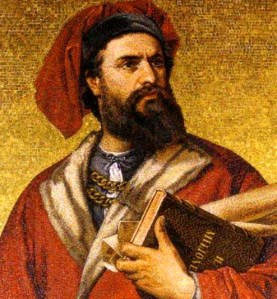
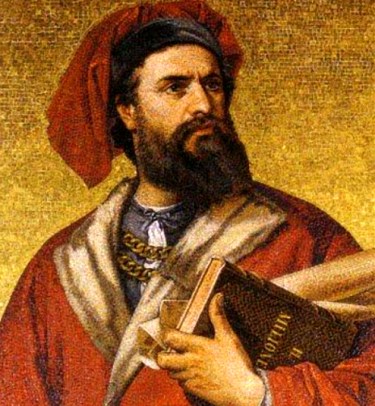 Marco Polo, 1254 –1324, was a Venetian Merchant who traveled from the West through the East, by foot and camel, along what is known as the Silk Road, 1271–1295.
Marco Polo’s book is commonly known as, The Travels of Marco Polo, also titled, The Marvels of the World, Il Milione, c. 1300. Il Milione was Marco’s nickname. Rustichello da Pisa chronicled Marco’s journey to Arabia, Persia, India, Cathay, and Japan. He wrote about the people, their customs, religions, language, foods, of all the many items produced, and invented in these far-away lands, especially about the silks, gems, and exotic animals.
Along with documenting Marco’s travels, adventures and his return, this book helped to inspire, inspire and expand commerce and trade between Europe and the Far East. This book became one of the most popular manuscripts of all time. It was usually hand copied, but often edited. Some even took liberties by changing the details or removing the more meretricious details. 150 years later, the book would inspire the explorer and navigator Christopher Columbus, who believed by sailing West he would find the East. He kept a copy of the book with him on his journeys.
Marco’s Youth
Merchants of Venice
Marco was Venetian, a citizen of the Republic of Venice. He was born, September 15, 1254, in Venice, Italy. His parents were Niccolò Polo, Nicole Anna Defuseh. His father was from a family of wealthy merchants. Both Marco’s father Niccoló and his uncle Maffeo traveled extensively, having trading posts in Constantinople, Sudak, Crimea, and Western Mongolia, and they had gone as far east as Cathay, where they met the Kublai Khan, the son of Genghis Khan, the mighty warrior of the Yuan Dynasty.
Soon after Marco was born, his father and uncle left for a trip to Cathay During his father’s absence, when Marco was age 3, his mother died. It is assumed he was raised by his father’s family members. Not much is known about his life between birth and age 15. Furthermore, Marco’s education is controversial, was he well- educated, befitting the son of a wealthy merchant, or was he illiterate?
In 1269, The Khan summoned the Polo Brothers to his estate, Xanadu. He wished them to deliver a letter to Pope Clement IV. In this letter, The Khan asked the Pope to send one-hundred learned men in order to teach his people about Christianity and Science. He also requested that the Pope procure and send him oil from the lamp at the Holy Sepulchre in Jerusalem.
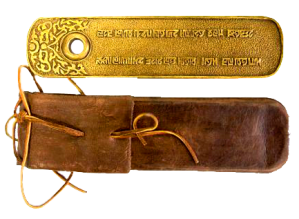 The Khan then gave the Brothers special gold cards, called, Gereges. These were solid gold tablets, 12 inches long, and 3 inches wide. Inscribed were the words,
“By the power of eternal heaven, this is an order of the Great Khan.”
This guaranteed the Polo’s safe passage through the Mongolian lands, providing protection from being molested, robbed or killed.
To their dismay, when the brothers returned home to Venice, they had discovered that Pope Clement IV had died. Niccoló also found that his wife had died as well. However, he was reunited with his son Marco, who was now a young man of 15.
Niccoló and Maffeo took some time to get reacquainted with their family. They sorted out their business affairs, and were very curious about what to make of Marco. They were also men of their word, and they never forgot their promise to Kublai Khan and the learned missionaries to acquire. They waited for the appointment of the new Pope, but after two years with no appointment, they began to worry. However, being so active in the community and church, they felt that Father Teobaldo Visconti, who was currently in Accre, in Palestine, would be chosen as the next Pope. The two Brothers, and now 17-year-old Marco, packed their gear and made their way to Accre. As luck would have it, soon after they arrived, Teobaldo Visconti was chosen, and he would go on to become Pope Gregory X.
The brothers and Marco had an audience with his Holiness, and they presented him with the letter from The Great Khan. Pope Gregory X was pleased. He then gave them letters and gifts to bring to The Khan. However, he sent them off with only two friars. They then stopped at the Holy City to retrieve the consecrated oil.
Marco’s Travels
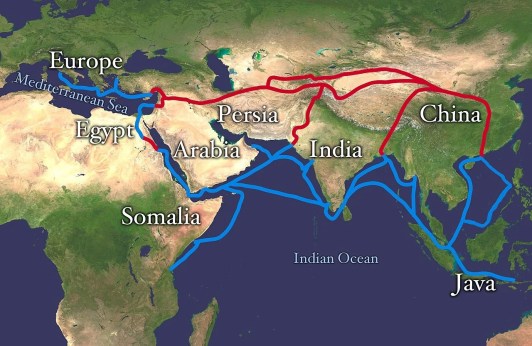
The Silk Road
In 1273, they traveled north to the Black Sea, joining with a group of other travelers and merchants on their way to the court of Kublai Khan. However, when they reached the Christian Armenian border and Eastern Turkeye, they found themselves in the middle of a war zone between the Byzantium and Ottoman Turks. In fear, the friars turned-tail and headed back to Palestine. The Polos pushed forward, and they made it through the conflict. Through Armenia, Persia, and Afghanistan, and then they followed the route over the Pamir Mountains that brought them into Cathay proper, into the realm of the Tartars [Europe’s name for the Mongols].
Because of the conflict, they headed north, following the shores of the Black Sea and over the Caucasus Mountains into Georgia, before heading South to Tabriz in Persia, the Ilkhanid, Mongol capital, now part of Independent Azerbaijan. Marco describes Tabriz,
“A great city surrounded by beautiful and pleasant gardens. It is excellently situated, so the goods brought here come from many regions. Latin merchants, especially Genevie, go there to buy the goods that come from foreign lands.”
Tabriz was an important cultural and political center.
Marco met many people on his travels, Nestorian Christianity, Saracens, Turkish Merchants, Kerman., Persian Zoroastrians. Marco seemed to be very good at picking up various languages, which was endearing to the people he met. While in Baghdad, they thought they might take boats through the Arabian Sea and around India to Cathay, but they felt the Persian boats would not make the trip. As they left Persia, they approached the Alamut Valley, the Eagle’s Nest. This is where a great battle took place in 1256 between Mongol Ruler Hulagu Khan and the Assassins of Hashshashin. Marco tells the tales he heard of the Assassins with great excitement, but it also filled him with great enthusiasm to leave the place as fast as he could.
They Polo’s now joined a camel caravan along the Silk Road proper.
Forward to Badakhshan
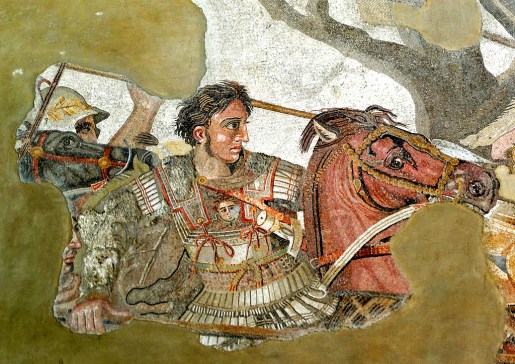
The Polo’s stopped and spent some time in Badakhshan. This was a very special place. The people living there can still trace their lineage to Alexander The Great, even the line of horses in the area date back to Alexander’s infamous horse Bucephalus. Marco, knowing the legends and stories of his battles, to now stand, where Alexander once stood, was indeed very exciting. From that point on, Marco took up the culture of the Mongol life, horseback riding, and falconry. He, like his father and uncle, learned the Mongol language. The more he immersed himself in to the culture, the more he admired the Mongol people.
In this region, this is the line where East meets West. India to the South, Cathay to the East. Crossing over the Pamir Mountains, they were now walking into Cathay proper. Soon, they encountered Buddhist Monks. Shaved heads and dressed in saffron and blue robes. Marco had never seen any people like this before. He found it all very fascinating. Flying Mystics – sensin. In his book there are descriptions of all the different Buddhist Monks, and tribes, their rituals, families, and dedication.
“When a man is riding through this desert by night and for some reason -falling asleep or anything else -he gets separated from his companions and wants to rejoin them, he hears spirit voices talking to him as if they were his companions, sometimes even calling him by name. Often these voices lure him away from the path and he never finds it again, and many travelers have got lost and died because of this. Sometimes in the night travelers hear a noise like the clatter of a great company of riders away from the road; if they believe that these are some of their own company and head for the noise, they find themselves in deep trouble when daylight comes and they realize their mistake. There were some who, in crossing the desert, have been a host of men coming towards them and, suspecting that they were robbers, returning, they have gone hopelessly astray…. Even by daylight men hear these spirit voices, and often you fancy you are listening to the strains of many instruments, especially drums, and the clash of arms. For this reason bands of travelers make a point of keeping very close together. Before they go to sleep they set up a sign pointing in the direction in which they have to travel, and round the necks of all their beasts they fasten little bells, so that by listening to the sound they may prevent them from straying off the path.”
Once over the Pamirs, they made their way to the oases of Kashgar and Khotan. This was the last stop before crossing the Taklamakan Desert. The name comes from the words Terk-i Mekan, which translates to,
‘You can go in, but you will never come out.’
Traveling along the rim of the Himalayan and the southern edge of the Gobi Desert, it is a 40-day walk. The Polo’s made it through, and finally, after three and a half years, 1275 they were on their way Suchow, what is called today as Shanghai, to the Summer Palace of Kublai Khan.
Mongol Dynasty

In Service of the Khan
When Marco arrived with his father and uncle, he was 20 years old. Through his journey, he grew to admire of the Mongol people. They were nothing at all like the stories he heard. He notes:
“They are those people who most in the world bear work and great hardship and are content with little food, and who are for this reason suited best to conquer cities, lands, and kingdoms.”
Now meeting the Great Kublai Khan, Emperor of the Yuan Dynasty in his summer Capital of Shangdu, or what we call in the West, Xanadu. Marco describes the beauty of the place:
“The halls and rooms, are all gilded and wonderfully painted with pictures and images of beasts and birds, trees, and flowers. It was fortified, like a castle, in which were fountains and rivers of running through the beautiful gardens.”
To be in the presence of such a great man filled Marco’s heart with joy and great respect.
“They knelt before The Great Kublai Khan, son of Genghis Khan Emperor of the Mongol Empire. They bowed before him in obeisance and with the upmost humility. The Great Khan bade them to rise so that he could receive them with honor. Welcoming them in to his home he began to ask them many questions about the condition of their journey, and how they fared after their last departure. The brothers assured The Khan that they had indeed fared well, and more so now, that they found him well and flourishing.
They presented The Khan with the gifts and letters from the Pope. Khan was greatly pleased. They presented him with the holy oil. The Khan received this with joy and prized it highly. When The Khan spied Marco, he asked who this young man was. ‘Sir, said Niccolò, he is my son, and your servant.’ ‘He is heartily welcome,’ said the Khan.
The Khan and all his Court welcomed the arrival of these emissaries. They were well served and all their needs attended to. At Court they had a place of honor above the others.” – From Travels of Marco Polo – Abridged
17 Years Of Service
The Polo’s lived in Yuan, Cathay. However, they were not allowed to leave without the permission of The Khan. The Khan, particularly like Marco, and referred to him as his Venetian Pet. This, of course, made those in the court jealous of Marco.
They had many conversations. Marco mentions The Khan was very curious about Catholicism, and at one point thought he might convert. Of course, this wasn’t so far-fetched, for The Khan’s mother had been a Nestorian Christian. Still, a conversion to a western faith might have alienated many of his subjects, so such a conversion would have been highly unlikely.
In his book, Marco describes the wealth and splendor of the Yuan court. Its size and the vastness of the Empire. He was impressed with how organized each city was. Marco spent a great deal of time in the city of Hangzhou, Southern Cathay, which held a population of over 1 million people. There was no comparison in Europe. Venice, the largest city, housed at most 100 thousand people.
During this time, Marco became well traveled, learned many languages, studied business, and discovered paper money. The Khan grew to trust Marco. He sent him off on special missions to India, Burma, and all over his Empire in Cathay. Soon he was The Khan’s special emissary, traveling to places no European had even been to before. Places no one would believe even existed for over 500 years.
The Khan eventually appointed Marco to a long term Administrative Post. He became the Governor of Yangzhou. In this position, he was the collector of taxes and salt profits. He commanded this post for 3 years.
By 1291, The Khan had reached the age of 75. Yet, even at that age, he was still full of vigor and vitality. The Polo’s wondered if The Khan would ever die. After 17 years, they wanted to go home before they did. The Khan sensed that the Polo’s were homesick, and though he hesitated to let them go, he decided to send them off on one last mission. To serve as escorts of a Mongol Princess Kokachin to Persia as a bride to the Persian Prince Arghun.
The Polo’s served The Khan well and true for those 17 years, and they had also amassed great wealth of their own in gold and jewels. With the escort of the Princess, under the protection of The Khan, they could take it all home with them.
The Journey Home
With The Princess and Gereges in hand, the Polo’s took the sea route back. First, they boarded a ship to Sumatra. However, once they landed, the monsoon season marooned them for 5 months. Once the winds had shifted, off they sailed to Ceylon, and then to India. Marco recollects his fascination with Hinduism and Jainism. In particular, sacred cows, mystical yogis, and the prohibition of harming even an insect. From there, it was off to Arabia and north to Hormuz in Persia, where the Princess was delivered to her Prince. It took over two years to travel from Cathay back to Italy. Marco was now 40-years-old.
“I believe it was God’s will that we should come back, so that men might know the things that are in the world, since, as we have said in the first chapter of this book, no other man, Christian or Saracen, Mongol or Pagan, has explored so much of the world as Messer Marco, son of Messer Niccolo Polo, great and noble citizen of the city of Venice.”
Home
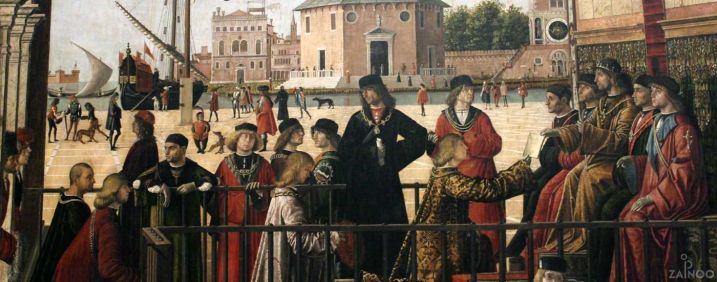
Home At Last
The Polo’s returned to Venice in 1295. With them were piles of exquisite goods, gifts, and gems. Not only were they the Merchants of Venice, they were known as Imperial Emissaries and very savvy traders. There was no doubt the greatest of traders and travelers of all time.
Unfortunately, Venice had gone to war with Genoa, their neighbor, in 1294 over control of the trade routes that had enriched the Polo’s. Marco himself took up arms and command of a Venetian Army. However, he was a better trader than a commander. Captured, he ended up as a prisoner of the Genoese Army. However, as luck would have it, one of his prison mates was a man named Rustichello, from Pisa. Rustichello was a writer of romance novels. They became fast friends. Marco told him about his adventures and Journey to Cathay. It didn’t take long for Rustichello to put his talents as a writer to use, and document all the fabulous stories Marco told him of all the far-away lands and customs of so many different people.
 The Book
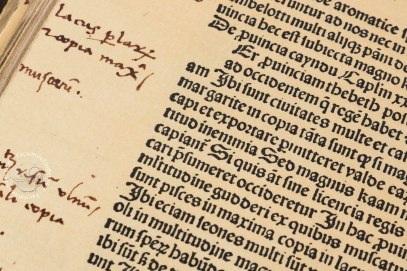
The collaboration between Marco and Rustichello to a manuscript became the book for which Marco is still famous. The book was published in 1300. The Marvels of the World, and Il Milione, c. 1300. Il Milione, by Rustichello da Pisa, from stories told by Italian Explorer Marco Polo. Today, it is titled: The Travels of Marco Polo.
There were no printing presses at the time. Once submitted, the manuscript would need to be copied by hand. Some took liberties with the manuscript, they left some of the more unorthodox and spicier stories out, especially the church. There were also endless controversies, since the writer was a well-known Romance writer, that he took liberties with Marco’s accounts of what actually took place. Many of these false statements were dashed when Europeans took control of the seas in the 1700s as they traveled more extensively around the world. From that point on, almost all the accounts of what Marco said he experienced were proven to be true.
War’s End & Life At Home
After his release from prison in 1299, Marco returned to Venice and continued working as a merchant. He never went traveling again, however, he hired others to make the expedition and instructed them on the journey, who to meet and speak to.
In 1300, Marco married Donata Badoer. She was the daughter of a successful trading family, they had three daughters; Bella, Fantina, and Moreta.
When the book was complete, Marco often recollected tales of his journey to the locals, some of the people did not believe him, or thought he exaggerated, they began to call him, Bragger.
Marco’s Last Will and Testament
In January of 1324, Marco Polo died at the age of about 69. It is said that on his death bed, he when given his last rites, and the opportunity to recant the false tales of his travels. He refused stating in his final words,
“I have only told half of what I saw!”
Marco Polo’s last will and testament show that he died quite wealthy. He bequeathed substantial amounts of money to his wife and daughters. The will also showed that upon his death he still owed many splendid things from far-away countries, including brocades of silk and gold, and the golden tablet given to the Polos by Kublai Khan.
It also stated in that he freed a “Tartar slave” Peter, who had served him since his return from Cathay.
Signature
There is no last will and testament with Marco’s signature. During those times, if one could not read or write, they would simply dictate their will near death, and hold their hand over the document, attesting to what was written by the scribe.
This has led to wild speculations that Marco Polo was illiterate. His education is controversial. Was he a well-educated man befitting the son of a wealthy family, or was he illiterate? Nothing states he could read, nor anything he actually wrote, nor any proof he actually wrote anything regarding his travels. It is said, that he dictated his adventures to the writer, Rustichello da Pisa, and there is no signature on his will.
Further skepticism by some historians have questioned if Marco Polo actually visited the court in Beijing {Dadu}. There are no records of his name recorded in the Annals of the Empire (Yuan Shih). To not appear in these records is strange, if he was actually such a prominent visitor and personal friend to The Khan, as his book stated.
Life Well Lived and Legacy
Regardless of the controversies, his story lives on. He inspired the imaginations and adventures of many Great Europeans and people still today.
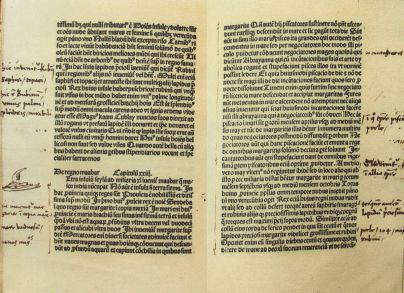
Christopher Columbus had a copy of Marco Polo’s “Travels,” which he notated heavily in the margins. Whether or not, they believed his stories, the people of Europe certainly loved to hear about the fabulous Kublai Khan and his wondrous courts at Xanadu and Dadu.
Quotes:
India’s Breathtaking Splendor – The rich trade of spices, gems lying in riverbeds, and elephants used for work and display
“Pepper and ginger grow in such abundance that it seems as if they were nothing but roots and vegetables.”
A member of our community, Daniel Santorini, has spent his life following the footsteps of Marco Polo. He has, though his own study and experiences, put together a lecture on Marco Polo’s life and travels. He has also collected a number of artifacts from this particular time in history. His presentation helps the audience to understand the consciousness of the people during this time in our history and brings a warmth to the man, for the last 700 years, many have grown to admire and love. He also heads the Book Club on the topic of Marco Polo’s Book, The Marvels of the World, Il Milione.
This is part of the historical lecture series. First Friday in February, 7PM. Lecture Hall I.
Venice – Italy
Considering this was a being a city-state, it was the n economic powerhouse of the whole Mediterranean regions. They escalated in trads, banking and industry.
1204 (pre-1250 context): Fourth Crusade boosts Venetian trade empire.
Venice (Italy): Economic and cultural giant early on, but Atlantic trade shifts reduce its clout by 1700. Still wealthy, but no longer a top-tier power
Milan/Florence – Italy
The greatest cultural and economic region in history. Florence led the Renaissance, funded by the wealthy Medici family.
.
.
.
.
 PEACH COMMUNITY